5D consciousness is a spiritual concept describing a state of awareness built on unconditional love, unity, and inner peace, in contrast to the fear, separation, and survival focus associated with “3D” living. To “shift” to a higher vibration, in this framework, means changing how you perceive and respond to your life rather than relocating anywhere. It is an inner reorientation, and while the language around it is metaphorical, the qualities it points toward (compassion, presence, intuition) are ones that many traditions and a growing body of research take seriously.
The idea is popular and often misunderstood. This guide explains what fifth dimension consciousness means, how the 3D, 4D, and 5D model works, what science can and cannot say about it, and how people practice it day to day.
What Is 5D Consciousness?
In spiritual teachings, 5D consciousness refers to an expanded way of perceiving reality, one centered on the heart and the higher self rather than on ego and fear. People who describe living this way tend to emphasize interconnectedness, the sense that individual lives are woven into something larger. They also describe a felt connection to their soul’s purpose and a habit of trusting intuition over anxiety.
The word “dimension” here is not used the way a physicist uses it. In physics, dimensions are measurable axes of space and time. In spiritual usage, dimensional consciousness is a metaphor for levels or qualities of awareness. Treating it as a map of inner experience, rather than a literal claim about geometry, keeps the concept both honest and useful.
Nor is the shift described as departure. Nobody boards anything or moves to another planet. Teachings on 5th dimensional consciousness describe an expansion of frequency, awareness, and perception that happens right where you are, inside ordinary days and ordinary relationships.
3D, 4D, and 5D: A Map of Shifting Awareness
The model works best as a progression of perspectives rather than a ladder of better and worse people.
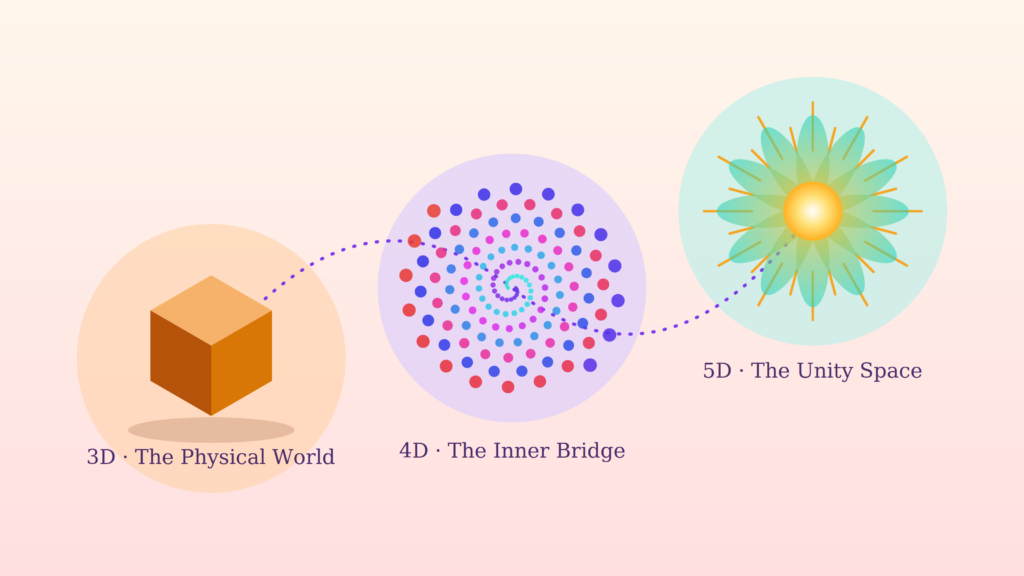
3D consciousness is described as experiencing reality mainly through the physical senses. External circumstances strongly shape thoughts and reactions, material security and survival are central concerns, and competition, separation, and ego have a strong pull on behavior. This is not framed as a failure. It is the layer of awareness that keeps bodies fed, bills paid, and children safe, and nearly everyone lives in it much of the time.
4D consciousness is the bridge. Teachers describe it as an inner realm connected to imagination, dreams, emotional processing, and healing. It is where people begin to notice that internal change tends to come before external change, and that the stories they carry shape what they see.
5D consciousness is described as operating from the higher self. Instead of being steered by judgment, comparison, or fear, life is guided by empathy, grace, compassion, and a deeper sense of universal wisdom. Oneness, the felt sense that separation is a surface appearance, sits at the center of this state.
A related idea is 5D Earth, a collective vision in which humanity as a whole lives from love, harmony, and joy. Many spiritual teachers, including the hypnotherapist and author Dolores Cannon, have taught that the planet’s energetic blueprint shifts as human awareness evolves. This is a belief drawn from spiritual teaching and personal accounts, not an empirically established event, and it is best read as a hope about what collective transformation could look like.
How the Shift to 5D Consciousness Is Said to Work
At the heart of the teaching is the idea of vibration. Followers of 5D consciousness describe everything, including thoughts and emotions, as energy with a characteristic frequency. Fear, resentment, and shame are said to carry a heavier, denser quality, while gratitude, compassion, and love carry a lighter one. To raise your vibration is to spend more of your time in the lighter states, and, over time, to have them become your default.
Practitioners describe the shift as arriving through several recognizable changes:
- Heart-centered choices. Choosing compassion over anger, forgiveness over resentment, gratitude over complaint, and self-love over self-judgment.
- Detachment from duality. Learning to witness conflict without absorbing it, neither fighting a difficult situation nor being consumed by it.
- Flow and synchronicity. Noticing meaningful coincidences, a stronger sense of inner knowing, and a feeling of being carried by life rather than pushing against it.
- Connection with the higher self. A growing sense of alignment with what feels true and purposeful.
Common signs of 5D consciousness
Accounts of the shift tend to list similar experiences. Increased peace is the most frequently mentioned, along with deeper intuition and a natural pull toward helping others. Many people also report a shedding of old patterns, such as toxic relationships, harsh self-talk, the need for control, and the hunger for external validation. Interest in material status often softens, and a desire for solitude commonly appears, since time alone offers space to process, reflect, and release old habits.
Some teachings also describe temporary physical or energetic sensations during the transition, including fatigue, random aches, and heightened sensory sensitivity, interpreted as the body adjusting to new rhythms. These symptoms have many ordinary causes, so it is wise to check persistent ones with a healthcare professional rather than assuming a spiritual explanation.
5D Consciousness Alignment: Scientific Evidence and Other Perspectives
An honest look at the evidence has to separate two questions: the metaphysical claims, and the practices and qualities associated with the shift.
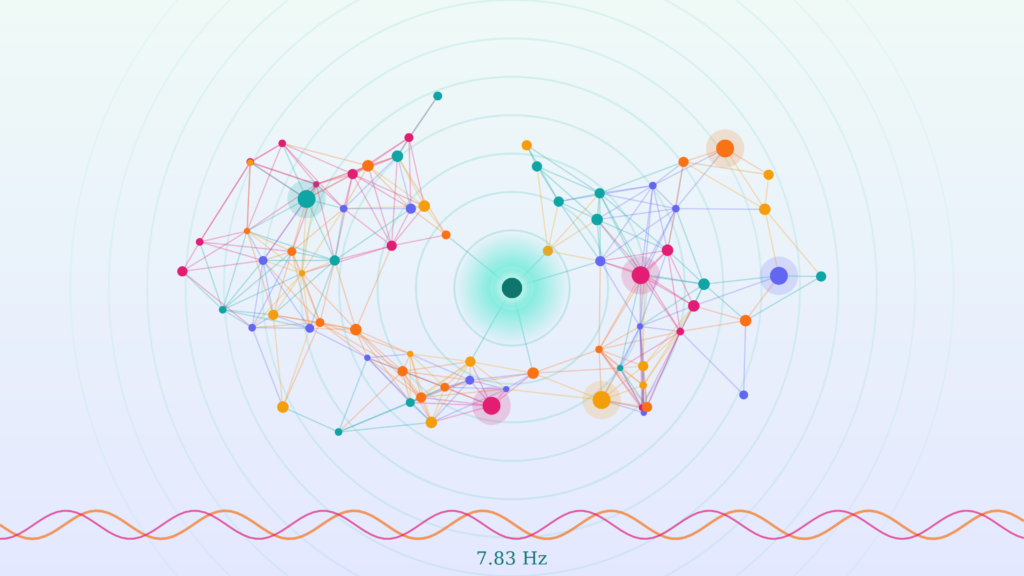
On the metaphysical claims, there is currently no scientific evidence that a literal fifth dimension of consciousness exists, that people vibrate at measurable “love frequencies,” or that Earth is being lifted into a new dimension. The most cited link is the Schumann resonance, a real phenomenon: naturally occurring electromagnetic waves circling the space between Earth’s surface and the ionosphere, with a base frequency near 7.83 Hz, energized largely by lightning. It varies modestly with time of day and solar activity, but monitoring data does not show the sustained rise that some teachings describe, and there is no established mechanism connecting it to human awareness. Science can measure the resonance. It cannot currently confirm the meaning that spiritual teachings attach to it.
On the qualities and practices, the picture is more interesting. Research on the experiences that 5D teachings emphasize is substantial:
- Studies of experienced meditators, including work by Judson Brewer and colleagues published in 2011, found reduced activity in the default mode network, a brain system linked to self-referential thinking and mind-wandering. This maps loosely onto the “quieting of the ego” that practitioners describe.
- Research by Britta Hölzel and colleagues found that an eight-week mindfulness program was associated with changes in brain regions tied to learning, memory, and emotion regulation.
- Compassion training studies, such as those led by Olga Klimecki, found that cultivating compassion increased positive emotion and engaged different neural networks than empathy alone.
- Gratitude research by Robert Emmons and Michael McCullough found that people who regularly recorded things they were grateful for reported higher well-being.
- Psychologists studying self-transcendent experiences, including a 2017 review by David Yaden and colleagues, describe moments in which the sense of self recedes and a sense of connection expands, often accompanied by lasting improvements in well-being. Awe research points in a similar direction.
Traditional and experiential perspectives fill in the rest. Contemplative traditions across many cultures describe unity, the softening of ego, and love as an organizing principle of awareness, using their own vocabularies. The 5D framework is one contemporary expression of that long human interest. Whether you read it literally, symbolically, or as a useful language for growth, the observable outcomes (more peace, more compassion, less reactivity) are worth taking seriously on their own terms.
How to Cultivate 5D Consciousness in Everyday Life
Teachers of 5D consciousness generally agree that the shift is not passive. It is described as an intentional practice, built from small, repeated choices rather than a single breakthrough.

Meditation and mindfulness. Regular stillness quiets the ego’s chatter and creates room to notice what is beneath it. If you are new to it, starting a simple daily meditation practice is a gentle way in. Even ten minutes of paying attention to your breath can change how a day feels.
Heart-centered living. Gratitude, kindness, compassion, and self-love are the everyday expressions of the 5D state. In practice, this can be as simple as pausing before reacting, asking what compassion would look like in a difficult moment, or ending the day by naming three things you appreciated.
Loosening 3D attachments. Much of 3D living runs on the belief in scarcity and separation. Noticing where those beliefs drive your decisions, and questioning them, helps you release attachment and trust that you are supported. This does not require giving up possessions or ambitions, only holding them more lightly.
Inner work and emotional clearing. Healing old wounds and clearing emotional blockages is considered central. This can include journaling, therapy, emotional healing and shadow work, or other reflective practice. Professional support is a strength here, not a detour.
Trusting your intuition. Many practitioners treat developing intuition as both a sign and a support of the shift. Small, low-stakes experiments, such as noticing gut responses before checking whether they were right, build a working relationship with inner knowing.
Community. Feeling connected with like-minded people can reinforce the journey and make it less lonely. Choose company that encourages grounded reflection over spiritual competition.
One caution comes from psychology. John Welwood coined the term “spiritual bypassing” for using spiritual ideas to avoid difficult emotions or real-world responsibilities. The most durable versions of 5D consciousness include the hard feelings rather than skipping past them.
Common Misconceptions About 5D Consciousness
“5D consciousness means being positive all the time.” The higher-vibration language can suggest that anger, grief, or doubt mean you have slipped. Most traditions, and most psychology, point the other way: feeling difficult emotions fully is how they pass. 5D consciousness is better understood as a wider capacity to hold all experience with love, not a ban on the uncomfortable parts.
“3D is bad and 5D is superior.” The dimensional map describes perspectives, not rankings of human worth. Someone focused on survival or building a stable life is not behind. The framework itself describes 3D as the necessary ground the rest stands on.
“Everyone must go through the same symptoms.” Fatigue, sensitivity, and solitude are described in some accounts, but they are not required, and they are not proof of anything. Many people describe their shift as quiet and gradual, felt mostly as a little more spaciousness in ordinary moments.
“It means withdrawing from the world.” Some people do crave more solitude for a while. But the emphasis in 5D teachings is on connection, service, and compassion in the world, so the retreat, when it comes, is usually seasonal.
Seen clearly, 5D consciousness is less a destination than a direction: toward more love, more presence, and less fear driving your choices. You do not need to settle the metaphysics to benefit from that direction. You can hold the cosmology loosely, keep what proves true in your own experience, and let the practices speak for themselves.
For daily insights on consciousness, clarity, and trusting yourself, explore Bahlon’s free daily transmissions. Subscribe here to receive them in your inbox.
Related Readings:
- How to Develop Your Intuition
- Shadow Work Guide: Everything You Need to Know
- Meditation Guide for Beginners: How to Start, Step by Step
Frequently Asked Questions
What is 5D consciousness in simple terms?
5D consciousness is a spiritual term for a state of awareness centered on love, unity, and inner peace instead of fear, ego, and separation. It describes a shift in perspective and perception, not a physical relocation.
What is the difference between 3D and 5D consciousness?
3D consciousness is described as focused on the physical world, survival, material concerns, and separation. 5D consciousness is described as guided by the higher self, with compassion, intuition, and a sense of interconnectedness at the center. 4D is the bridge, involving emotional processing and inner healing.
Is there scientific evidence for 5D consciousness?
There is no scientific evidence for a literal fifth dimension of consciousness or for claims that Earth’s frequencies are rising in ways that affect awareness. However, research on meditation, compassion, gratitude, and self-transcendent experiences supports many of the practices and outcomes associated with the 5D shift.
What are the signs of shifting to 5D consciousness?
Commonly reported signs include greater inner peace, stronger intuition, a desire for solitude, less attachment to material validation, letting go of old emotional patterns, and more frequent synchronicities. Some accounts also mention fatigue or sensory sensitivity, which are worth discussing with a doctor if they persist.
How do you raise your vibration?
Traditional advice centers on meditation, mindfulness, gratitude, kindness, forgiveness, emotional healing, and letting go of fear-based attachments. Consistency matters more than intensity, so small daily practices tend to be more effective than occasional dramatic ones.