What is a Collective consciousness? At its core, it’s the set of shared beliefs, values, and ideas that bind a group of people together, shaping how they think, behave, and understand right from wrong. It was first defined by the French sociologist Émile Durkheim, who argued that this shared mental fabric exists independently of any single person’s mind. Today the term stretches well beyond sociology, showing up in psychology, spirituality, and everyday conversations about how societies seem to move and think as one.
The idea sounds abstract until you notice it in action. A stadium erupting in unison after a goal. A nation observing a moment of silence. Strangers online converging on the same outrage or the same joke within hours. None of these moments require coordination in the traditional sense, yet they happen because something shared already exists beneath the surface, something Durkheim spent his career trying to name and explain.
The Origins of the Concept
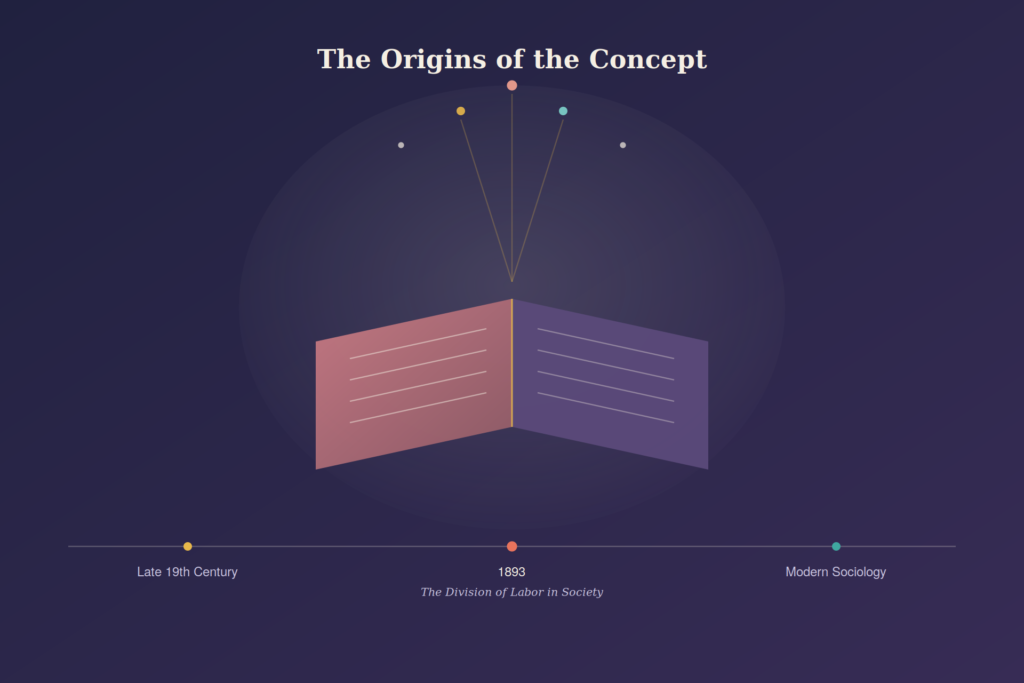
Durkheim introduced the term in his 1893 book The Division of Labor in Society, one of the founding texts of modern sociology. He described collective consciousness as the totality of beliefs and sentiments common to the members of a society, forming a determinate system with a life of its own.
That last phrase matters. Durkheim wasn’t describing a metaphor. He believed collective consciousness had real, observable effects on individual behavior, and that it persisted across generations even as the specific people carrying it were born, aged, and died. In his view, society was not just a collection of individuals pursuing their own interests. It was held together by something more fundamental: a shared moral and cognitive framework that predates any one person and outlasts them.
This was a radical claim for its time. Durkheim was writing during a period when many thinkers assumed that social order was simply the sum of individual choices and contracts. He argued the opposite: that individuals absorb their beliefs, norms, and even their sense of self from a collective source that exists prior to and outside of them. Understanding what a collective consciousness is, in Durkheim’s original sense, means accepting that some parts of our mental life aren’t really “ours” at all. They’re borrowed from the group.
How Collective Consciousness Works
Durkheim didn’t just describe collective consciousness in the abstract. He traced how it functions differently depending on the structure of a society, and how it gets built and reinforced over time.
Mechanical and Organic Solidarity
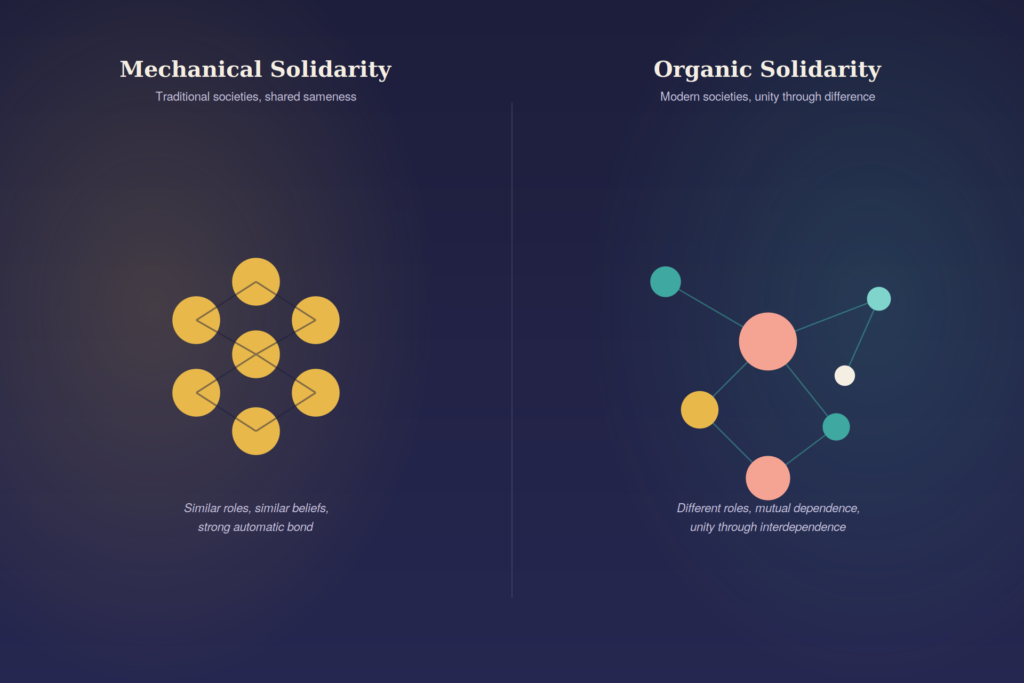
Durkheim distinguished between two types of social bonding, which he called mechanical and organic solidarity.
In traditional or pre-industrial societies, people tend to live similar lives, hold similar beliefs, and perform similar roles. Durkheim called the resulting bond mechanical solidarity. Because everyone’s experience is so alike, the collective consciousness in these societies is strong, uniform, and often deeply tied to religion, ritual, and custom. Deviation from shared norms is treated seriously, because it threatens the unity that similarity provides.
Modern, industrialized societies work differently. People take on specialized roles, hold varied beliefs, and depend on one another precisely because they are different, not because they are the same. Durkheim called this organic solidarity, comparing it to the interdependence of organs in a body. Here, the collective consciousness becomes less uniform and less totalizing. It shifts away from rigid, shared moral codes and toward broader principles like individual rights, tolerance, and pluralism. Unity comes less from everyone thinking alike and more from everyone needing each other to function.
The Institutions That Build It
Collective consciousness doesn’t maintain itself. It’s continually produced and reinforced by the institutions people move through every day:
- The state, through national symbols, civic education, and appeals to patriotism
- Schools, which transmit not just knowledge but shared values and expected behaviors
- Media, which spreads ideas, trends, and norms at a scale no single community once could
- Religious institutions, which build shared belief systems and communal rituals
- Law and the judiciary, which formally define acceptable and unacceptable conduct
Rituals do a quieter version of the same work. Parades, holidays, weddings, and even everyday habits like how people dress or greet one another all reinforce a shared sense of what is normal and expected. When someone violates a social norm, the collective response, whether it’s outrage, gossip, or formal punishment, isn’t just about that individual. It’s the group reaffirming its own boundaries.
Collective Consciousness Across Disciplines
One reason the topic generates so much curiosity is that the phrase means slightly different things depending on which field you’re standing in.
In Sociology
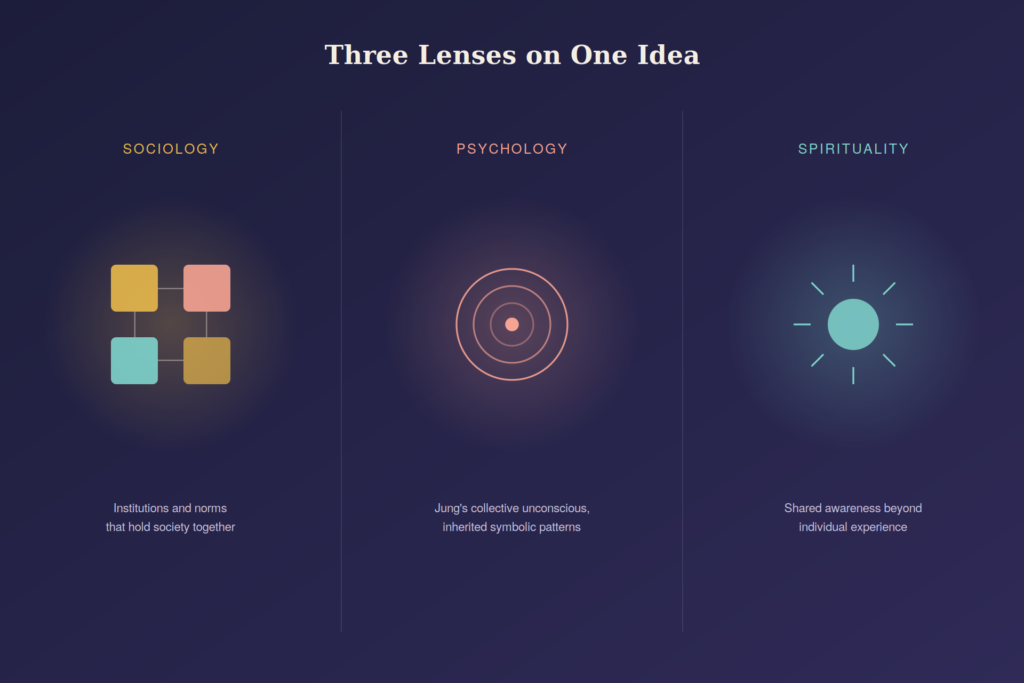
This is Durkheim’s original territory. Sociologists use collective consciousness theory to explain social cohesion, the persistence of shared norms, and how societies maintain order without every interaction being individually negotiated. It’s a foundational concept for understanding why groups act with a kind of internal coherence that outlives any single member.
In Psychology
Carl Jung introduced a related but distinct idea: the collective unconscious. Where Durkheim was describing shared social beliefs that people are largely aware of, Jung theorized a deeper, inherited layer of the psyche, made up of archetypes and symbols common across all of humanity, operating below conscious awareness. The two concepts are often confused because they sound alike, but they emerged from different disciplines asking different questions. Durkheim was studying society from the outside; Jung was studying the psyche from the inside. Both, in their own way, were trying to explain why humans seem to share patterns of thought and behavior that no individual consciously invented.
In Spirituality
Outside academic frameworks, collective consciousness is often used more loosely, to describe a shared awareness or energetic connection that some traditions believe links all people, or all living things, at a level beyond ordinary individual experience. This usage draws on ideas from various contemplative and mystical traditions, some of which describe a form of universal consciousness underlying all individual minds. These are experiential and philosophical claims rather than empirical ones, and it’s worth being clear about that distinction. They aren’t measured in a lab the way sociological patterns can be observed in institutions or behavior. But they represent a long and serious lineage of human thought about interconnectedness, one that many people find genuinely meaningful in their own lives, even without scientific verification. A fair treatment of the topic holds both threads at once: the empirical and the experiential, without collapsing one into the other.
Real-World Examples of Collective Consciousness
Abstract definitions become clearer with concrete cases. A few well-known collective consciousness examples show the concept operating at very different scales:
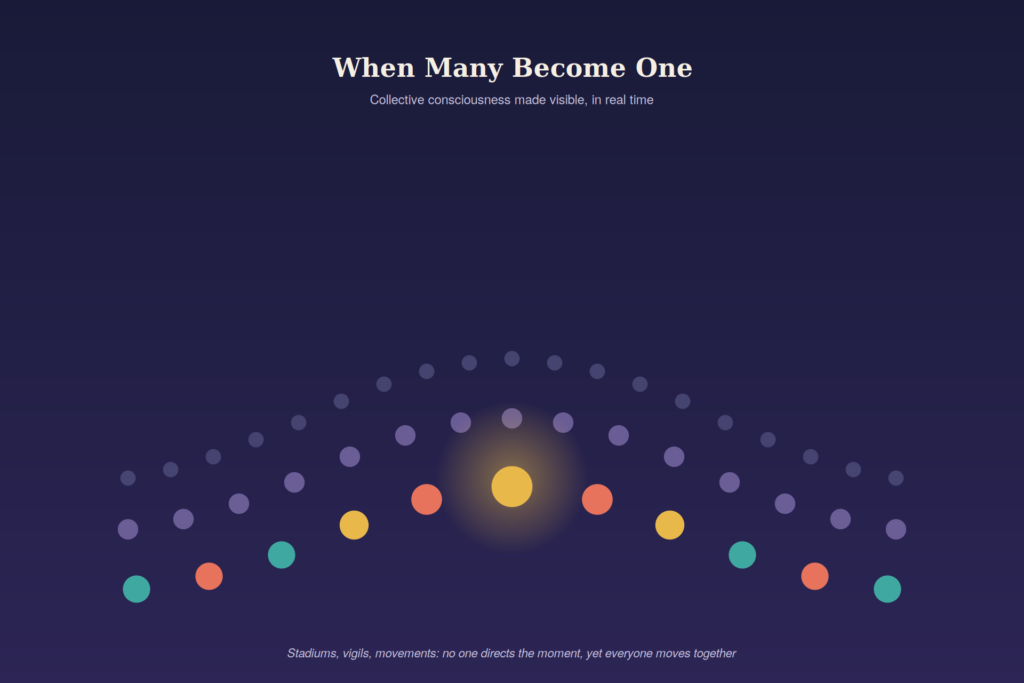
- National mourning, such as the shared grief and solidarity that followed events like the September 11 attacks, where an entire country experienced a collective shift in awareness, priorities, and behavior almost overnight.
- Sporting events, where tens of thousands of strangers synchronize their emotional highs and lows around a single shared symbol, a team, without any formal coordination.
- Social movements, where a shared sense of injustice spreads across a population and translates into aligned action, from historical civil rights movements to more recent global protests.
- Cultural trends, where a shift in language, fashion, or values (like changing attitudes toward the environment or mental health) spreads through media and institutions until it becomes part of the general social fabric.
In each case, no single person designed the outcome. It emerged from the interaction of shared beliefs, institutional reinforcement, and the everyday behavior of people responding to one another.
How to Apply This Understanding
Recognizing collective consciousness isn’t just an academic exercise. It has practical value for anyone trying to understand their own beliefs more clearly.
Start by noticing which of your convictions feel genuinely examined and which ones you’ve simply absorbed from your environment, your upbringing, your media diet, or your social circle. This isn’t about rejecting shared values wholesale; a functioning society needs some degree of collective consciousness to hold together. But there’s a real difference between values you’ve thought through and values you’ve inherited without question.

It’s also worth paying attention to the institutions actively shaping collective belief around you right now. Media algorithms, in particular, function as a modern, accelerated version of the mechanisms Durkheim described in the 19th century, spreading shared ideas and norms faster and more relentlessly than any previous technology. Being aware of that pull doesn’t mean withdrawing from it. It means engaging with more intention and giving yourself room to distinguish your own clarity from the noise of collective momentum.
For those drawn to the spiritual interpretation of the concept, the practical application often looks different: contemplative practice, meditation, or simply quiet reflection, approached as ways of exploring whether individual awareness might connect to something larger. These practices are personal and experiential by nature. They don’t require rejecting the sociological view; the two can coexist as different lenses on the same underlying human experience of connection.
Common Misconceptions
A few misunderstandings come up repeatedly when people first encounter this idea.
One is assuming collective consciousness means everyone in a society thinks identically. Durkheim never claimed this, especially not in the case of organic solidarity in complex modern societies, where diversity of thought is not just tolerated but structurally necessary. Collective consciousness describes shared underlying norms and values, not uniform opinions on every issue.
Another is conflating Durkheim’s sociological concept with Jung’s collective unconscious, as though they’re the same theory dressed in different language. They address different levels of human experience: one social and largely conscious, the other psychological and largely unconscious.
A third misconception treats the spiritual notion of universal consciousness as either fully proven fact or complete fiction. Neither framing is accurate. It’s a philosophical and experiential claim with a long tradition behind it, taken seriously by many thoughtful people, but it sits outside the domain of empirical scientific measurement. Honest treatment of the topic means neither dismissing it nor overstating its scientific standing.
For daily insights on consciousness, clarity, and trusting yourself, explore Bahlon’s free daily transmissions.
Related Readings:
- Consciousness for Self-Exploration
- Unified Theory of Consciousness
- Collective Consciousness: One Thought at a Time
Frequently Asked Questions
What is a collective consciousness in simple terms?
It’s the shared beliefs, values, and norms that a group of people hold in common, which shape individual behavior and give a society its sense of cohesion and identity.
Who came up with the theory of collective consciousness?
Émile Durkheim, a French sociologist, introduced the concept in his 1893 book The Division of Labor in Society.
Is collective consciousness the same as Jung’s collective unconscious?
No. Durkheim’s collective consciousness refers to shared, largely conscious social norms and beliefs. Jung’s collective unconscious refers to inherited psychological structures, like archetypes, operating below conscious awareness. They come from different fields and describe different phenomena.
What are some everyday examples of collective consciousness?
National holidays, shared mourning after major tragedies, sports fandom, viral cultural trends, and widely held moral norms around right and wrong all reflect collective consciousness in action.
Is collective consciousness a scientific concept?
In sociology, yes, it’s a well-established theoretical framework used to explain social cohesion. In spiritual and some psychological contexts, it’s used more loosely to describe a shared or universal awareness, which is an experiential and philosophical idea rather than an empirically tested scientific claim.