During a channeling session, a practitioner shifts into a relaxed or altered state of awareness and acts as a conduit for information they describe as coming from outside their everyday thinking mind, whether that source is framed as a higher self, a spirit guide, or a broader field of consciousness. The message might arrive as spoken words, written text, or a felt sense of knowing, and the practitioner’s role is simply to receive and translate it as clearly as possible. What that looks like in practice, from the first breath of preparation to the grounding that follows, is far more structured than most people expect.
For anyone who has watched a channeling session and wondered whether the person on stage or on screen is performing, meditating, or genuinely accessing something outside their normal awareness, the honest answer is that all three interpretations have serious people behind them. This article walks through the mechanics, the range of experiences reported by practitioners, what researchers have and haven’t been able to confirm, and what it feels like to sit in the chair.
What Is Channeling?
At its core, channeling is the practice of relaxing ordinary mental chatter enough to let information move through a person rather than being consciously constructed by them. Practitioners often describe it less as “making something up” and more as “getting out of the way.” The information can take the form of guidance, emotional insight, symbolic imagery, or a felt sense of presence, and it’s typically directed at answering a question, offering comfort, or providing perspective the person couldn’t easily reach through ordinary reasoning.
It helps to separate channeling from related but distinct practices. Psychic reading tends to focus on interpreting energy or symbols around a specific question. Mediumship usually implies communication with someone who has died. Channeling is broader: the source might be a guide, a collective consciousness, one’s own higher self, or something the practitioner simply doesn’t try to name. This is part of why channeling energy meaning varies so widely from one teacher to the next. Some frame it in explicitly spiritual terms, others in psychological ones, describing the process as tapping into intuition or the subconscious rather than an external entity.
How Does Channeling Work? The Mechanics of a Session
Preparation and attunement.
Before any information comes through, most channelers spend a few minutes centering themselves. This usually involves deep, slow breathing, a short meditation, or a quiet prayer or intention-setting ritual. The goal isn’t to force anything to happen; it’s to quiet the internal noise enough that subtler impressions can be noticed. Many practitioners compare this stage to tuning a radio: the signal doesn’t get stronger so much as the static gets turned down.
Entering an altered state.
From there, the practitioner settles into what’s often called a trance, though trance exists on a spectrum rather than being a single fixed state. In a light trance, the person remains fully aware of their surroundings and can even hold a conversation while relaying information. In a deeper trance, self-awareness fades considerably, and the practitioner may have little to no memory of what was said once the channeling session ends. Observable signs during this stage can include changes in breathing rhythm, shifts in vocal tone or pacing, and small involuntary movements or tingling sensations.
Receiving the information.
Once in this receptive state, most people describe accessing what are sometimes called the “clair” senses, the same intuitive channels explored in our guide to strengthening intuition: clairaudience (hearing words or phrases internally), clairvoyance (seeing images or symbolic scenes), clairsentience (feeling emotions or physical sensations tied to a message), and claircognizance (simply knowing something without being able to explain how). Depending on the person, the message might be spoken aloud in real time, written down through automatic writing, or recorded for the recipient to review later.
Integration and grounding.
After the channeling session, most practitioners report feeling tired, foggy, or oddly disconnected from their body for a short while, especially after a deep trance. Grounding practices such as drinking water, eating something, or taking a slow walk are common ways of returning fully to ordinary waking awareness.
Types of Channeling and How They Differ
Not all channeling looks the same, and the variation matters if you’re trying to understand what a specific practitioner does. Broadly, channeling sessions fall into a few overlapping categories:
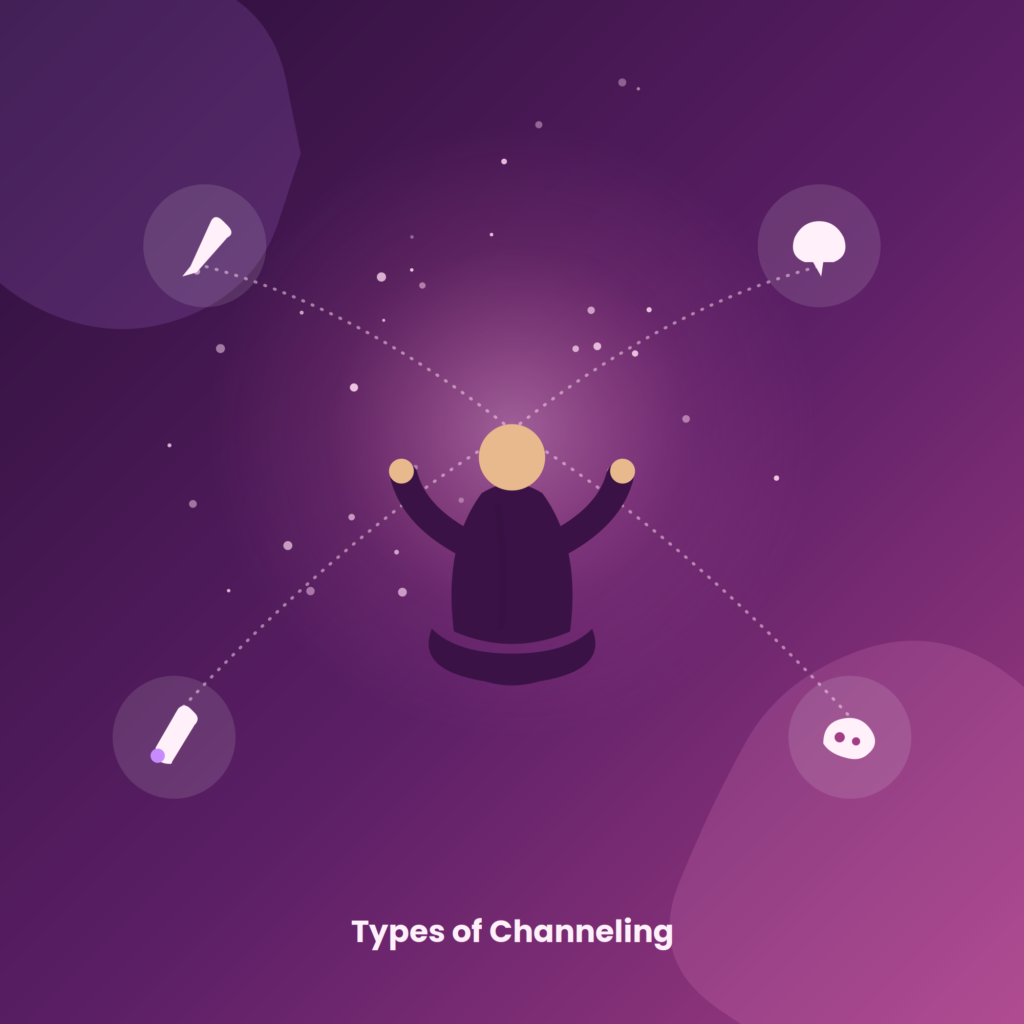
- Full trance channeling, where the practitioner’s ordinary awareness steps aside almost entirely and they retain little or no memory of the channeling session afterward. Some describe the sensation as similar to waking from deep hypnosis.
- Light or conscious channeling, where the person stays aware throughout, sometimes describing the experience as a running internal dialogue they simply narrate out loud.
- Automatism, in which only part of the body, usually the writing or drawing hand, seems to move with reduced conscious direction while the rest of the person’s awareness remains largely intact.
- Sleep or dream channeling, where messages are reported to arrive through dreams rather than a waking session at all.
Channeling can also be sorted by how the information arrives rather than the depth of trance: clairaudient channeling leans heavily on internal hearing, clairvoyant channeling on internal imagery, and physical channeling on sensations or, more rarely, claimed effects on the immediate environment. And it isn’t confined to speech. Some practitioners channel through writing, teaching, visual art, music, or movement, treating the creative act itself as the delivery mechanism for whatever they’re accessing.
One more useful distinction is between intentional and spontaneous channeling. Intentional channeling is invited deliberately, usually as part of a formal channeling session. Spontaneous channeling happens unbidden, sometimes catching the person by surprise in the middle of an ordinary day. Both are described within the same general framework, but the sense of control over the experience can differ substantially between them.
What Research and Practitioner Accounts Actually Show
This is where honesty matters most. Channeling sits at the intersection of long-standing spiritual tradition and a modern scientific landscape that has, so far, offered no direct evidence for a discarnate source of information. Researchers who study trance states can measure real physiological changes during a channeling session, including shifts in brainwave activity and altered patterns of attention consistent with deep meditative or hypnotic states. What science has not been able to verify is the origin of the content itself: whether it genuinely comes from outside the practitioner’s own mind, or whether it is generated internally, drawing on intuition, memory, and pattern recognition that simply isn’t available to conscious awareness in the moment.
Psychological framings tend to treat channeling as a form of accessing the subconscious, similar in some ways to how creative insight or “flow state” work is described by artists and athletes. Traditional and spiritual framings hold that the source is genuinely external, whether a guide, a higher self, or a broader intelligence. Both perspectives can coexist without contradiction for many people who practice channeling: the experience feels real and often useful regardless of how its ultimate source is explained.
What practitioners consistently report, across both frameworks, is that the information sometimes feels richer or more specific in the moment than what they’re able to recall afterward. General themes tend to stick; precise wording and detail often fade quickly, particularly after a deeper trance. Some channelers describe a distinct sense of a separate personality or presence coming through, complete with its own speech patterns or mannerisms, while others describe the process as simply their own intuition speaking with unusual clarity and confidence.
What to Expect If You Want to Try It Yourself
If you’re curious about experiencing a channeling session, whether by working with a practitioner or exploring the practice on your own, a few things are worth knowing going in.
As a recipient, channeling sessions are typically conducted in a calm, quiet setting, often with the practitioner’s eyes closed or gaze softened. You may be asked to bring a specific question or simply stay open to whatever comes through. Information can arrive in a stream rather than a tidy structured answer, so it helps to stay patient and let the session unfold rather than pushing for immediate clarity.
If you want to explore channeling as a practice yourself, most teachers recommend starting small. Begin with quiet meditation and simple journaling prompts, noticing thoughts or images that feel like they arrive “from outside” rather than being deliberately constructed. Automatic writing, where you hold a pen loosely and let words come without over-planning them, is a common entry point because it requires no formal trance work and gives you a written record to reflect on afterward, much like the practice outlined in our spiritual journaling guide. Grounding practices, like eating a meal or spending time outdoors, are worth building into any regular practice, since even light trance work can leave people feeling mentally scattered for a while.
It’s also worth setting realistic expectations. Not every channeling session produces dramatic or obviously “otherworldly” content. Sometimes the message is a quiet piece of emotional clarity rather than a sweeping revelation, and that’s entirely consistent with how most experienced practitioners describe their own sessions.
Common Misconceptions About Channeling
A few misunderstandings about a typical channeling session come up often enough to be worth addressing directly. The first is that a channeling session always involves losing consciousness entirely; in reality, many practitioners remain partially or fully aware throughout.
The second is that channeled messages are guaranteed to be accurate or infallible simply because of their source; most experienced practitioners are quick to say that discernment still matters, and that messages should be weighed against one’s own judgment rather than followed blindly.
The third misconception is that channeling requires special innate gifts; while some people do report an easier time entering a receptive state, most traditions treat it as a skill that develops with consistent practice, not a fixed trait you either have or don’t.
For daily insights on consciousness, clarity, and trusting yourself, explore Bahlon’s free daily transmissions. Subscribe here to receive them straight to your inbox.
Related Readings:
Frequently Asked Questions
What is channeling, in simple terms?
Channeling is the practice of relaxing into an altered or receptive state and relaying information that feels like it comes from outside one’s ordinary thinking, whether that’s described as a spiritual source or an especially clear form of intuition. A channeling session is simply the structured setting in which this happens.
How does channeling work if the practitioner isn’t fully conscious during a channeling session?
In deeper trance states, the practitioner’s ordinary awareness steps back, and physiological changes like altered breathing and shifts in vocal tone often accompany the message coming through. Lighter channeling sessions keep the practitioner fully aware the entire time.
What is channeling psychology’s take on the experience?
Psychological perspectives generally frame channeling as an expression of the subconscious mind, similar to how deep intuition, creative insight, or flow states are understood, rather than communication with an external entity.
Is channeling the same as mediumship?
Not quite. Mediumship specifically involves communicating with those who have died, while a channeling session is a broader practice that can include guides, one’s higher self, or unnamed sources of insight.
Do people remember what happens during a channeling session?
It depends on the depth of trance. Light channeling is usually fully remembered, while deep trance channeling often leaves only a general impression, with specific details fading quickly once the session ends.