Synchronicity vs coincidence comes down to one question: does the timing carry personal meaning, or is it just chance? Carl Jung coined “synchronicity” for a coincidence that feels too meaningful to be random: an inner experience, like a thought or a dream, that lines up with an outer event in a way that seems symbolically connected rather than causally connected. A plain coincidence, by contrast, is simply two unrelated things happening at the same time, explainable by chance and probability alone. The difference isn’t in the event itself but in what it means to the person experiencing it.
That distinction sounds simple, but it opens onto one of the more interesting corners of twentieth-century psychology, where clinical observation, mythology, and questions about the nature of reality all collide. Jung didn’t propose synchronicity as a replacement for cause and effect. He proposed it as something running alongside causation, a second way that events might relate to one another. Whether you find that persuasive or not, understanding what he actually argued, and where mainstream science pushes back, makes the whole conversation far more interesting than the popular “everything happens for a reason” shorthand it often gets reduced to.
What Is Synchronicity? Jung’s Original Definition
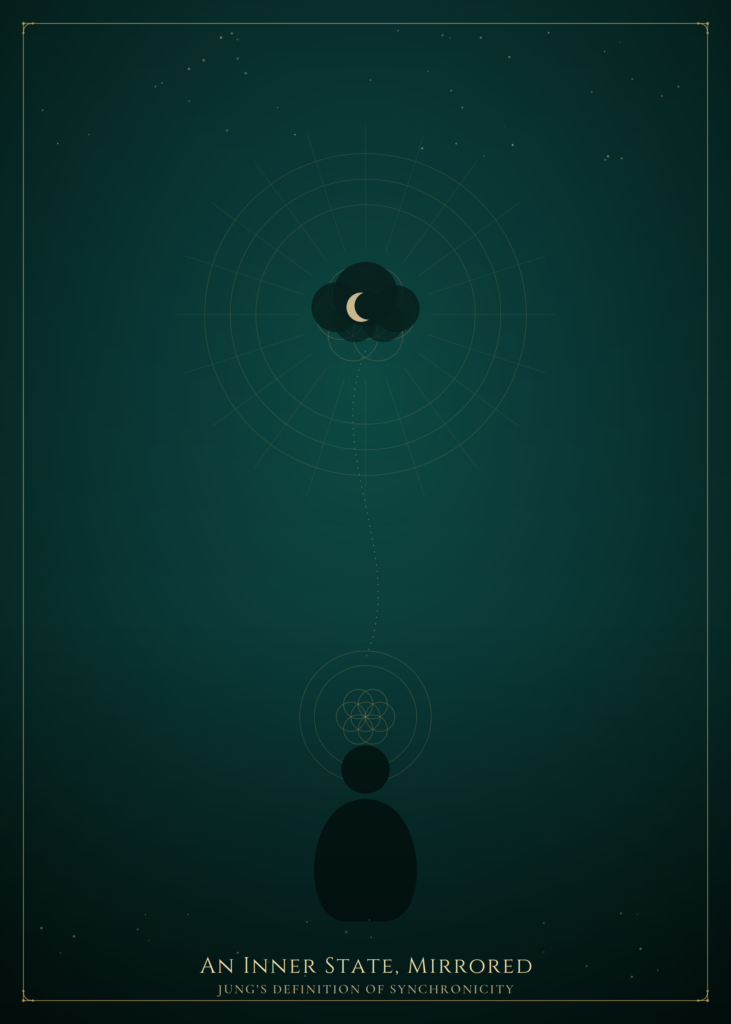
Jung defined synchronicity as the simultaneous occurrence of an inner psychological state and an outer event that mirrors it, where the two are connected by meaning rather than by any traceable physical link. He first laid out the idea formally in the 1950s, though it grew out of decades of clinical work with patients whose dreams, intuitions, and emotional states seemed to correspond with things happening in the world around them.
Two elements have to be present for Jung to call something synchronicity rather than ordinary coincidence. First, there has to be a genuine parallel between the inner experience and the outer event, not just any two things happening together, but a resemblance strong enough to feel uncanny. Second, the connection has to carry personal significance for the person involved. A stranger’s coincidence means nothing to you because you have no emotional or symbolic stake in it. Your own coincidence, tied to something you were already thinking, grieving, or hoping for, can feel like it’s speaking directly to you.
This is why Jung insisted that synchronicity is not simply a more dramatic word for coincidence. A coincidence is neutral. Synchronicity, in his framework, is charged with meaning that the observer supplies and recognizes.
Synchronicity vs. Coincidence: The Key Differences
The two terms get used interchangeably in casual conversation, but Jung’s theory draws a sharper line between them.
A coincidence is a random alignment of events with no necessary link to a person’s internal life. It doesn’t need to reflect what someone is thinking, feeling, or dreaming, and it can usually be accounted for through probability. Mathematicians have offered several frameworks for why coincidences happen far more often than intuition suggests. Littlewood’s Law proposes that, given enough opportunities, a person should expect to experience something with roughly one-in-a-million odds about once a month, simply because they encounter so many events in that time. The Law of Large Numbers works similarly: across a big enough sample of daily experiences, improbable-seeming overlaps become statistically ordinary rather than exceptional.
Synchronicity, in Jung’s usage, is narrower and more personal. It requires a felt connection between an inner state and an outer event, one that feels emotionally or symbolically significant rather than arbitrary. Jung linked these experiences to what he called archetypal patterns, deep psychological structures he believed were shared across humanity, rather than to any physical chain of cause and effect. In his view, synchronicity acts as a bridge between the subjective world of the mind and the objective world outside it, a bridge that ordinary causation can’t account for.
Put simply: every synchronicity involves a coincidence, but not every coincidence rises to the level of synchronicity. The dividing line is meaning.
The Mechanics: Acausal Connection and the Collective Unconscious
Jung’s theory rests on two ideas that are worth separating out, since they do different jobs.
The first is what he called the acausal connecting principle. Jung argued that cause and effect isn’t the only way events can relate to one another. He proposed that meaning itself can act as a connective thread between two events, even when there’s no physical mechanism linking them. This was a genuinely radical claim for a psychologist to make, and it drew Jung into extended correspondence with physicist Wolfgang Pauli, who was independently exploring related questions in quantum theory. Neither man claimed to have proven the idea; they treated it as a serious hypothesis worth taking seriously rather than a settled fact.
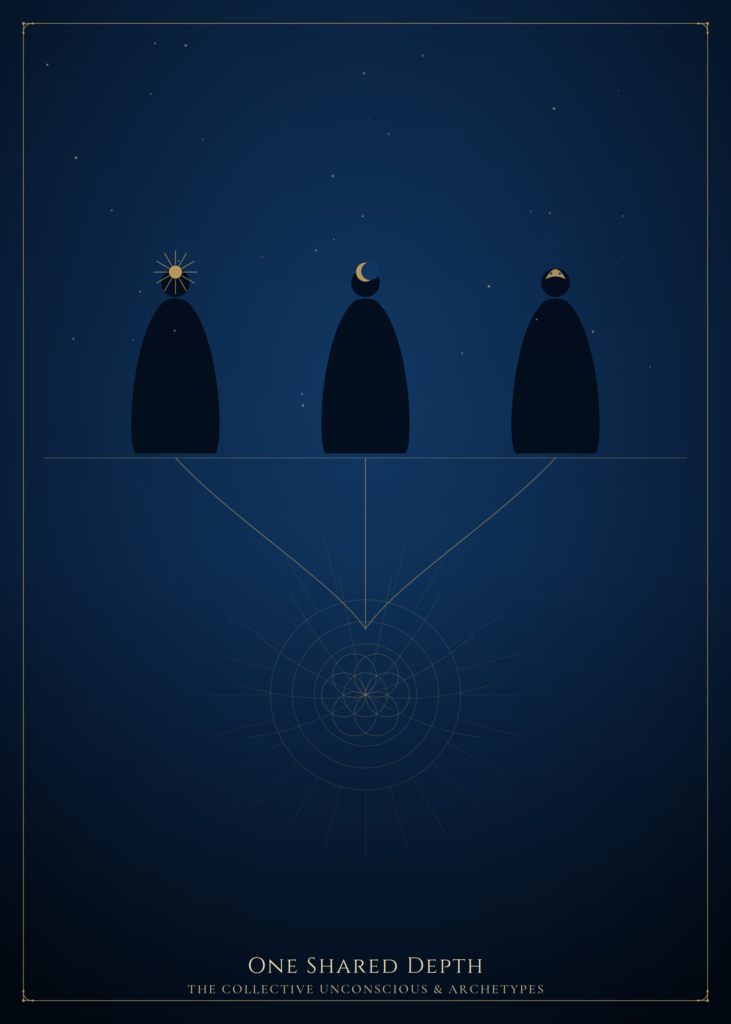
The second idea is the collective unconscious, a concept Jung had already developed earlier in his career. He believed that beneath each person’s individual unconscious mind lies a deeper, shared psychological layer containing universal symbols and archetypes, patterns like the mother, the hero, the shadow, that show up across cultures and eras. Jung suggested that synchronicities often surface from this shared layer, momentarily connecting a person’s conscious awareness to something larger than their individual experience. In this sense, synchronicity wasn’t just about strange timing for Jung. It was evidence, he believed, of a deeper interconnection between the mind and the world that couldn’t be reduced to biology or physics alone.
Evidence and Perspectives: Jung, Skeptics, and Lived Experience
Jung’s Scarab Beetle
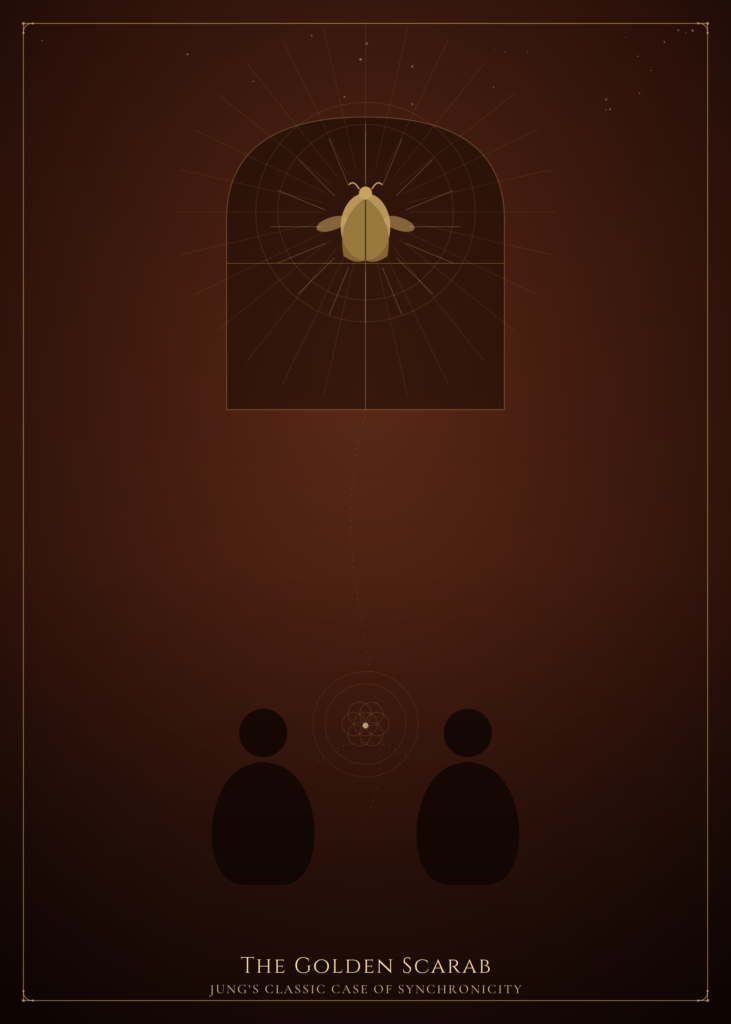
The example Jung returned to most often involved a patient in analysis who had become, in his words, overly rational and resistant to psychological insight. During one session, she described a dream from the night before involving a golden scarab beetle. As she spoke, Jung heard a tapping at the window. He opened it and caught a flying insect that turned out to be the closest local equivalent to a scarab beetle, a species not normally drawn to enter rooms that way. Jung handed it to her and said, “Here is your scarab.” He later wrote that the experience cracked open her rigid defenses in a way that months of conventional interpretation hadn’t managed, precisely because the external event mirrored her inner one so exactly.
Everyday Reports
Beyond the clinical literature, people describe synchronicity in far more ordinary terms. Someone forgets their wallet, turns back home, and later learns of an accident on the route they would have taken. Someone unhappy in their career starts noticing advertisements for a specific training program everywhere they look, on billboards, in conversations, across social media, until the repetition itself starts to feel like a nudge. Someone missing a parent who has died finds an old recipe card on the floor at the exact moment they were thinking of them, or keeps finding rubber bands in unlikely places because their father always wrapped cash with rubber bands. None of these events can be verified as anything other than chance. What gives them weight is the timing relative to the person’s inner state, and many people describe interpreting such moments as signs, reassurance, or even communication from someone who has passed.
The Scientific Counterargument
Mainstream psychology generally offers a different account of the same experiences. Researchers point to pattern recognition, the brain’s well-documented tendency to find order in randomness, as a major driver. Confirmation bias plays a role too: people tend to notice and remember the coincidences that felt meaningful while forgetting the vastly larger number of near-misses and irrelevant overlaps that never registered. Combined with the statistical arguments behind Littlewood’s Law and the Law of Large Numbers, skeptics argue that what feels like an acausal connection is really just selective memory operating on ordinary probability. This isn’t necessarily a dismissive position. Many researchers who study coincidence take the psychological experience seriously as a phenomenon worth understanding, even while rejecting the idea of a literal mystical force behind it.
Both readings can be true at once in a practical sense. The statistics explain why coincidences happen this often. They don’t fully explain why a particular one lands with such emotional force on a particular day, and that gap is where Jung’s theory continues to do useful work, whether taken literally or as a psychological framework.
How to Recognize and Work With Synchronicity
You don’t need to resolve the scientific debate to get something useful out of paying attention to synchronicity. A few practical approaches show up consistently among people who work with these experiences intentionally.
Start by noticing rather than forcing. Synchronicities tend to lose their charge when chased; they’re more often recognized in hindsight than manufactured on demand. Keeping a simple journal of moments that felt meaningfully timed, without judging them, can help you see patterns over weeks or months rather than trying to interpret each one in isolation.
Ask what the moment is mirroring, not what it’s predicting. Jung’s framework is symbolic, not fortune-telling. A synchronicity that surfaces while you’re wrestling with a decision is more useful as a prompt for reflection, what does this event echo about my inner state, than as a literal instruction to act.
Hold both explanations lightly. You can find an experience personally meaningful and still acknowledge that chance played a role in the mechanics. The two aren’t mutually exclusive, and treating them as compatible tends to produce a more grounded, less anxious relationship with these moments than insisting on a single explanation.
Finally, use synchronicity as an entry point into self-reflection rather than an endpoint. Jung viewed these experiences as connective tissue between the conscious and unconscious mind, useful precisely because they interrupt habitual thinking and invite a closer look at what’s happening beneath the surface. Approaching intuition and inner awareness with that kind of curiosity is a theme worth exploring further if it resonates with you.
Common Misconceptions About Synchronicity
A few misunderstandings tend to follow this topic around. The first is that synchronicity means “everything happens for a reason” in a fatalistic sense. Jung’s theory doesn’t claim that events are predetermined or orchestrated; it claims that meaning can connect events without one causing the other, which is a different and more modest proposition. The second misconception is that synchronicity is simply a spiritual rebrand of coincidence, interchangeable in every context. As outlined above, Jung was specific about the criteria: a felt inner-outer parallel, plus personal significance, are both required. The third is that believing in synchronicity requires rejecting probability and statistics outright. Many people, including some researchers, hold both frameworks simultaneously, using statistics to explain frequency and using symbolic meaning to explain personal significance.
For daily insights on consciousness, clarity, and trusting yourself, explore Bahlon’s free daily transmissions. Subscribe here.
Related Readings:
- Understanding Synchronicity: The Meaning Behind Life’s Most Puzzling Coincidences
- Synchronicities: Meaningful Coincidences in Daily Life
Frequently Asked Questions
What is the simplest definition of synchronicity?
Synchronicity is a meaningful coincidence: an inner experience, like a thought, dream, or feeling, that occurs alongside an outer event that mirrors it in a way that feels symbolically connected rather than accidental.
Is synchronicity scientifically proven?
No. Jung’s acausal connecting principle remains a psychological and philosophical theory rather than an established scientific finding. Mainstream science generally explains these experiences through pattern recognition, confirmation bias, and statistical probability.
What’s the difference between synchronicity and déjà vu?
Déjà vu is the sensation of having already experienced a current moment, generally attributed to memory processing quirks in the brain. Synchronicity involves an external event that meaningfully mirrors a separate internal state, such as a thought or dream, and doesn’t involve a false sense of familiarity.
Can synchronicity be a coincidence and still feel meaningful?
Yes. Many people, and even some researchers, hold that an event can be statistically ordinary while still carrying genuine personal or emotional significance for the individual experiencing it. The two readings aren’t mutually exclusive.
Did Carl Jung believe synchronicity was supernatural?
Jung framed synchronicity as a natural but non-causal ordering principle rather than a supernatural force. He treated it as evidence of a deeper interconnected structure to reality, developed partly through his correspondence with physicist Wolfgang Pauli, rather than as proof of the paranormal.