The core difference in new moon vs full moon rituals comes down to direction: new moon practices are about setting intentions and starting fresh, while full moon practices are about releasing what no longer serves you and celebrating what’s been accomplished. Both are built around the same 29.5-day lunar cycle, but they ask something different of the person observing them. One is a quiet beginning. The other is a bright reckoning.
For thousands of years, cultures across the world have looked to the sky to mark time, plan harvests, and structure inner life. Moon rituals are a modern continuation of that instinct, less about astrology as prediction and more about using a reliable, visible rhythm to organize reflection, goal-setting, and emotional release. Whether or not someone believes the moon exerts any measurable influence on human behavior, the practice of pausing twice a month to check in with yourself has an appeal that doesn’t require belief to explain. Understanding new moon vs full moon practices side by side makes it easier to see how the two halves of the cycle actually work together rather than in competition.
What Moon Rituals Actually Are
A moon ritual is a set of intentional actions, journaling, meditation, cleansing, affirmations, or small ceremonies, performed in alignment with a specific lunar phase. The idea isn’t unique to any single tradition. Elements of it show up in Wiccan practice, in various indigenous lunar calendars, in yoga and wellness communities, and in more secular self-improvement circles that have simply borrowed the moon as a scheduling device.
The two anchor points are the new moon and the full moon, which sit roughly two weeks apart. Because the cycle repeats predictably, it works well as a personal rhythm: pick a theme for the month at the new moon, live with it, then use the full moon to evaluate, release, and reset before the next cycle begins. Framed as new moon vs full moon, the pairing gives a practice both a starting point and a natural checkpoint, which is part of why it’s held on across so many different traditions.
It’s worth being clear about something from the outset: none of this requires supernatural belief to be useful. A person can treat the new moon and full moon simply as two dependable check-in points on the calendar, the same way others use the first of the month or a Sunday evening planning session. For others, the practice carries deeper spiritual or magical significance tied to specific traditions. Both approaches are valid ways to engage with the same basic structure.
How the Lunar Cycle Actually Works
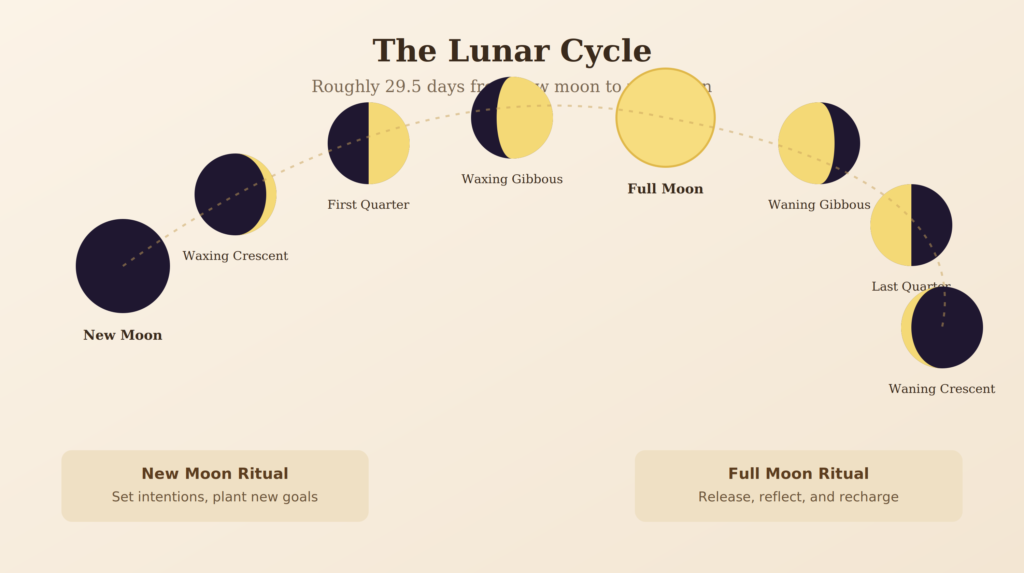
Before getting into ritual, it helps to understand the mechanics, because the symbolism of new moon vs full moon practices is drawn directly from what’s happening astronomically.
A new moon occurs when the moon sits directly between the Earth and the Sun. From Earth’s vantage point, the side of the moon facing us is completely unlit, so the sky appears dark where the moon should be. This is considered day zero of the lunar cycle. Because there’s no visible moon, the night feels especially still and blank, which is part of why this phase is associated with a “clean slate.”
A full moon happens roughly two weeks later, when the Earth sits between the Sun and the moon. The moon’s entire visible face is illuminated, producing the bright, glowing disc most people picture when they think of “the moon.” This is the phase most closely tied to heightened energy, visibility, and emotional intensity in ritual practice, largely because the moon itself is at its most dramatic and hardest to ignore.
Everything else in moon ritual practice, the timing, the symbolism, the mood of each phase, follows from this simple mechanical difference between darkness and full illumination.
New Moon vs Full Moon: Key Differences at a Glance
Laid out side by side, the new moon vs full moon contrast becomes easier to apply in practice rather than just in theory.
| New Moon | Full Moon | |
|---|---|---|
| Sky appearance | Dark, moon barely visible | Fully illuminated, brightest point in the cycle |
| Core theme | Beginnings, intention-setting | Completion, release |
| Emotional tone | Quiet, introspective | Expressive, energized |
| Common practices | Journaling intentions, vision boards, meditation | Release journaling, moon water, energy cleansing |
| Associated crystal | Labradorite | Selenite |
| Traditional herbs | Patchouli, sweetgrass, palo santo | White sage, palo santo |
| Closing ritual | Mint or green tea, holding a crystal | Ginger or citrus tea, oracle card draw |
The new moon versus full moon distinction isn’t about one phase being more powerful than the other. Each depends on the one before it: intentions set at the new moon give the full moon something concrete to evaluate, and whatever gets released at the full moon clears space for the next round of new moon intentions. Read together rather than separately, new moon and full moon rituals form a single, ongoing rhythm rather than two unrelated practices.
The Evidence: Science, Tradition, and Practitioner Experience
Here’s where it’s important to separate three distinct types of claims, because they don’t carry the same weight.
Scientific research on lunar influence over human behavior is limited and largely inconclusive. Studies looking for correlations between moon phases and sleep quality, mood, hospital admissions, or crime rates have produced mixed and often contradictory results. A widely cited 2021 study in Science Advances did find a subtle correlation between lunar phase and human sleep patterns in some populations, but researchers were careful to note this doesn’t establish the moon as a driver of emotional states, fertility, or manifestation, claims commonly made in ritual contexts. In short: there is some evidence the moon may have a faint, measurable relationship to human sleep cycles, but no solid scientific evidence that lunar phases influence luck, intention-setting outcomes, or emotional release in the ways ritual practitioners often describe.
Traditional and cultural perspectives are a different category entirely, and they deserve to be represented on their own terms rather than measured against a scientific yardstick. Many spiritual traditions associate the full moon with the Moon Goddess Selene, connect specific stones like Selenite (whose name derives from the Greek word for “moon stone”) to lunar energy, or treat Labradorite, said in some Indigenous Canadian traditions to have formed from frozen fire released by the Northern Lights, as a stone of manifestation. These beliefs aren’t claims meant to be scientifically verified; they’re part of long-standing cultural and spiritual frameworks that give the practice meaning for the people who observe them.
Practitioner accounts sit somewhere in between. People who journal or set goals on a lunar schedule often report the same benefits associated with any structured reflection practice: better follow-through, clearer priorities, and a felt sense of emotional release after writing something down and letting it go. Psychologists would likely attribute this to the well-documented benefits of expressive writing and goal-setting rather than to the moon itself, but the lived experience of feeling lighter after a full moon release ritual is real, even if the mechanism is more psychological than astronomical.
New Moon Rituals: Practicing New Beginnings
With the new moon vs full moon groundwork in place, it’s worth looking at each phase in more practical detail, starting with the new moon. This phase is treated as a personal, introspective one, ideal for asking honestly what you actually want before committing to it.
Intention Setting
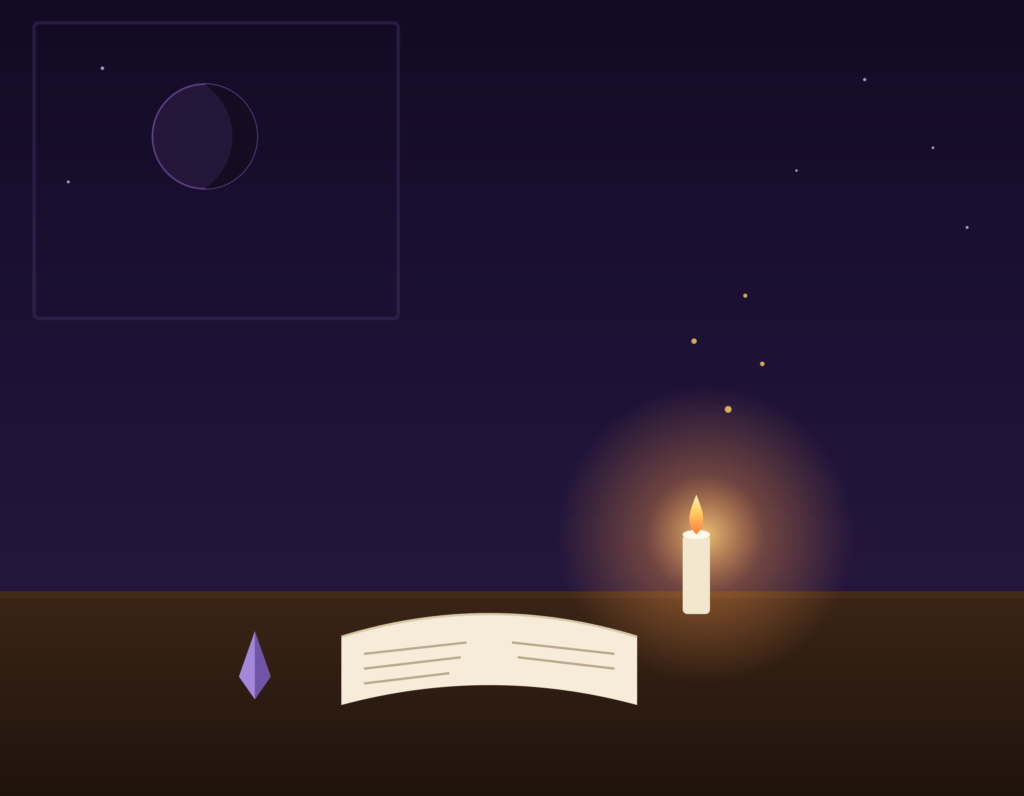
The most common new moon practice is writing down three to five clear intentions for the month ahead. Keeping the list short matters here; spreading focus across a dozen goals tends to dilute follow-through, while three to five intentions can realistically receive sustained attention over a full cycle. Many people phrase these as simple affirmations: “I am ready to find my true path,” or “I am open to new opportunities in my work.” The specificity of the language seems to matter less than the act of committing something to paper.
Vision Boards and Quiet Meditation
Others prefer a visual approach, arranging images and words that represent their goals onto a vision board they can return to throughout the month. A simpler version is a few minutes of quiet meditation, visualizing goals the way one might picture a seed taking root in soil, a slow, gradual image that fits the new moon’s association with fresh starts rather than instant results.
A New Beginnings Bath
A warm bath with salts and calming oils, lavender in particular, is a common way to quiet the mind before setting intentions. Some add peppermint or pink grapefruit oil, both traditionally associated with mental clarity and fresh thinking.
Space Cleansing and Crystals
Preparation often includes cleansing the physical space with incense or herbs such as palo santo, sweetgrass, or patchouli, materials traditionally linked to love, abundance, and clarity of purpose. Clear Quartz, Moonstone, Selenite, and Labradorite are the crystals most frequently used during this phase, with Labradorite in particular associated with manifestation and new beginnings. Some practitioners meditate while watching the way light moves across the stone’s surface, using it as a small, physical reminder to recommit to their intentions as the month unfolds.
Full Moon Rituals: Release and Peak Energy
The other half of the new moon vs full moon cycle works in the opposite direction. If the new moon is about planting, the full moon is about harvest and clearing the field for what comes next.ext.
Release Journaling
The signature full moon practice is release journaling: writing down habits, fears, or relationships you’re ready to let go of, then safely tearing up or burning the page. The physical act of destroying the paper is often described as more emotionally significant than the writing itself, a tangible gesture that reinforces the decision to move on.
Full Moon Affirmations
Where new moon affirmations tend to start with “I am ready to,” full moon affirmations lean toward release: “I let go of,” “I forgive myself for,” “I free myself from needing to be liked.” The full moon is generally treated as a moment for radical honesty, since the bright light is thought to bring hidden emotions closer to the surface.
Moon Water and Energy Cleansing
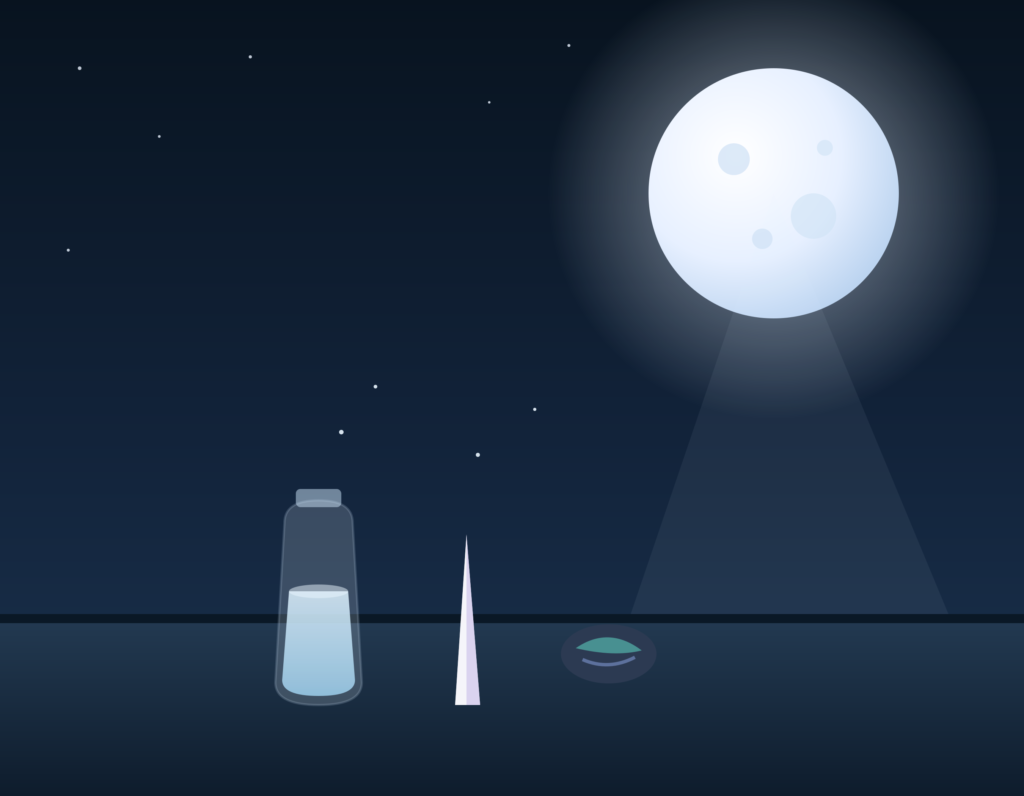
A jar of drinking water left under the full moon overnight, often called moon water, is believed by practitioners to absorb the moon’s peak energy for later use in rituals or self-care. Living spaces are frequently cleansed during this phase using white sage, believed to clear negative energy, or palo santo, associated with restoring a room to a more positive state. Some traditions suggest cracking a window during cleansing to let stagnant energy leave the space entirely.
Selenite and Crystal Recharging
Selenite is the crystal most specifically tied to the full moon, its name drawn from Selene, the Greek goddess of the moon. It’s said to channel lunar energy, support affirmations, and help release negativity, often placed on a windowsill to recharge in the moonlight throughout the following weeks. Other crystals, Clear Quartz, Moonstone, and Labradorite among them, are recharged the same way: set out to absorb direct moonlight overnight.
Common Questions and Misconceptions
One frequent misconception is that new moon and full moon rituals are opposites in the sense of being contradictory. They aren’t. They’re complementary phases of a single cycle, a full moon vs new moon comparison isn’t a competition between two systems but two halves of the same rhythm. You set an intention at the new moon, live with it, and use the full moon to evaluate and release whatever is standing in its way.
Another misconception is that these rituals require elaborate tools, expensive crystals, or advanced spiritual training. Most traditional practices described above, journaling, a warm bath, a few quiet minutes of reflection, are accessible with materials most people already have at home. The crystals, herbs, and specific affirmations are meaningful additions within certain traditions, but they aren’t prerequisites for the practice to be worthwhile.
How to Actually Practice This
For anyone curious but unsure where to start, the simplest version of a new moon vs full moon practice looks like this:
- On the new moon, spend ten quiet minutes writing down three to five intentions for the coming month, phrased in the present or future tense.
- Throughout the month, revisit the list occasionally, perhaps by keeping a related object, a crystal, a photo, a written note, somewhere visible.
- On the full moon, write down what’s been weighing on you, whatever feels finished, unhelpful, or ready to be released, and dispose of the page in whatever way feels right, tearing it, burying it, or safely burning it.
- Close the ritual with something grounding: a few slow breaths, a cup of tea, or a few minutes of stillness before returning to ordinary life.
- Repeat with the next new moon.
There’s no single correct way to do this. Some people add oracle cards, incense, or specific affirmations drawn from particular traditions; others keep it as simple as a notebook and ten quiet minutes twice a month. The consistency of the rhythm tends to matter more than the elaborateness of the ritual itself.
For daily insights on consciousness, clarity, and trusting yourself, explore Bahlon’s free daily transmissions. Subscribe here.
Related Readings:
- Crystal and their Meanings Guide
- The Chakras Guide: Everything You Need to Know
- How To Unblock Your Chakras – Simple & Easy!
Frequently Asked Questions
What is a full moon ritual?
A full moon ritual is a set of intentional practices, most commonly release journaling, space cleansing, and affirmations, performed during the full moon phase to mark completion, celebrate progress, and let go of what no longer serves you.
What’s the difference between new moon and full moon rituals?
New moon rituals focus on setting intentions and new beginnings during the moon’s darkest phase, while full moon rituals focus on release, reflection, and closure during the moon’s brightest phase, roughly two weeks later.
Do I need crystals or special tools for moon rituals?
No. While crystals like Selenite and Labradorite, along with herbs such as palo santo or sage, are traditionally used, the core practices, journaling, meditation, and quiet reflection, require nothing more than a notebook and some uninterrupted time.
Is there scientific evidence that the moon affects mood or behavior?
Research on this is mixed. Some studies suggest a subtle link between lunar phase and sleep patterns, but there’s no strong scientific evidence connecting moon phases to mood, luck, or manifestation outcomes. Many of the benefits people report likely come from the structured reflection itself.
How often should I do a moon ritual?
Most practitioners follow the natural rhythm of twice monthly, setting intentions at the new moon and revisiting or releasing them at the full moon, though there’s no rule against adjusting the frequency to fit your own schedule.