Nonlocal consciousness is the hypothesis that awareness is not confined to the brain or body, and may instead be a fundamental feature of reality that reaches across space and time. In this view, the brain does not necessarily generate consciousness by itself. It may filter, shape, or interact with a wider field of awareness. The idea remains open and contested, and it is best understood as a serious question rather than a settled fact.
Nonlocal Consciousness Explained: A Plain-Language Definition
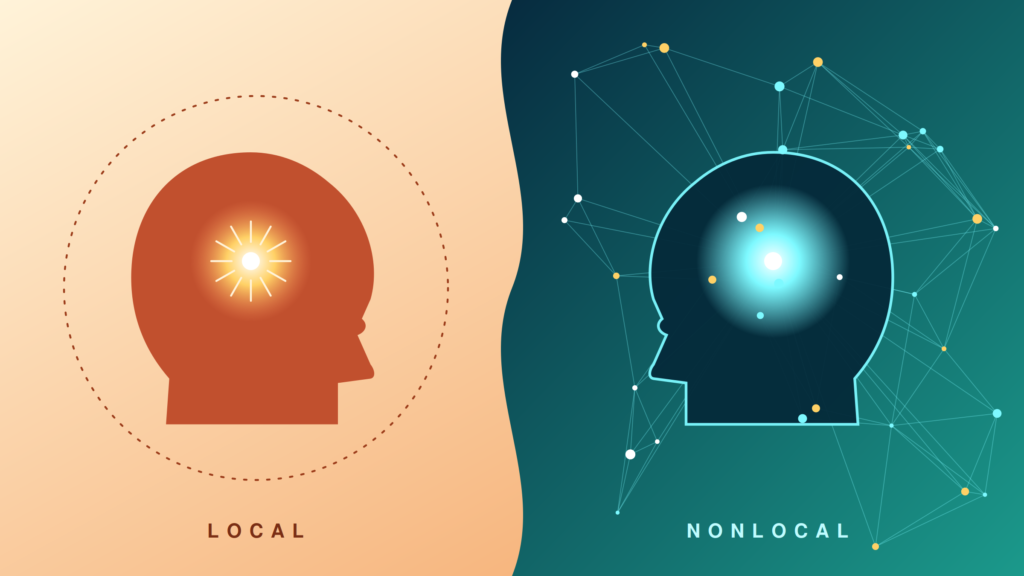
To understand nonlocal consciousness, it helps to start with its opposite. Local consciousness is the familiar picture: your awareness sits inside your skull, is produced by neurons firing, is tied to what your senses report right now, and ends when the brain stops working. Most of modern neuroscience works from this assumption, and it has been enormously productive.
The nonlocal view asks whether that picture is complete. It proposes that consciousness may not be pinned to a single point in space, such as the brain, or a single point in time, such as the present moment. Awareness, on this account, may be more like a field than a product, something the brain participates in rather than manufactures from scratch.
A few features define the idea:
- Consciousness may not be wholly produced by the brain.
- Awareness may not be bound by physical distance or a strictly linear sequence of time.
- Living beings may share a deeper underlying connection.
None of this is new to human thought. Many contemplative and philosophical traditions have long described mind as something wider than the individual person. What is newer is the attempt by some researchers to frame these intuitions in scientific language and test them. Whether that attempt succeeds is exactly what is debated.
The Receiver Model: How Nonlocal Consciousness Might Work
The most common way to picture nonlocal consciousness is the receiver model, sometimes called the filter or transmission theory. A radio does not create the music it plays. It tunes into signals that already exist and converts them into sound. If you damage the radio, the music distorts or disappears, but nobody concludes that the radio was the composer.
Applied to the mind, the analogy suggests the brain may work as an antenna or filter that narrows a broader awareness into the focused, personal experience of being you. The idea has respectable roots. Psychologist William James floated a version of it in the late nineteenth century, suggesting that the brain might transmit consciousness rather than produce it. Henri Bergson and Aldous Huxley later explored similar “reducing valve” ideas.
The model is attractive to supporters because it can, in principle, explain why brain injury, anesthesia, and psychoactive substances alter experience while still leaving room for consciousness to be more than the brain.

It also has a well-known weakness, which critics raise quickly. A broken radio can only be so informative, but the evidence linking specific brain regions to specific mental functions is detailed and consistent. The receiver model has to explain why every measurable feature of conscious experience tracks brain activity so closely, and why that would not simply mean the brain produces it. Proponents answer that correlation does not settle the direction of causation. Critics answer that a model which explains everything the production view explains, plus something extra, needs evidence for the extra part. That tension is the heart of the debate.
Quantum Physics and Nonlocal Consciousness: What Is Borrowed and What Is Not
The word “nonlocal” comes from physics, and it carries a lot of weight in this conversation, so it deserves care.
In physics, local realism is the intuitive view that objects have definite properties on their own, and that influences cannot travel faster than light. In the 1960s, physicist John Bell showed that this view makes predictions that differ from quantum mechanics, and later experiments, including those by Alain Aspect, John Clauser, and Anton Zeilinger, sided with quantum mechanics. Their work earned the 2022 Nobel Prize in Physics. This is why you will see headlines saying the universe is not locally real, meaning that no theory combining local influences with pre-existing properties can reproduce what experiments show.
Nonlocality in this physical sense describes correlations between measured quantum systems. It does not, by itself, say anything about minds. Many physicists would stress that entanglement cannot be used to send signals, and that nothing in Bell’s theorem shows consciousness to be nonlocal.
Some thinkers still use quantum ideas as a bridge. Physicist David Bohm’s concept of an implicate order described a deeper, enfolded reality from which ordinary space and time emerge. Roger Penrose and Stuart Hameroff proposed Orchestrated Objective Reduction (Orch-OR), which suggests that quantum processes in neural structures may play a role in consciousness. Orch-OR has drawn sharp criticism, including physicist Max Tegmark’s argument that the warm, wet brain would destroy quantum coherence far too quickly, though defenders have offered counterarguments and the discussion continues.
A quick clarification for anyone searching “local universe vs cosmos”: in astronomy, the “local universe” simply means the relatively nearby region of space, while the cosmos means everything. That is a question about distance and scale, not about consciousness. Nonlocality in the mind-and-physics sense is a separate use of the word “local.”
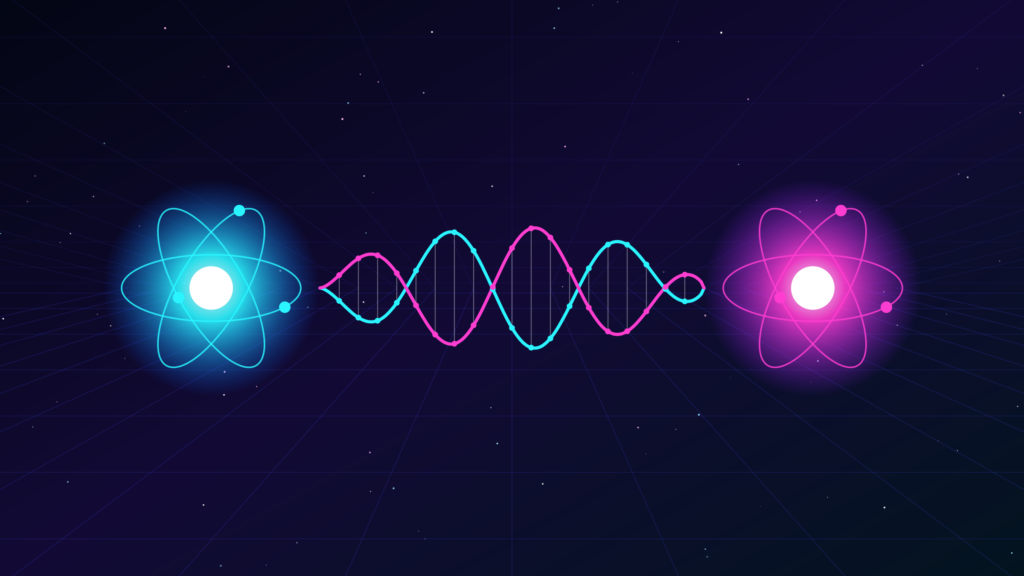
The honest summary is that quantum physics gives proponents a useful vocabulary and a reminder that reality is stranger than everyday intuition suggests. It does not, on its own, demonstrate that consciousness is nonlocal.
Does Consciousness Exist Outside the Brain? Evidence and Perspectives
This is where the discussion becomes most concrete, and where it is most important to separate what has been observed from what has been inferred.
Anomalous experiences that supporters cite
Advocates of nonlocal consciousness often point to experiences that seem hard to fit into a strictly brain-bound model:
- Near-death experiences (NDEs): vivid, often life-changing experiences reported by some people who come close to death. A well-known 2001 study in The Lancet by cardiologist Pim van Lommel and colleagues found that 62 of 344 cardiac arrest survivors, about 18 percent, reported some kind of NDE.
- Terminal lucidity: rare reports of people with severe dementia or other conditions becoming unexpectedly clear and communicative shortly before death.
- Out-of-body perceptions during clinical death: accounts of patients describing events that took place while they were unresponsive.
Supporters argue that coherent awareness during minimal or absent brain activity suggests the mind may have an origin that is not purely neural.
What researchers testing these claims have found
The strongest tests of out-of-body claims have been modest in their results. The AWARE study led by Sam Parnia placed hidden visual targets in resuscitation rooms to see whether patients could report them. Of the roughly 2,000 cardiac arrests studied, very few survivors could be interviewed, and only a small number reported awareness. One verified an auditory event during the arrest, but none identified the hidden images. A follow-up study reported similar difficulties with the visual targets, though it did document that some survivors recalled meaningful experiences.
Mainstream researchers offer alternative explanations: brief surges of brain activity near death (researchers have recorded bursts of high-frequency activity in the dying brains of animals and some human patients), the effects of oxygen deprivation, memory reconstruction after the event, and expectation. Supporters reply that these explanations do not yet account for every reported detail, and that surges of activity are not the same as organized, lucid experience.
Post-materialist science and the 2014 Manifesto
In February 2014, scientists from biology, neuroscience, psychology, medicine, and psychiatry met at a summit in Tucson, Arizona, co-organized by Gary Schwartz and Mario Beauregard of the University of Arizona and Lisa Miller of Columbia University. They discussed the influence of the mechanistic-materialist approach in science and the case for a post-materialist alternative. The meeting produced the Manifesto for a Post-Materialist Science, published in the journal Explore.
A second gathering, the Final Transition Conference, was held in 2015 and organized by researcher Stephan Schwartz. Its participants explored what happens at death and what good end-of-life care looks like. Out of it came a declaration, drafted by Stephan and Gary Schwartz, calling for end-of-life care that takes nonlocal consciousness into account. The declaration cites research areas including near-death experiences, after-death communications, deathbed visions, studies with research mediums, and reincarnation research involving young children. It also claims that seven experimental protocols have produced very strong statistical results.
It is worth being clear about how these claims are positioned. They represent the consensus of the conference participants, not of the wider scientific community, and the declaration itself acknowledges that other consciousness researchers consider the existing evidence insufficient for certainty.
The mainstream response
Many neuroscientists argue that nonlocal consciousness lacks sufficient direct empirical support. Their central objection is the dependable link between brain and mind: damage to particular regions changes particular abilities, anesthesia switches awareness off, and neurological disease gradually alters personality and memory. Organizations such as the Institute of Noetic Sciences continue to investigate non-material models, arguing that some subjective experiences remain hard to explain through standard materialist accounts.
The fair conclusion is that there is no single agreed-upon scientific position. The idea is a live hypothesis for some researchers, an unproven one for others, and a meaningful framework for many people whose traditions and experiences have long pointed beyond the individual brain.
Practical Ways to Explore Nonlocal Consciousness
You do not need to settle the scientific argument to explore the question in your own life. A few approaches are worth considering:
- Treat it as a question, not a creed. Hold the idea with curiosity. Notice what feels true in your experience without demanding that it be proven or disproven.
- Build a regular contemplative practice. Meditation, prayer, and quiet reflection are traditional ways to observe awareness itself, including how thoughts arise and pass. Many practitioners describe a sense of spaciousness that feels larger than the personal self, and they report it honestly as experience rather than as proof.
- Keep a record of your experiences. Journaling intuitions, unusual dreams, or moments of felt connection helps you see patterns over time and separate meaningful signals from wishful thinking.
- Read widely on both sides. Study the research on near-death experiences alongside the neuroscientific critiques. A balanced reader is a better judge.
- Pay attention to how the idea affects your life. Many people find that considering a wider view of consciousness reduces fear of death and deepens compassion. That is a legitimate human outcome, even though it is not scientific confirmation.
Common Misconceptions About Nonlocal Consciousness
“It has been scientifically proven.” It has not. It is a hypothesis with supporting arguments, anecdotal and experimental reports, and significant disagreement among researchers.
“Quantum entanglement proves it.” Quantum nonlocality is a real, Nobel-recognized finding about correlated particles. Linking it to consciousness is an interpretation, not a result.
“It means the brain doesn’t matter.” Even proponents generally accept that the brain is deeply involved in the shape of experience. The disagreement is about whether it is the whole story.
“Believing it requires rejecting science.” Many researchers who explore it want more rigorous testing, not less. Skeptics and proponents alike benefit from clear evidence.
“It belongs to one religion or worldview.” The core idea appears in many philosophical and spiritual traditions, and the post-materialist framing is explicitly non-sectarian.
Holding the Question Open
Nonlocal consciousness sits at the edge of what science, philosophy, and lived experience can currently explain. It asks whether the brain is the author of awareness or one of its instruments, and honest researchers on every side admit that the answer is not yet known. Exploring it with curiosity, rigor, and respect for different traditions is a reasonable way to live with an unresolved question.
For daily insights on consciousness, clarity, and trusting yourself, explore Bahlon’s free daily transmissions. Subscribe here to receive them.
Related Readings:
If you are curious about related territory, you might continue with our guide to:
- Near-Death Experiences: What Science Actually Says
- The Hard Problem of Consciousness, Explained Simply
- Can Meditation Trigger a Spiritual Awakening?
Frequently Asked Questions
What is nonlocal consciousness in simple terms?
It is the idea that your awareness is not strictly locked inside your brain and may be part of something broader that is not limited by distance or time.
Is nonlocal consciousness real?
It is not an established scientific fact. It is a hypothesis that some researchers find promising and others consider unsupported, and the evidence is still debated.
Can consciousness exist outside the brain?
Mainstream neuroscience says the evidence overwhelmingly ties consciousness to brain activity. Proponents of nonlocal consciousness point to near-death experiences, terminal lucidity, and other anomalies as reasons to keep the question open. No experiment has yet settled it.
What is the difference between local and nonlocal consciousness?
Local consciousness is awareness produced in and limited to the brain and the present moment. Nonlocal consciousness is awareness that may extend beyond the brain, space, and time.
What does it mean when people say the universe is not locally real?
It refers to experiments in quantum physics showing that no theory based on local influences and pre-existing properties can explain certain correlations. It is a statement about physics, not directly about consciousness.