Waking up at 3 AM carries many spiritual interpretations, from a thinning boundary between worlds to a call to pray or reflect, while sleep science points to natural sleep cycles, rising cortisol and stress. These explanations are not mutually exclusive, and which one fits depends on your beliefs, your habits and what is happening in your life. What follows separates tradition from evidence so you can weigh each perspective for yourself.
What Waking Up at 3 AM Means Spiritually
The hour just after three in the morning has long attracted symbolic meaning. Part of the reason is practical: it sits in the deepest, quietest stretch of the night, when the world is dark and your mind has fewer distractions. Different traditions have filled that silence with different stories.
The Witching Hour and the Devil’s Hour
In Western folklore, the hours after midnight were considered a time when the boundary between the physical and supernatural worlds grew thin. Spirits, witches and other unseen forces were believed to be at their strongest. The exact timing of the witching hour varies by tradition. Some place it at midnight, while others place it between 3 AM and 4 AM.
Shakespeare gave the idea literary weight in Hamlet, written in the early 1600s, where the prince describes night as a time when dark forces stir. Some Christian folk traditions go further and call 3 AM the devil’s hour, reasoning that it mirrors 3 PM, the hour traditionally associated with the death of Jesus.
These are beliefs rooted in folklore and religious symbolism. They are not supported by scientific evidence, and they are not shared by every culture. Many traditions treat the night as peaceful, or even sacred.
Spiritual Awakening and Inner Transformation
In modern metaphysical and New Age communities, waking up at 3 AM is often read as a sign of inner change. People who hold this view describe the experience as a shift in personal energy, a period of spiritual growth, a heightened sense of intuition, or an attempt by guides or ancestors to communicate. Some use the term “ascension symptoms” for such experiences.
These readings are experiential and belief-based. They can be personally meaningful, and many people find real value in them, but they are not established explanations for nighttime awakenings. Waking at this hour does not automatically mean you are undergoing a spiritual awakening or receiving a message.
Angel Number 333 and Waking at 3:33 AM
Numerology and angel-number traditions give special attention to repeated digits. In these systems, 333 is commonly associated with alignment, creativity, personal growth and spiritual development. Someone who often wakes at 3:33 AM may take it as a nudge to return to a creative project or reconnect with their path.
As with other symbolic frameworks, this is an interpretation. It offers a lens for reflection rather than proof that a message is being delivered.
A Quiet Window for Intuition and Dreams
Several contemplative traditions regard the small hours as an especially receptive time. The house is still, the mind is less cluttered, and dreams may feel unusually vivid. Practitioners often describe this window as suited to meditation, noticing intuitive feelings and paying attention to dream imagery. Again, this reflects personal and traditional experience rather than a measured effect of the clock.
Waking Up at 3 AM in Christian and Chinese Medicine Traditions
Two older frameworks interpret the hour in more structured ways, and both offer a gentler reading than folklore about dark forces.
Christian Prayer and the Fourth Watch
In some Christian traditions, waking up at 3 AM is understood as an invitation rather than a warning. The period from roughly 3 AM to 6 AM corresponds to what Scripture calls the fourth watch of the night. Believers who hold this view may use the time to pray, read Scripture, seek guidance or intercede for family and friends.
For them, a sleepless hour becomes a moment of devotion instead of dread. This interpretation depends on individual faith and is not a universal Christian teaching.
The Traditional Chinese Medicine Body Clock
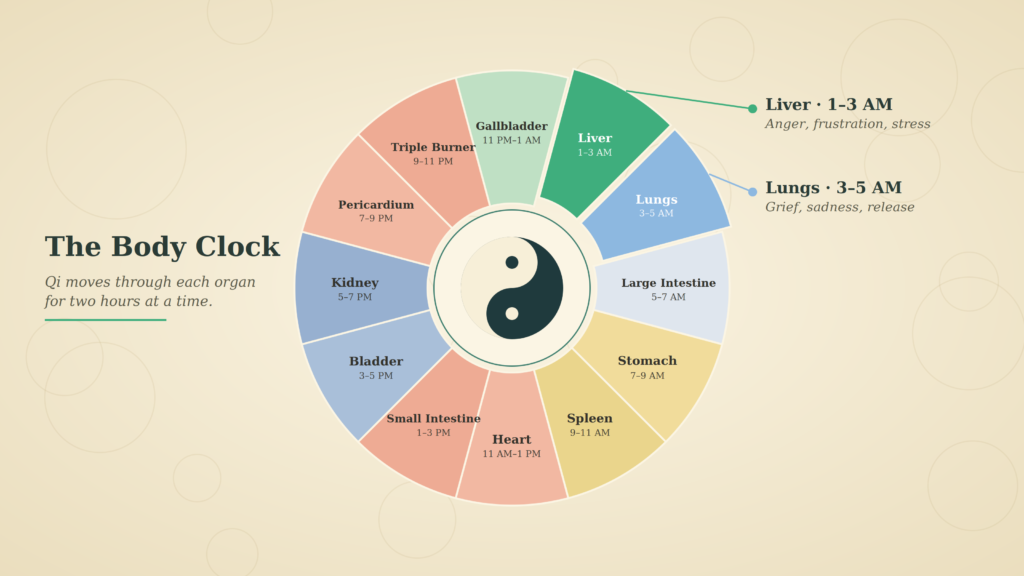
Traditional Chinese Medicine (TCM) describes qi, or vital energy, moving through different organs in two-hour windows across the day and night. Each window is associated with particular organs and emotions.
The period from 1 AM to 3 AM is linked to the liver, which TCM connects with anger, frustration and stress. Waking in that window is traditionally read as a sign of unresolved emotional tension. The period from 3 AM to 5 AM belongs to the lungs, which TCM connects with grief, sadness and emotional release. Waking then may be seen as a prompt to acknowledge feelings that have not been fully processed.
These associations belong to the TCM framework, which has a long history and many dedicated practitioners. They should not be mistaken for medically established explanations of why people wake at a given time.
Why You Keep Waking Up at 3 AM: What Sleep Science Says
If you have been asking “why do I keep waking up at 3 AM,” biology offers several well-documented answers. They can also explain why waking up in the middle of the night feels so common.
Natural Sleep Cycles
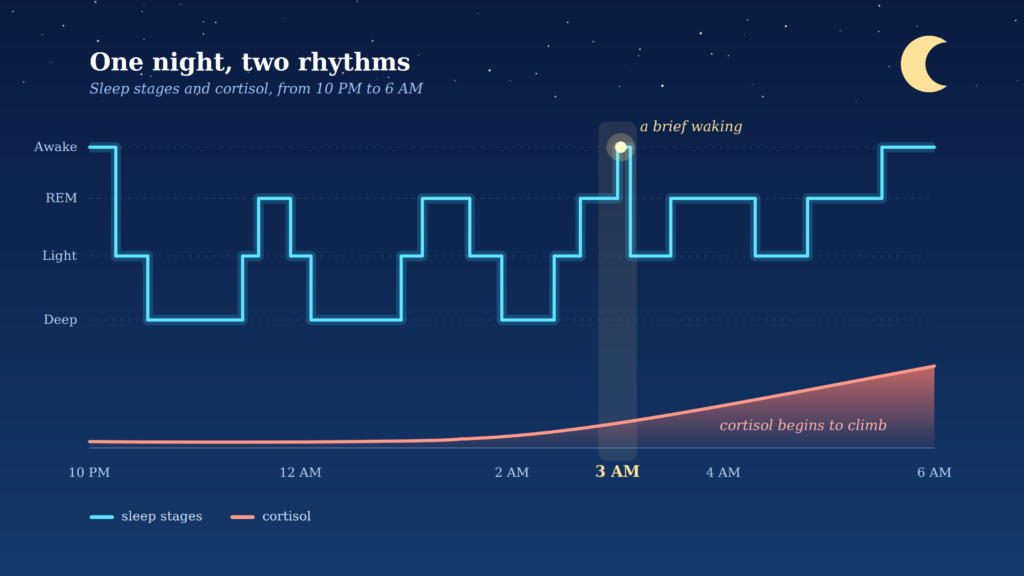
Sleep moves through repeating cycles of roughly 90 minutes, shifting between lighter and deeper non-REM stages and REM sleep. As the night goes on, you spend proportionally more time in REM and lighter sleep. These transitions are natural points at which brief awakenings occur. Most of the time you drift back off without remembering it, but at 3 AM the conditions for staying awake can be stronger.
Cortisol, Stress and Anxiety
Cortisol, a hormone tied to the stress response and the body’s daily rhythm, begins to rise in the early morning hours as the body prepares for waking. For someone under heavy stress, this normal rise may be enough to tip a light sleep into wakefulness. Anxiety also makes it harder to fall back asleep, because worries tend to feel louder in the dark.
This is why waking up at 3 AM does not necessarily point to a spiritual event. It may simply reflect the body’s rhythm meeting a busy mind.
Lifestyle Factors
Everyday habits can fragment sleep and make nighttime awakenings more likely:
- Caffeine late in the day, which can linger in the body for hours
- Alcohol, which may help you fall asleep but often disrupts sleep later in the night
- Heavy late meals, which can interfere with comfortable rest
- Screen light, since the blue light from phones and computers may affect sleep patterns
If you wake at other times, such as 4 AM, or find yourself waking every two hours, the same factors often apply, along with others such as room temperature, noise and bedtime consistency.
When Waking in the Night Was Normal: The History of Biphasic Sleep
Our expectation of a single, unbroken night of sleep is more recent than many assume. Before electric lighting became widespread, people in some historical societies practiced biphasic sleep. Historian Roger Ekirch gathered extensive references to “first sleep” and “second sleep” in European records.
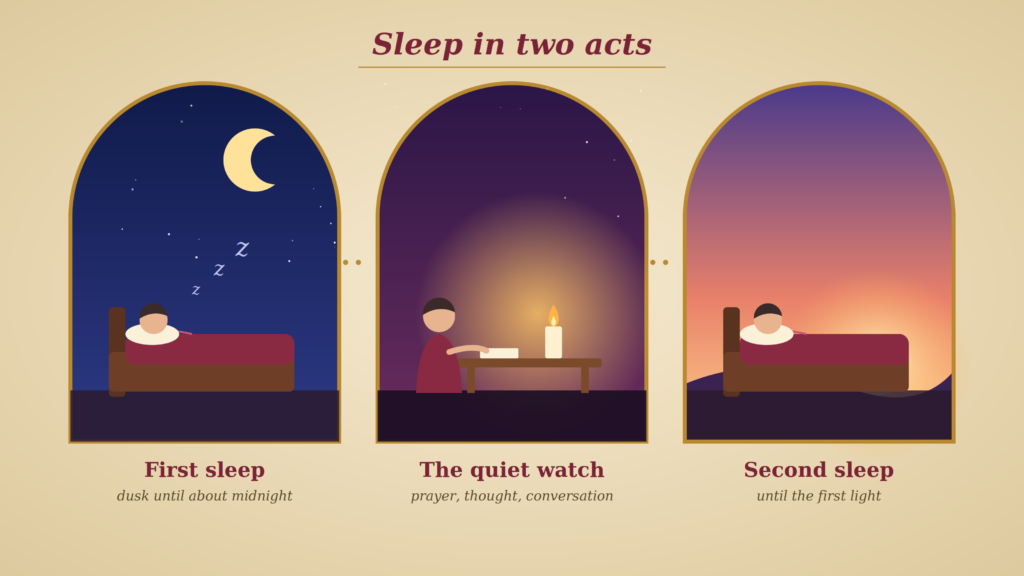
The pattern often looked like this:
- First sleep: People went to bed after dusk and woke around midnight.
- A waking interval: They stayed up for a few hours, sometimes praying, talking, doing household tasks or reflecting on dreams.
- Second sleep: They returned to bed until morning.
For many, that quiet interval was a recognized part of the night, often used for prayer or contemplation. This history suggests that waking up in the middle of the night has not always been seen as abnormal, and it may help explain why so many spiritual traditions treat these hours as meaningful.
What to Do When You Keep Waking Up at 3 AM
Whether you see the experience as spiritual, biological or both, there are gentle ways to meet it. None of these are required responses to a supernatural event. They are options.
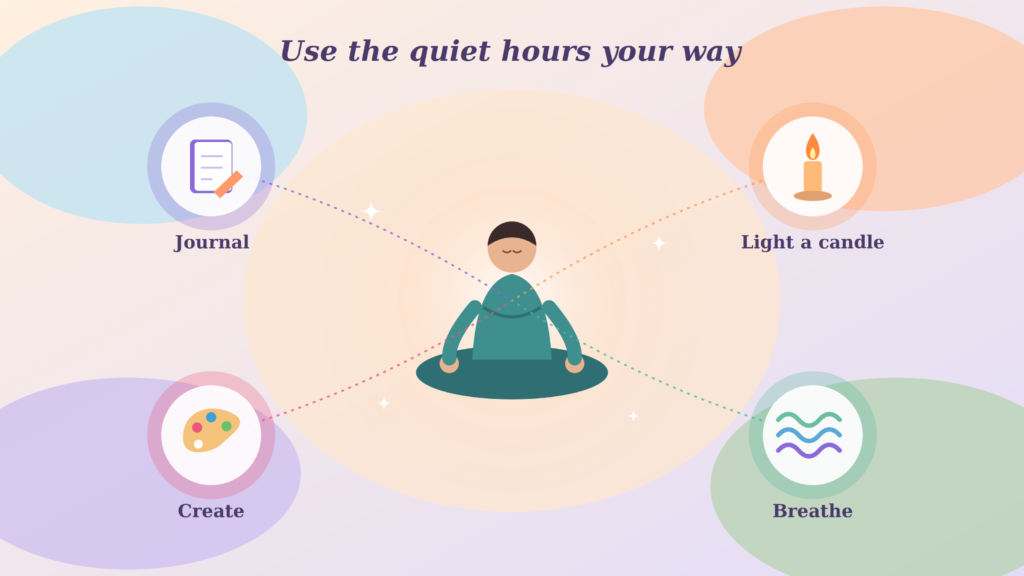
Try a short meditation. Sitting quietly and observing your thoughts without chasing them can help you feel grounded and may ease the return to sleep.
Write it down. Journaling worries, feelings or dream fragments gets them out of your head and onto the page. Many people find this lets the mind settle.
Light a candle or pray. If ritual is meaningful to you, a simple candle, a prayer or a few lines of Scripture can turn a restless hour into a calm one.
Use the time creatively. In numerological tradition, the number three is associated with creativity. Whatever you believe about that, the stillness can suit writing, sketching or other pursuits that are hard to fit into a busy day.
Look at your habits. Consider your caffeine timing, evening alcohol, late meals and screen use. Keeping your lights low and avoiding your phone during a night waking can also help.
If waking up at 3 AM happens most nights, leaves you exhausted, or comes with loud snoring, pauses in breathing, low mood or persistent anxiety, it is worth speaking with a doctor or sleep specialist. A medical check-in does not conflict with a spiritual interpretation. Many people find that attending to both leads to the clearest picture.
Is Waking Up at 3 AM a Bad Sign?
Not necessarily. Folklore about the devil’s hour is one tradition among many, and other perspectives connect the same hour with prayer, intuition, inner growth or emotional release. From a practical standpoint, an occasional night waking is not a dark omen, and it is not automatically chronic insomnia.
A useful approach is to avoid rushing to a single conclusion. Consider your own beliefs, your emotional state, your sleep habits and what is going on in your life. You can honor a spiritual reading while also respecting biology. The two can sit side by side. At its core, waking up at 3 AM is an invitation to pay attention, and what you do with that attention is yours to decide.
For daily insights on consciousness, clarity, and trusting yourself, explore Bahlon’s free daily transmissions.
Related Articles:
- Unlocking the Mysteries of Waking Up at 3 AM
- Sleep Paralysis: Spiritual Meaning vs. Scientific Explanation
Frequently Asked Questions
What does it mean when you wake up at 3 AM?
Spiritually, it may be read as the witching hour, a prompt to pray, a sign of inner transformation or a reminder linked to angel number 333, depending on the tradition. Scientifically, it often reflects natural sleep cycles, early-morning cortisol changes, stress or lifestyle habits.
Why do I wake up at 3 AM every night?
Waking at the same time repeatedly often points to a pattern, such as stress, anxiety, alcohol, caffeine or an irregular schedule. Some people also find meaning in the repetition spiritually. If it is persistent and affecting your daytime functioning, consider talking with a healthcare provider.
Is waking up at 3 AM a spiritual awakening?
For some people, yes, within their belief system. It is not a proven sign, and waking at this hour does not automatically mean you are having a spiritual awakening or receiving a divine message.
Why do I keep waking up at 4 AM or every 2 hours?
Early-morning awakenings can come from the same causes as 3 AM ones, including lighter sleep late in the night, stress, alcohol, noise or temperature. In TCM, the 3 AM to 5 AM window is associated with the lungs and grief. Waking every two hours may suggest fragmented sleep worth discussing with a professional.
Was it normal to wake up in the middle of the night in the past?
Yes. Historical records point to biphasic sleep in some societies, with a first sleep, a waking period and a second sleep. People often used the interval for prayer, reflection or quiet conversation.