Why do I get goosebumps for no reason? In most cases, the body is responding to an emotion, a flicker of stress, or a small shift in the nervous system that you did not consciously register. Some traditions read these moments as spiritual signals, while medicine points to a short list of physical explanations worth knowing about.
Both views deserve a fair hearing. This guide walks through what is physically happening in your skin, seven possible causes, the spiritual meanings people have attached to sudden chills across traditions, and the signs that suggest it is time to talk to a professional.
Why Do I Get Goosebumps for No Reason? How Goosebumps Actually Work
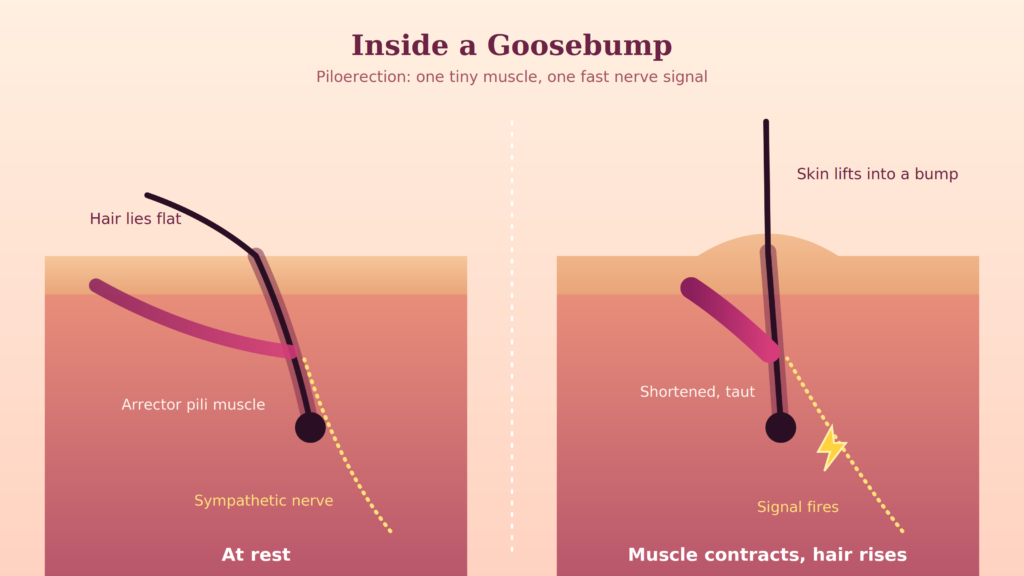
The medical terms for goosebumps are piloerection and horripilation. Each hair on your body sits in a follicle, and at the base of that follicle is a tiny muscle. When the sympathetic nervous system, the branch responsible for rapid, automatic responses, signals those muscles to contract, the hair stands upright and the skin around it rises into a small bump.
In our evolutionary past, this reaction had practical value. Raised hair trapped warmth against the body and made an animal look larger to a threat. Humans have far less body hair, so the response is largely vestigial, yet the wiring remains. That is why you can feel goosebumps for no reason at all, with no draft in the room and no obvious trigger.
The key point is that the nervous system reacts to more than temperature. It also responds to emotion, anticipation, and sensory surprise, and it does so faster than conscious thought. Often the trigger has passed before you notice it.
7 Possible Causes of Goosebumps for No Reason
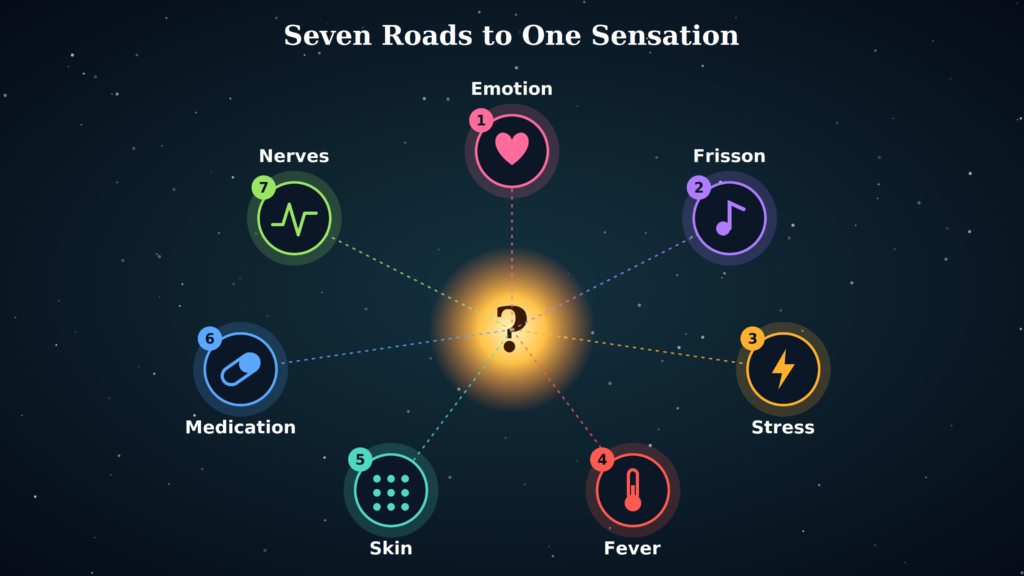
If you keep getting goosebumps for no reason, these seven explanations cover most of what researchers and clinicians describe.
1. Intense Emotions
Strong feelings are among the most common triggers. Awe, fear, shock, anxiety, love, and deep inspiration can all release adrenaline and activate the autonomic nervous system, which raises the hair on your skin. Because emotions can build quietly, the chills may seem to arrive from nowhere even though something internal set them off.
2. Frisson, or Aesthetic Chills
Frisson is a French word for a shiver, and researchers use it for the chills people feel in response to moving music, a powerful speech, or a striking piece of art. Many describe it as pleasurable, and some even call it a skin orgasm.
Research suggests frisson is linked to the personality trait Openness to Experience, which reflects an appreciation for feelings, imagination, and new ideas. A study published in Psychology of Music assessed 100 college students and found that those who experienced aesthetic chills scored higher on that trait. Estimates cited in the literature suggest that roughly 55% to 86% of people experience these chills at some point.
3. Subconscious Stress and the Fight-or-Flight Response
Your body is constantly scanning for threat, often below awareness. A sudden rise in alertness, a tense atmosphere, or a faint sense that something is off can trigger the fight-or-flight response. Goosebumps are one of its visible signs. When the trigger is subtle, the reaction can feel unexplained, even though your nervous system had a reason.
4. Fever or Illness
When your body fights an infection, it raises its temperature set point. Until the rest of you catches up, you can feel cold and develop chills, shivering, and goosebumps. These feel different from emotional chills. They tend to come with achiness, fatigue, or a sense of being unwell, rather than a lift of feeling.
5. Keratosis Pilaris
Keratosis pilaris is a harmless and very common skin condition that creates rough, small bumps, usually on the upper arms or thighs. It can look like goosebumps that never go away. The difference is persistence: true goosebumps fade within minutes, while keratosis pilaris bumps stay visible for long stretches. If your bumps are always there, this may be the explanation.
6. Medication Effects or Substance Withdrawal
Some medications, including certain antidepressants and stimulants, can cause chills or goosebumps as a side effect. Stopping a substance or medication can do the same by changing nervous system activity. If the sensations began after you started, changed, or stopped something, mention it to your prescriber rather than adjusting anything on your own.
7. Neurological or Autonomic Triggers
Less commonly, persistent and unexplained goosebumps can be associated with neurological or autonomic conditions. Examples that appear in medical references include temporal lobe epilepsy, multiple sclerosis, and autonomic dysreflexia. These are uncommon explanations, and goosebumps alone rarely point to them. They matter mostly when the chills are constant or arrive alongside other unusual symptoms.
Spiritual Meanings of Goosebumps Without a Clear Cause

Across spiritual, metaphysical, and holistic traditions, sudden chills are often treated as meaningful. People call them spiritual chills, psychic chills, or godbumps. These readings are experiential and traditional rather than scientifically established, and they differ from one belief system to another. They are offered here as the interpretations practitioners describe, not as proven facts.
A Sense of Presence or Spiritual Connection
Many people interpret sudden goosebumps as a sign that a guide, guardian angel, or loved one who has passed is nearby. In this reading, the chill carries comfort, protection, or a reminder that you are not alone.
Inner Validation and Alignment
A common interpretation treats goosebumps as the body’s version of a yes. You might feel them while considering a major decision, hearing words that resonate, or realizing something true about your life. Practitioners often describe this as a signal that a thought or path feels aligned with your authentic self.
Heightened Intuition and Clairsentience
Clairsentience refers to the ability to sense information through feelings or physical sensations. People who identify with it often describe goosebumps as a response to the emotional or energetic atmosphere of a person or place, a kind of inner compass registering subtle impressions.
A Premonition or Coming Change
Some traditions suggest chills can appear before a significant life change, as if the subconscious or the energy field senses a shift before the conscious mind does. This is a spiritual interpretation, and it is not a scientifically established way of predicting events.
Energetic Clearing and Emotional Release
In many holistic frameworks, goosebumps accompany the release of stagnant energy, the loosening of an emotional block, or a reaction to an environment that feels unusually charged. Here the sensation symbolizes transformation or a change in energetic balance.
Spiritual Chills and the Authentic Self
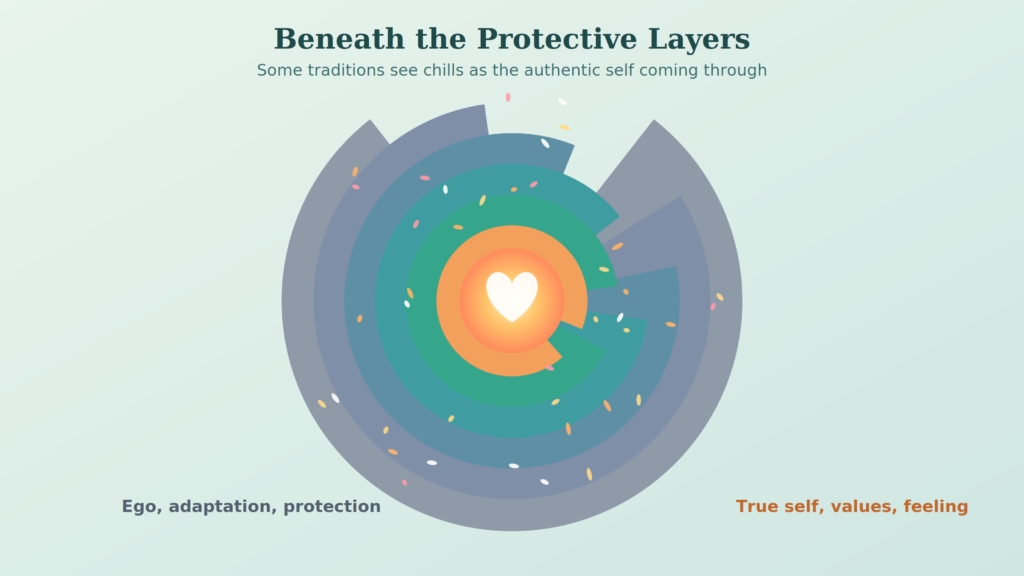
One perspective connects goosebumps to the relationship between emotion and identity. The idea is that we begin life close to our true selves, then build a protective ego to guard against emotional pain. During a spiritual awakening, people start questioning whether their choices reflect who they genuinely are. Chills, in this view, are moments when you feel particularly close to that authentic self, such as when a song, an idea, or a decision lands with unusual depth.
It is worth adding one honest caveat that thoughtful practitioners often share themselves: a goosebump alone cannot confirm that you are on the right path. It is an invitation to notice, not a verdict.
What the Research Says About Spiritual Chills
The physical sensation behind a spiritual chill can be studied even when its spiritual meaning cannot. The frisson research above shows a real link between emotional responsiveness and aesthetic chills. People who are more open to feeling and imagination tend to experience them more readily.
What the research does not do is settle the larger question. It does not show that goosebumps are messages from spirit guides, evidence of psychic ability, or proof of energetic change. It also does not rule those experiences out. Science describes the body’s mechanism, while spiritual traditions describe the meaning people find in it. Many people hold both at once: the chill is a nervous system event, and it is also a moment worth paying attention to.
The available evidence does not offer a single definitive explanation for every experience described as a spiritual chill, and that honesty is a good starting point for anyone exploring them.
Why Some People Get Chills and Others Do Not
Not everyone experiences frisson. If you rarely get goosebumps at a moving concert or a powerful speech, that does not mean you are less intuitive, less emotional, or less spiritually connected. Responses vary widely between individuals, shaped by personality, attention, mood, and context.
Researchers sometimes test for frisson using emotionally powerful music, which tends to produce chills in people who are highly responsive to it. The same song can move one listener to tears and leave another calm. Neither response tells you anything about the depth of your inner life. Spiritual connection can show up as stillness, clarity, or a quiet sense of rightness just as easily as through the skin.
When Frequent Goosebumps for No Reason Need a Doctor
Occasional goosebumps are normal. Persistent or unexplained episodes should not be automatically attributed to spiritual causes. Consider seeing a medical professional if you have frequent goosebumps for no reason that occur constantly without a clear trigger, or if they come with any of the following:
- Severe headaches
- Dizziness
- Fainting
- Other neurological symptoms, such as numbness, vision changes, or unusual sensations
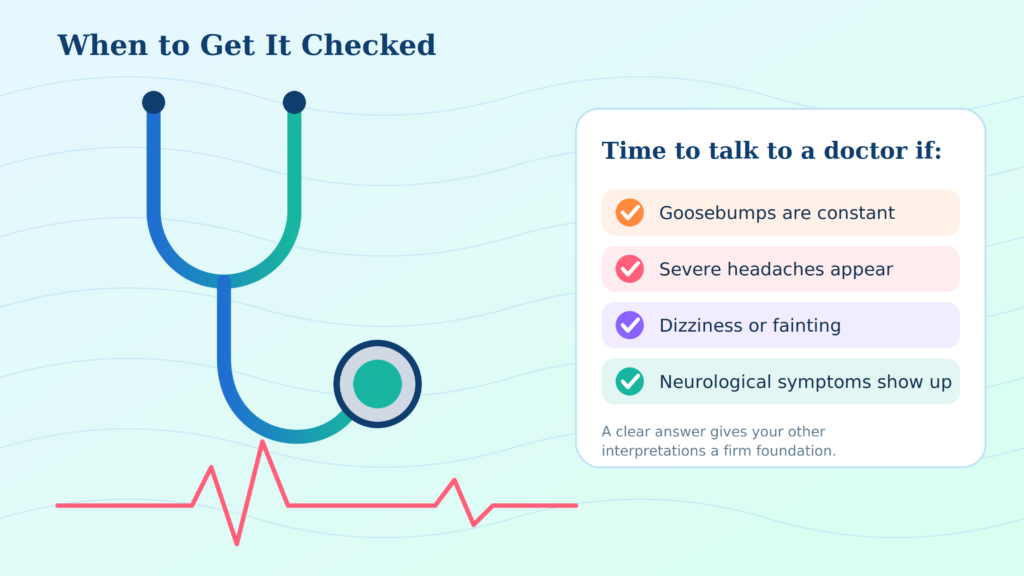
Fever, illness, medication effects, withdrawal, and neurological or autonomic conditions are all part of the picture a clinician will consider. Ruling out a physical cause does not take anything away from a spiritual interpretation. It simply gives you a clearer foundation.
How to Respond the Next Time It Happens
Whether you read your chills spiritually, scientifically, or both, a few simple habits can help you make sense of them.
- Pause and notice. What were you thinking, hearing, or feeling in the seconds before? The trigger is often an emotion or a thought.
- Keep a short log. A few notes on time, setting, mood, and thoughts can reveal patterns over a couple of weeks.
- Check the practical factors. Consider your temperature, any illness, recent medication changes, caffeine, and sleep.
- Stay curious about meaning. If a spiritual reading resonates, hold it with openness rather than certainty. You can explore it through reflection, meditation, or deepening your intuition without needing it to be proven.
- Escalate when needed. If the sensations are constant, one-sided, or paired with other symptoms, seek medical advice.
If you are curious about related experiences, our articles on what a spiritual awakening feels like and How to Trust Yourself When Life Feels Uncertain offer further perspective.
For daily insights on consciousness, clarity, and trusting yourself, explore Bahlon’s free daily transmissions. Subscribe here.
Frequently Asked Questions
Why do I get goosebumps for no reason when I am not cold?
Goosebumps are triggered by the sympathetic nervous system, which responds to emotion, stress, and sensory input as well as temperature. A passing thought, a memory, or a subtle change in your surroundings can set it off before you consciously notice.
Why do I keep getting goosebumps on one leg for no reason?
Localized goosebumps are often caused by a small, local trigger such as a draft, clothing contact, or a skin condition like keratosis pilaris. If they affect only one leg repeatedly and come with numbness, weakness, or pain, have it checked by a clinician.
Are sudden goosebumps a sign of something spiritual?
Some traditions interpret them as signs of presence, intuition, or alignment. These are personal and traditional interpretations rather than scientific conclusions. Many people find value in the experience while also recognizing the physical explanations.
Are chills and goosebumps for no reason dangerous?
Usually not. They are most often tied to emotion, stress, or mild illness. Seek medical care if they are persistent or accompanied by severe headaches, dizziness, fainting, or neurological symptoms.
Why do I always get goosebumps from music?
This is frisson. Research links it to Openness to Experience, and estimates suggest a majority of people feel it at least occasionally. Not feeling it is also completely normal.