The spiritual meaning of seeing a rainbow most often centers on hope, renewal, and the feeling of being accompanied by something larger than yourself. Across cultures and faiths, a rainbow is read as a sign that a hard season is easing, that a promise is being kept, or that the boundary between the visible and invisible worlds has briefly thinned. These readings are traditional and personal rather than scientifically proven, yet they have endured for thousands of years because they speak to something people genuinely feel.
What Does Seeing a Rainbow Mean Spiritually?
If you have ever stopped mid-sentence to look at a rainbow, you already know that the experience is not purely visual. Something shifts. The question “what does it mean when you see a rainbow” is really a question about that shift, and spiritual traditions offer several overlapping answers.
Hope after hardship. A rainbow appears when light returns while rain is still falling. That timing is the heart of its symbolism. Many people read it as a sign that a difficult chapter, whether grief, illness, financial strain, or heartbreak, is beginning to clear. It does not promise that the storm never happened. It suggests that light and difficulty can exist in the same sky.
Divine presence and reassurance. Seeing a rainbow is frequently interpreted as a message from God, angels, spirit guides, or a loved one who has passed. People who hold this view often describe a quiet sense of being seen, as though their private struggle had been noticed.
Renewal and awakening. Some people take unexpected or repeated rainbow sightings as a marker of inner change, a sign that their awareness is deepening or that a new phase of personal growth is opening. This is an experiential interpretation, and its value lies in the attention it invites rather than in any external proof.
Protection, peace, and promise. In several religious traditions the rainbow carries the weight of a covenant, a sacred agreement between the human and the divine. We will look at those traditions more closely below.
Notice that none of these meanings contradict one another. Most people who ask what seeing a rainbow signifies find that more than one reading resonates, and which one fits tends to depend on what they were carrying when the rainbow appeared.
How a Rainbow Forms, and Why It Feels Sacred
Understanding the physics does not have to cancel the wonder. In fact, many people find that it deepens it.
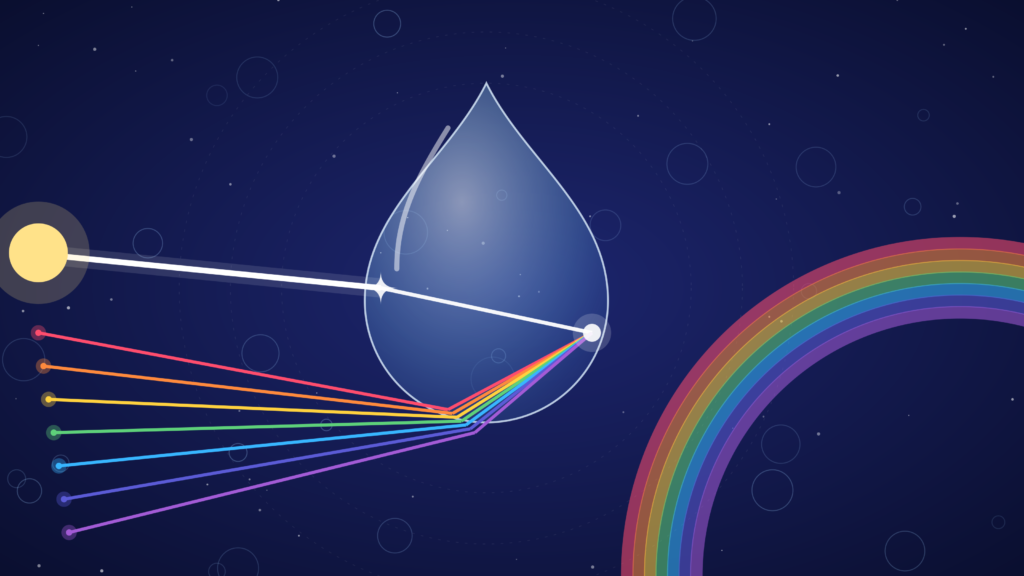
A rainbow forms when sunlight enters millions of tiny raindrops, bends as it slows down inside the water, reflects off the back of each drop, and bends again as it exits. Because each color of light bends at a slightly different angle, white sunlight is spread into its spectrum. Descartes worked out the geometry of this in the seventeenth century, and Newton later showed that white light is itself a blend of colors.
There are two details worth noticing. First, a rainbow is not an object in a fixed place. Every observer sees their own rainbow, formed by a different set of raindrops, which is why no two people stand under exactly the same one. Second, the bow always appears opposite the sun, at roughly 42 degrees from the line running from the sun through your head. You can never reach its end because it moves as you move.
Some readers find a quiet spiritual idea in those facts. The rainbow you see is, quite literally, yours. It exists only from where you stand. That fits neatly with the way many traditions describe a sign: not a universal broadcast, but something that meets a particular person at a particular moment.
There is also research on why such moments land so deeply. Psychologists studying awe, including the work of Dacher Keltner and Jonathan Haidt, describe it as the emotion we feel in the presence of something vast that stretches our usual sense of self. Studies have linked awe to greater humility, a stronger sense of connection to others, and improved well-being. A rainbow, sudden and luminous and gone within minutes, is a reliable trigger for exactly that state.
The Spiritual Meaning of Seeing a Rainbow Across Traditions
The spiritual meaning of seeing a rainbow varies in detail from culture to culture, but the underlying theme of connection between worlds appears again and again.
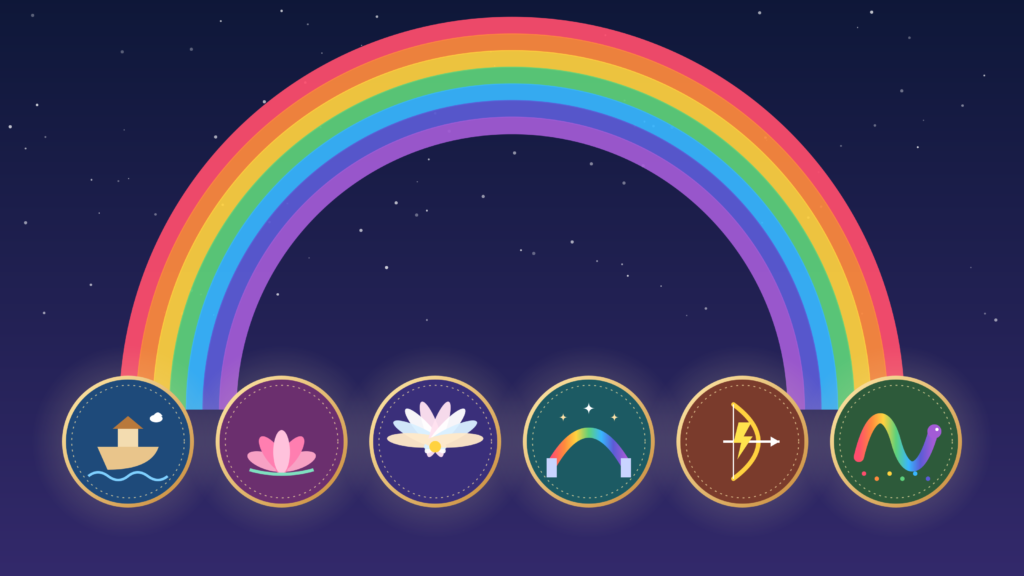
Judeo-Christian tradition. In the Book of Genesis, the rainbow is set in the clouds as a sign of God’s covenant with Noah after the flood, a promise never again to destroy the earth by water. For many believers, a rainbow is therefore a symbol of mercy, faithfulness, and protection, a reminder that divine promises hold even when circumstances look bleak.
Tibetan Buddhism. In Dzogchen teachings, the “rainbow body” describes a rare state of realization in which, according to tradition, the physical body of an accomplished practitioner dissolves into light at death. Here the rainbow is not a sign about circumstances but a picture of full spiritual attainment, the transformation of the ordinary into the luminous.
Greek and Roman tradition. The goddess Iris personified the rainbow as a messenger who travelled between the gods and humankind. The image of a bridge carrying communication from the divine to the human is one of the oldest rainbow meanings on record.
Norse tradition. The rainbow bridge Bifröst connected the human world to the realm of the gods, guarded so that only the worthy could cross.
Hindu tradition. The rainbow is known as Indradhanush, the bow of Indra, the deity associated with rain and storms. It carries associations of divine power and of the fertility that follows rainfall.
Aboriginal Australian traditions. In many Aboriginal Australian cultures, the Rainbow Serpent is a creator being linked to water, land, and life. Accounts differ widely between nations, and they are best understood in the words of the communities who hold them.
Different languages, different stories, and a strikingly consistent instinct: the rainbow is a bridge, a promise, or a messenger. Whether you read that as shared human psychology, as echoes of a genuine spiritual reality, or as both, it is a remarkable convergence. If you are curious about how other natural signs are interpreted, you might also enjoy this exploration of symbolic meaning in nature.
What Does It Mean When You See a Double Rainbow?
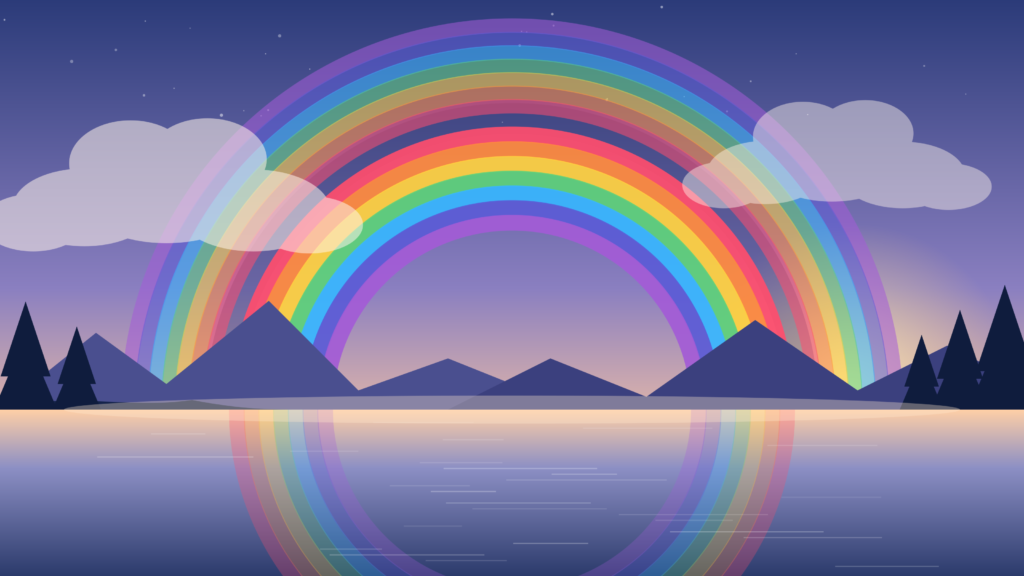
“What does seeing a double rainbow mean?” is one of the most searched questions on the topic, and it has both a scientific and a spiritual answer.
Scientifically, a double rainbow occurs when light reflects twice inside the raindrops. The second, fainter bow appears outside the primary one, at roughly 51 degrees, and its colors are reversed, with red on the inside. Between the two arcs, the sky often looks noticeably darker. This region is called Alexander’s dark band, named after the Greek philosopher Alexander of Aphrodisias, who described it nearly two thousand years ago.
Spiritually, seeing two rainbows is commonly read as an amplified message. People who hold this view describe it as double blessing, double luck, or a sign that a significant change is arriving. Others see it as a doorway, a moment when the physical and spiritual worlds feel unusually close. When someone asks what it means to see two rainbows, the most honest answer is that the traditional reading is one of strong encouragement, while the specific meaning is something each person discerns for themselves.
A helpful approach is to ask what was alive in your life at that moment. A double rainbow that appears while you are weighing a decision, grieving, or starting over tends to be read in light of that very situation. The sign is general, and the meaning is personal.
Seeing a Rainbow After Loss or During a Hard Season
Two situations draw people to the spiritual meaning of seeing a rainbow more than any others: grief and crisis.
After the death of a loved one. Many bereaved people report seeing a rainbow shortly after a loss and feeling comforted, as though the person they loved were offering reassurance of peace. Whether or not one believes this is communication from the departed, the experience is widely reported and deeply meaningful to those who have it. Grief researchers have also noted that maintaining an ongoing inner bond with the deceased, an idea often called continuing bonds, is a common and often healthy part of mourning. A rainbow can become a touchstone for that bond.
It is worth saying plainly that these interpretations reflect belief and personal meaning rather than established proof of contact with the dead. That does not make them less valid as sources of comfort. It simply places them where they belong, in the realm of faith and lived experience.
During a personal crisis. One account that illustrates this well comes from a woman named Kathy, who was running a mortgage training business in the 1990s when rising interest rates cut deeply into demand. Under heavy financial stress, she took a trip to Texas to clear her head. On the flight home, a small commuter plane was thrown around by a thunderstorm, and she found herself so low that the danger barely frightened her. When the turbulence eased, she felt compelled to look out the window, where the clouds had parted to reveal a rainbow so close it seemed within reach. She described hearing a voice tell her that everything was going to be just fine.
Kathy understood this as a message from God. Within weeks, a former student invited her to teach in New York, which led to classes around the country and a significantly higher income than before. She later reflected that had her Atlanta business stayed busy, she might never have said yes to the opportunity. She also drew on a verse from Romans, which says that all things work together for good for those who love God.
This is one person’s testimony, and it should be read as exactly that. It is not evidence that a rainbow predicts business success. What it does capture is the emotional pattern that so many people describe: a moment of feeling less alone, followed by renewed willingness to act. Whether you attribute that to divine intervention or to a shift in outlook, the practical effect, an open and hopeful posture toward what comes next, is the real gift. For more on this kind of inner shift, see our piece on trusting your intuition during uncertain times.
How to Respond When You See a Rainbow
The spiritual meaning of seeing a rainbow becomes most useful when it prompts a response rather than only a reaction. Here are a few simple ways to meet the moment.
Pause fully. Rainbows are brief. Give it a minute of undivided attention, without reaching for your phone first. Let yourself feel whatever arises, whether that is relief, sadness, gratitude, or simple delight.
Notice what you were thinking. Many people find that the thought they were holding just before the rainbow appeared is the one that deserves attention. Ask yourself gently what question was open in you.
Offer thanks or a quiet intention. Whether through prayer, a silent word of gratitude, or a simple intention for the days ahead, marking the moment helps it settle into memory rather than slipping away.
Write it down. Record the date, the setting, and what was on your mind. Over time, a record like this can reveal patterns in your own life that no single sighting could.
Hold the meaning lightly. The most grounded approach is to let the experience inform you without demanding that it predict anything. A sign can be an invitation to trust, to act, or to rest, and you remain the one who decides what to do with it. If you want a deeper practice for this kind of attentiveness, our guide to mindful awareness in daily life is a good place to begin.
Common Misconceptions About Rainbow Symbolism
“A rainbow is a guaranteed omen.” Traditions describe rainbows as signs of hope and promise, but they do not describe them as forecasts. Treating one as a guarantee can create disappointment, while treating it as encouragement tends to serve people better.
“If you see no rainbow, you are missing a message.” Rainbows depend on sun angle, weather, and where you happen to be standing. Their absence says nothing about your spiritual standing.
“Science and spiritual meaning are in conflict.” They answer different questions. Optics explains how a rainbow forms. Spiritual traditions address what the experience means to the person having it. Many people comfortably hold both.
“There is only one correct meaning.” The variety across cultures shows otherwise. A rainbow can be a covenant to one person, a messenger to another, and a symbol of realization to a third. Each reading is part of a rich shared heritage.
For daily insights on consciousness, clarity, and trusting yourself, explore Bahlon’s free daily transmissions.
Related Readings:
- Physical Symptoms of Spiritual Awakening
- What Does It Mean When a Butterfly Lands on You?
- Mindfulness in Action: 10 Practical Ways to Bring Mindful Awareness to Daily Life
Frequently Asked Questions
What does it mean when you see a rainbow?
Physically, it means sunlight is passing through rain or mist at the right angle. Spiritually, it is most often interpreted as a sign of hope, reassurance, and renewal, particularly after a difficult period.
What does seeing a rainbow mean spiritually when you are grieving?
Many people find it comforting and interpret it as a sign of peace or the lasting presence of a loved one. This is a matter of personal belief and meaning rather than scientific proof, and it can be a genuine source of solace.
What does it mean when you see two rainbows?
A double rainbow forms through two reflections of light inside raindrops. Spiritually, it is commonly seen as double blessing, strong encouragement, or a sign of meaningful change ahead.
Is seeing a rainbow a sign from God?
In Judeo-Christian tradition, the rainbow is a sign of God’s covenant, and many believers experience individual sightings as reminders of that promise. Others interpret rainbows through different frameworks. Whether a particular rainbow is a personal message is a matter of faith and discernment.
What does seeing a rainbow signify if it appears repeatedly?
Some people read frequent sightings as a sign of spiritual growth or alignment with their path. Others note that repeated noticing may simply reflect heightened attention. Either way, the pattern can be a useful prompt for reflection.