Aura colors and their meanings describe the different hues people report seeing (or sensing) in the energy field believed to surround every living being. Each color is traditionally linked to a specific emotional, physical, or spiritual quality, from the grounded vitality of red to the quiet wisdom of indigo. While no controlled scientific study has confirmed that auras exist as a measurable phenomenon, the concept has persisted across cultures and centuries, and millions of people continue to find real personal insight in it.
This guide walks through what an aura is said to be, how the color system is thought to work, what the major traditions and modern practitioners say about it, and how you can explore the idea for yourself, without pretending it’s settled science or dismissing it as nonsense.
What Is an Aura?
An aura is generally described as a subtle, layered field of energy that surrounds a living body. Practitioners say it reflects a person’s emotional, physical, mental, and spiritual condition at any given moment, and that it shifts as those conditions shift. It isn’t only a human concept, either; many traditions hold that animals, trees, and even flowers carry their own energetic fields.
A useful, if imperfect, comparison is a mood ring. Just as a mood ring is said to change color with body temperature and, by extension, emotional state, an aura is believed to change in tone and brightness depending on how a person is feeling, thinking, and living. Most auras aren’t a single flat color. They typically contain several shades at once, with one usually standing out as dominant while others appear as undertones or flashes near the edges.
The idea has deep historical roots. Ancient Hindu texts, including portions of the Vedas, describe the human body as wrapped in layered bands of color that correspond to different states of being. Similar concepts appear in Chinese medicine, in the halos of religious iconography across multiple faiths, and in early Theosophist writing from the late nineteenth century, which is where much of the modern seven-color aura system originates.
It’s worth being direct about the evidence here: there are no peer-reviewed scientific studies confirming that auras exist as a distinct, measurable field. What some people interpret as an aura may relate to ordinary visual phenomena, such as afterimages or the eye’s response to contrast, though this hasn’t been rigorously tested either. What can be said with confidence is that belief in auras is old, widespread, and taken seriously within numerous spiritual and healing traditions, even without a scientific consensus behind it. The framework of aura colors, in particular, has stayed remarkably consistent across generations of practitioners.
How Aura Colors Work: The Chakra Connection
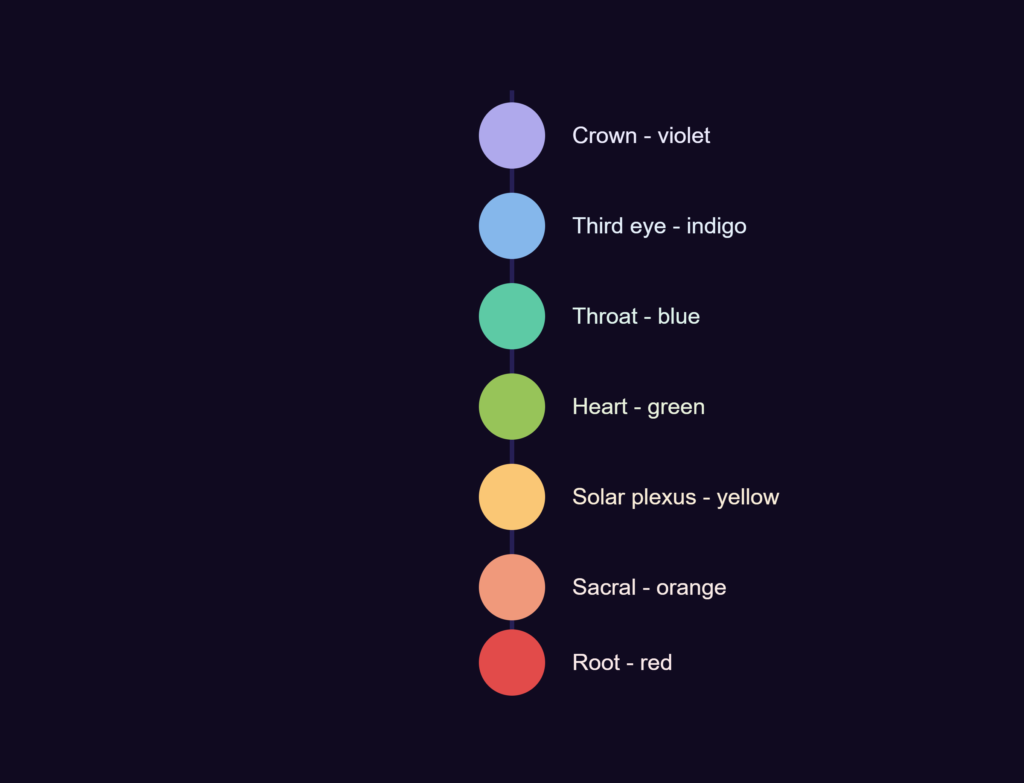
Most modern aura colors and their meanings are tied to the seven chakras, the energy centers described in yogic and tantric traditions as running along the spine from the base to the crown of the head. Each chakra is associated with one of the traditional aura colors, and each color is believed to reflect the state of that particular center, which is why the chakra map remains the most common starting point for learning aura colors.
- Root chakra – red
- Sacral chakra – orange
- Solar plexus chakra – yellow
- Heart chakra – green
- Throat chakra – blue
- Third eye chakra – indigo
- Crown chakra – violet or purple
This seven-color wheel is the traditional backbone of aura interpretation, but practitioners are quick to point out that it isn’t a closed system. Auras are described as showing far more than seven colors: pink, magenta, tan, gold, silver, brown, and even black or muddied tones can all appear, often as blends or fleeting flashes rather than solid fields. If you’re trying to understand your own chakra system in more depth, that seven-point map is generally the best starting place.
The Seven Layers of the Aura
Beyond color, the aura is traditionally described as having seven distinct layers, sometimes called bodies or planes, each stacked slightly further from the skin and each representing a different dimension of a person’s experience.
- Physical plane – the layer closest to the body, associated with physical health.
- Emotional plane – shifts with mood, and is said to look dull or smudged under stress.
- Mental plane – linked to logic, reasoning, and clear thought.
- Astral plane – connected to spiritual health and the capacity to feel and express love.
- Etheric plane – associated with psychic sensitivity and connection to others.
- Celestial plane – tied to dreams, intuition, and creative insight; sometimes called the plane of enlightenment.
- Causal plane – the outermost layer, believed to harmonize all the others and guide a person along their life path.
This layered model is one of the more elaborate parts of aura theory, and it’s largely absent from mainstream scientific literature. It’s best understood as a traditional framework, similar to how a tarot deck or an astrological chart offers a structured lens for self-reflection rather than a testable hypothesis.
Aura Meanings by Color
Here is what each major aura color is traditionally said to represent.
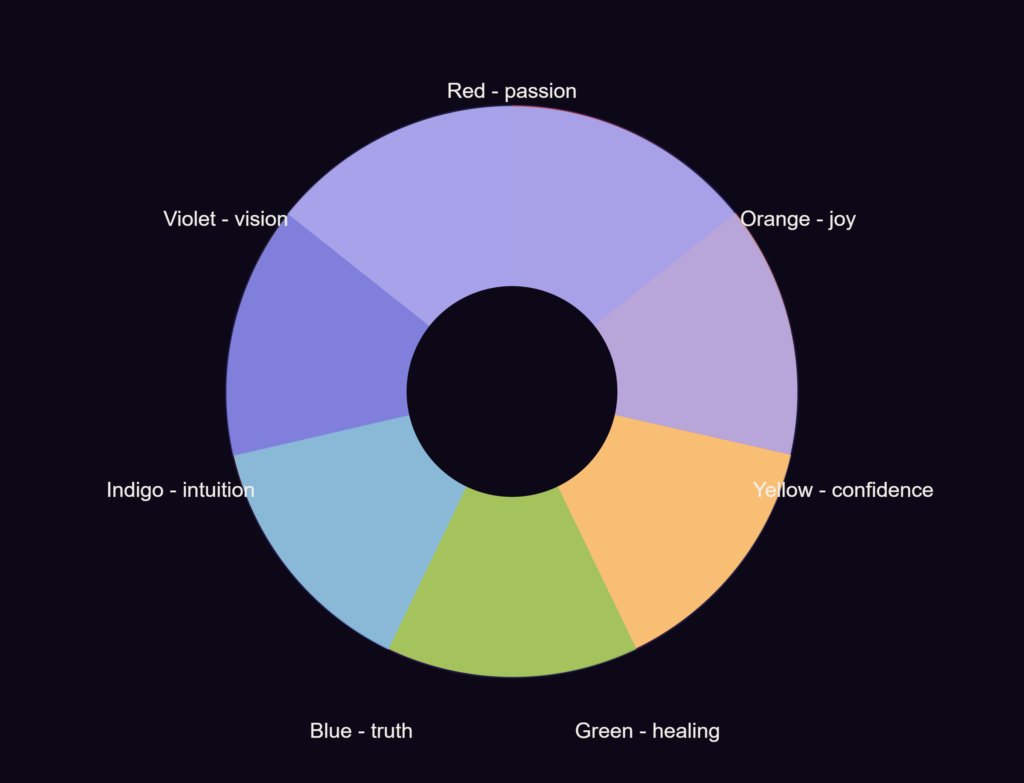
Red aura. Tied to the root chakra and the physical world, red is associated with vitality, passion, and grounded, unapologetic energy. People with a strong red presence are often described as fearless, driven, and drawn to physical experience. A darker or murkier red can point toward anger, exhaustion, or unresolved stress.
Orange aura. Linked to the sacral chakra, orange represents creativity, sensuality, and social connection. Those with orange in their field are typically described as energetic, sociable, and uncomfortable sitting still. A dull orange is sometimes associated with difficulty following through on commitments.
Yellow aura. Connected to the solar plexus chakra, yellow signals intellect, confidence, and optimism. People with a bright yellow tone are often seen as naturally encouraging and mentally sharp. A denser, darker yellow may suggest perfectionism or an overly ego-driven mindset.
Green aura. Associated with the heart chakra, green represents healing, compassion, and balance between personal ambition and care for others. Green auras are often linked to a deep connection with nature and a talent for self-healing. A muddy green can point to envy or a sense of victimhood.
Blue aura. Tied to the throat chakra, blue reflects clear communication and honesty. Lighter shades of blue are associated with inner wisdom and emotionally guided decision-making, while a brighter blue suggests natural skill in self-expression. As a general rule, the lighter the blue, the more peaceful the underlying energy is thought to be.
Indigo aura. Linked to the third eye, indigo represents intuition, empathy, and sensitivity to the energy of others. People with indigo tones are often described as deeply intuitive and prone to vivid or premonitory dreams. A cloudy indigo may point to self-doubt or a disconnect from one’s own intuition.
Purple or violet aura. Connected to the crown chakra, this color signals higher consciousness and spiritual connection. It’s associated with visionary thinking and a strong pull toward meaningful, large-scale goals.
Pink aura. Vibrating near the heart chakra, pink is uncommon and linked to gentleness, romantic sensitivity, and a naturally calming presence.
Magenta aura. A blend of red and blue, magenta suggests a mix of grounded practicality and intuitive originality, often showing up in people who are creative, unconventional, and unbothered by others’ opinions.
Tan aura. Associated with highly logical, methodical thinkers who are patient, detail-oriented, and often more comfortable with tasks than with sharing feelings.
White or silver aura. Linked to purity and spiritual centeredness, a fully white aura is considered extremely rare and is associated with someone largely free of the usual emotional or physical turbulence. White mixed with other colors is far more common and generally points toward a grounded, non-judgmental spiritual outlook.
Black or dark tones. Rather than representing a fixed negative trait, dark patches in an aura are usually interpreted as signs of fatigue, illness, or deep inner processing. Many practitioners argue there’s no true “black aura,” just a temporary dimming caused by depleted energy that resolves with rest.
Multicolored or “rainbow” auras. Some people are described as having many active colors at once, which can indicate a full, dynamic life but also a sense of being pulled in several directions simultaneously.
Evidence, Perspectives, and Practical Application
It’s fair to separate what’s testable from what’s traditional. Scientifically, there is no confirmed physical mechanism by which a human body emits a color-coded energy field visible to the naked eye, and no aura photography technology has been validated under controlled, peer-reviewed conditions. Devices marketed as aura cameras generally work by measuring skin temperature or galvanic skin response and translating that data into color, which is a real biometric signal, just not direct evidence of a metaphysical field.
That said, the experiential and traditional side of this practice is significant and shouldn’t be flattened into pseudoscience and dismissed outright. Practitioners who read auras, whether through trained visual perception or specialized aura photography, describe consistent color patterns tied to a person’s emotional state, and many people report that aura readings offer genuinely useful language for self-reflection, similar to how a personality framework like the Enneagram can clarify tendencies you already sensed but hadn’t named.
If you want to explore your own aura, a few approaches are commonly used:
- Aura photography, using a specialized camera that reads biofeedback and renders it as color, offers a concrete starting point and is widely available at metaphysical shops and wellness events.
- Trained aura readers work through visual perception developed over years of practice, often combined with intuitive impressions.
- Self-reflection and meditation are the most accessible route: sitting quietly, softening your gaze slightly in front of a mirror or plain background, and noticing what colors or sensations arise around your body. This takes patience and doesn’t work for everyone, but many longtime practitioners started this way. Pairing this with a regular meditation practice tends to make subtle perception easier over time.
Whichever method you try, the honest framing is that this is a subjective, experiential practice. Treat any reading as a prompt for reflection rather than a diagnosis.
Common Questions and Misconceptions
One frequent misconception is that a person has exactly one aura color for life. In practice, most descriptions of aura colors treat them as dynamic, shifting with health, mood, environment, and circumstance rather than fixed like an eye color. Another common misunderstanding is that a dark or black-looking aura is inherently bad. Most practitioners describe it instead as a sign of depletion or intense inner work, something that shifts once a person rests and recovers.
There’s also a tendency to treat aura color meaning as identical to zodiac sign or personality typing, when in fact the two systems, while sometimes used together, come from entirely separate traditions. And some people expect a reading to reveal a single, permanent “true color,” when most readers describe an aura as a blend, with one shade simply more dominant at a given time. Understanding this nuance is part of what makes the practice feel less like a party trick and more like an ongoing form of self-awareness work.
For daily insights on consciousness, clarity, and trusting yourself, explore Bahlon’s free daily transmissions. Subscribe to start receiving them each morning.
Related Readings:
- Channeling vs. Mediumship: What’s Actually Different?
- What Are the Akashic Records and How Do You Access Them?
- Energy Healing: Path to Wholeness
Frequently Asked Questions
What does aura mean?
An aura refers to the layered energy field that traditions describe as surrounding every living being, believed to reflect a person’s current emotional, physical, mental, and spiritual state.
What color is my aura?
There’s no single universal answer; your dominant aura color is traditionally thought to depend on your personality, current emotional state, and life circumstances, and it may shift over time. Aura photography or a reading from a trained practitioner are the two most common ways people try to identify it.
What does a red aura mean?
Red is associated with vitality, passion, and grounded physical energy, and is linked to the root chakra. A darker or murkier red is sometimes read as a sign of anger, stress, or exhaustion.
Is there scientific proof that auras exist?
No controlled, peer-reviewed research has confirmed the existence of auras as a measurable energy field. The concept remains rooted in tradition and personal experience rather than established science, which doesn’t diminish its long history or the value many people find in it.
How do you see or read an aura?
Common approaches include aura photography, which uses biofeedback sensors to render a color image, and trained aura readers who rely on developed visual perception. Some people also try self-reflection or meditation, softening their focus around the body’s edges to notice subtle color or sensation.