A black cat crossing your path is read as bad luck in the United States and parts of Europe, as good fortune in Britain, Ireland, and Japan, and as an invitation toward intuition and awareness in many modern spiritual traditions. No scientific evidence shows that the encounter changes your luck, so what it means depends largely on the cultural lens and personal beliefs you bring to it.
Few animals carry as much symbolic weight as a small, dark cat trotting across a road. The same moment can make one person turn around and another person smile. To understand why, it helps to separate three layers: folklore passed down through generations, spiritual interpretations that treat the encounter as a message, and what biology says about the animal itself.
What a Black Cat Crossing Your Path Actually Means
The honest answer is that a black cat crossing your path has no single meaning. It is a symbol, and symbols are shaped by the communities that hold them.
In practical terms, you have met a domestic animal going about its day. In cultural terms, you have met a figure loaded with centuries of stories about luck, danger, witchcraft, and protection. In spiritual terms, you may have met a prompt to pause and notice what is happening in your own life. None of these readings cancels the others. They simply answer different questions.
This is why searches such as “what does a black cat represent” return such contradictory results. One source promises wealth while the next warns of trouble. Both are drawing on real traditions. The useful move is to know where each belief comes from, then decide what, if anything, you want to take from it.
Black Cat Superstition Around the World
Are black cats good luck? That depends on where you are standing. A black cat superstition that sounds ominous in one country can sound like a blessing in the next.
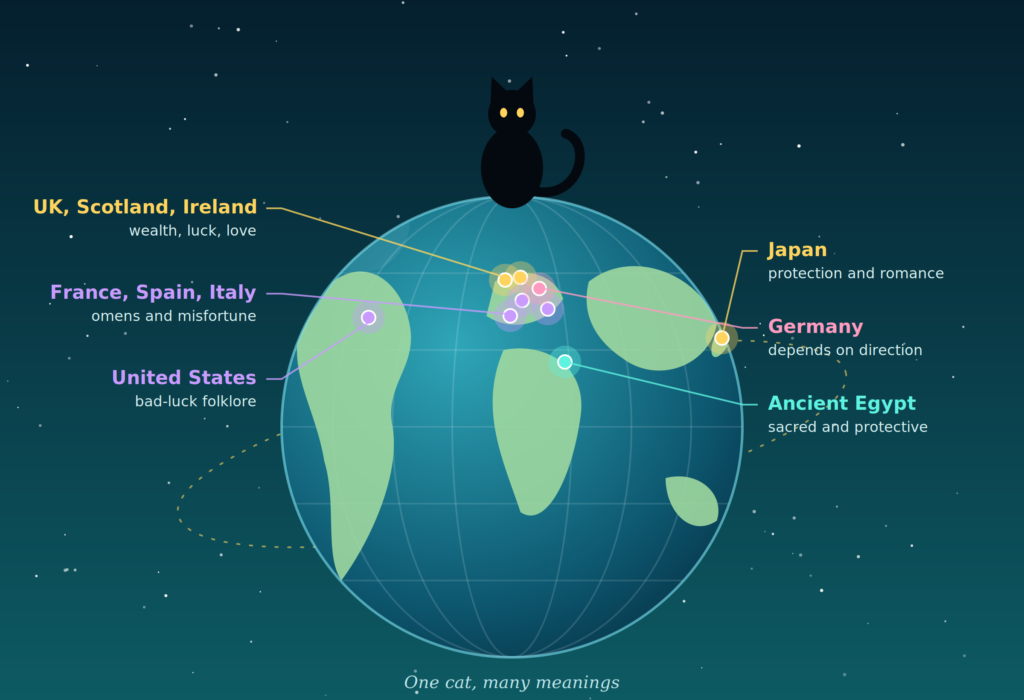
| Country or region | Traditional belief | Where it comes from |
|---|---|---|
| France and Belgium | Often linked to bad luck | Medieval European beliefs about witchcraft |
| Spain and Italy | Sometimes linked to misfortune | Regional folklore |
| United Kingdom | Good luck and prosperity | British folklore |
| Scotland | Wealth and good fortune | Scottish and Gaelic folklore |
| Ireland | Good luck or love | Traditional folklore |
| Japan | Protection, fortune, and romantic luck | Japanese folklore |
| Ancient Egypt | Cats were sacred and protective | Ancient Egyptian religion |
| Germany | Luck may depend on the cat’s direction | German folklore |
| United States | Often linked to bad luck | European-derived superstitions |
These are broad patterns, and beliefs differ between families and communities within every country listed.
Good Luck Traditions
In Japan, black cats are associated with protection, good fortune, and attracting a suitable romantic partner. British and Scottish traditions link them with prosperity. Scottish folklore holds that a strange black cat appearing on your doorstep predicts wealth, and in Ireland an encounter is traditionally tied to good fortune or love. Several traditions also treat a black cat entering a home as a sign of coming prosperity.
Bad Luck Traditions
In the United States and parts of Europe, the black cat bad luck idea is deeply familiar. Some European traditions treat a black cat crossing path moments as a warning, and people in these traditions might change sidewalks, turn around, or take another route. These habits are rooted in folklore rather than evidence, yet they persist even among people who say they are not superstitious.
Does the Direction the Cat Walks Matter?
Some stories say it does. In certain versions of the folklore, a cat walking toward you brings luck, while one walking away takes luck with it. Some European traditions say a cat crossing from left to right is a bad sign, and German folklore includes beliefs in which the cat’s direction shapes whether the meeting is fortunate. These details vary from region to region and are not universal rules.
Why Are Black Cats Unlucky? The Historical Roots
The question of why black cats are bad luck has a historical answer, and it begins with a very different attitude.
Ancient Egypt: Sacred Cats
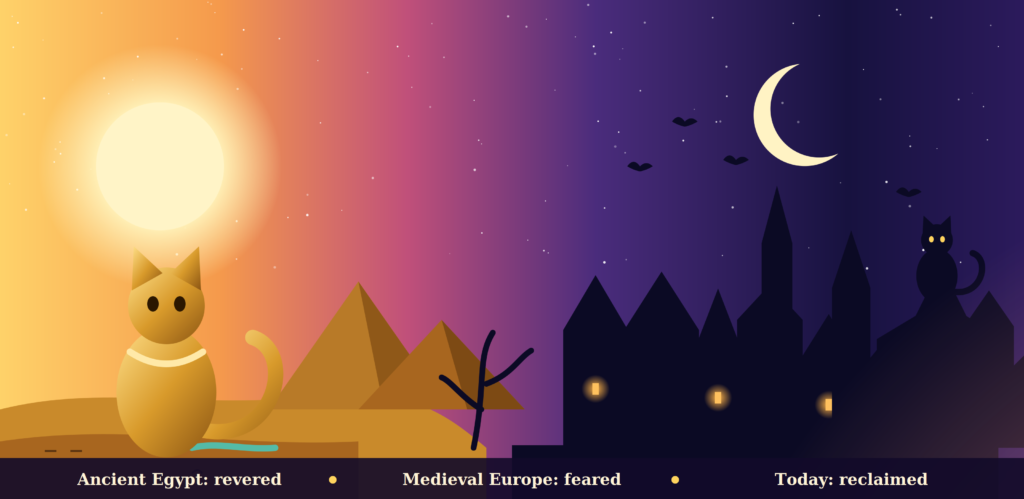
In ancient Egypt, cats were respected and tied to religious belief. The goddess Bastet, often shown with a feline head, was associated with protection, domestic life, and fertility. Cats were valued in homes for keeping pests away, and killing one was considered a serious offense. Archaeologists have found thousands of mummified cats at Egyptian sites, a sign of how much cultural weight these animals carried. Black cats were part of this wider reverence.
Medieval Europe: Witchcraft and Fear
The mood shifted in parts of medieval Europe. Black cats became linked with the devil, witchcraft, and evil, and popular belief held that witches could transform into black cats or keep them as companions. Between roughly 1450 and 1750, witch hunts took place across various parts of Europe. Women accused of witchcraft were often persecuted, and animals associated with them, cats included, could become targets. In some places, cats were killed in public ceremonies meant to protect a community from evil. Practices varied by region, but the long-lasting reputation of the black cat as an omen of misfortune took shape in this era.
The Black Death Question
You may have read that persecuting cats worsened the Black Death by letting rats multiply. It is an appealing story, and fewer cats could plausibly have helped pests thrive. Still, historians do not establish it as fact. The plague’s spread involved infected fleas, rodents, human movement, and environmental conditions. What the story does show is how fear-driven beliefs can lead to harm for animals and people alike.
A Shifting Reputation
So black cats have been sacred protectors in Egypt, suspected companions of witches in medieval Europe, symbols of intuition in modern spiritual circles, and, increasingly, animals whose unfair reputation people are working to undo.
The Spiritual Meaning of a Black Cat Crossing Your Path
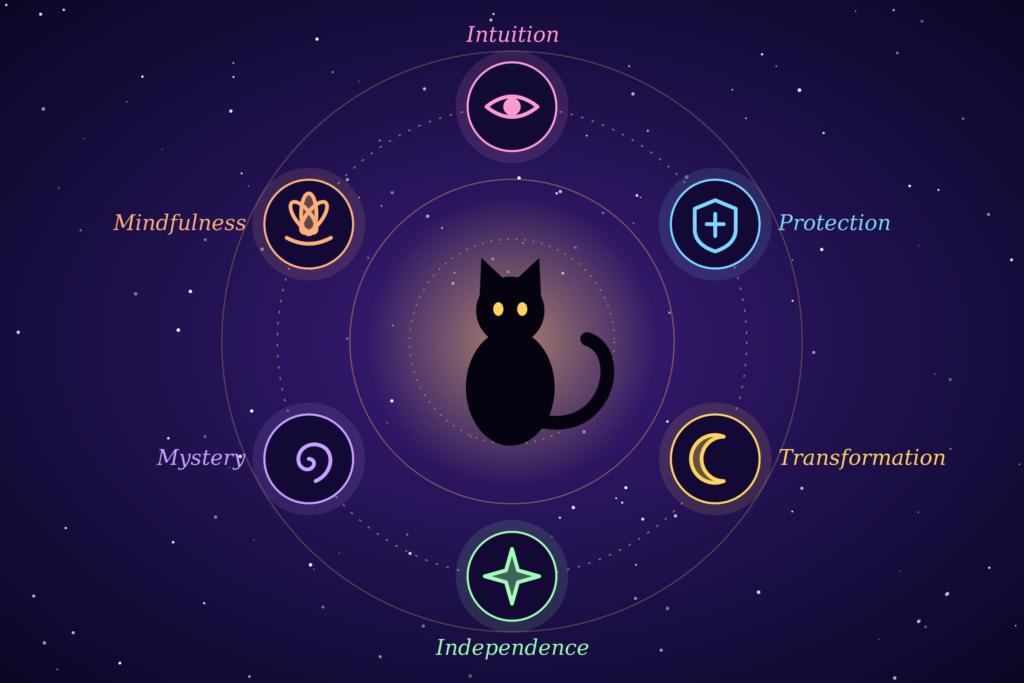
Outside folklore, many contemporary spiritual traditions read a black cat crossing your path as a symbol of inner awareness, growth, and the unknown. It helps to be clear about what these readings are. They are interpretations grounded in experience and tradition, not scientifically verified effects, and many people find real value in them anyway. If you have ever searched for the black cat’s spiritual meaning after an unexpected encounter, these are the themes you are most likely to find.
Intuition and Inner Wisdom
Black cats are frequently associated with intuition, partly because cats notice what others overlook. In this reading, the encounter reminds you to trust your inner voice. Seeing the same black cat repeatedly may prompt reflection on a situation you have been avoiding. A useful question to ask is: what might I need to notice more clearly right now?
Spiritual Protection
Some traditions regard black cats as guardians of homes, personal spaces, and spiritual boundaries. A crossing may be taken as a reminder that you are protected, and some contemporary esoteric practices hold that a black cat at home helps clear unwanted energy. These are spiritual ideas rather than proven abilities, but the comfort they offer is genuine for those who find meaning in them.
Transformation and Rebirth
The color black is often connected with the unknown and with the fertile darkness from which new beginnings emerge. Meeting a black cat during a hard season can be read as a sign of change, an invitation to release habits or situations that no longer serve you. Just as night gives way to dawn, the symbol suggests that uncertainty can lead somewhere new.
Independence and Personal Freedom
Cats are famously self-directed, and black cat symbolism often highlights that quality. The message here is to make your own decisions and to remember that your worth does not depend on the approval of others. There is also a quiet irony in the theme, since black cats have long endured rejection because of stereotypes they never chose.
Mystery and Acceptance of the Unknown
Because of their dark coats and their place in folklore, black cats stand for the parts of life that remain unexplained. Encountering one can prompt reflection on uncertainty and on the limits of what we know. The symbolism encourages loosening your grip on controlling every outcome, and treating mystery as something other than a threat.
Mindfulness and Awareness
Perhaps the most practical reading is the simplest. A black cat crossing your path can be an invitation to pause, look around, and ask whether you are reacting out of fear or choosing thoughtfully. This interpretation does not predict anything. It simply turns an ordinary moment into a moment of attention.
What Science Says About Black Cats
From a scientific standpoint, a black cat crossing your path is an ordinary animal encounter, and no reliable evidence shows it predicts events or alters anyone’s luck. The cat’s coat has a straightforward biological explanation.
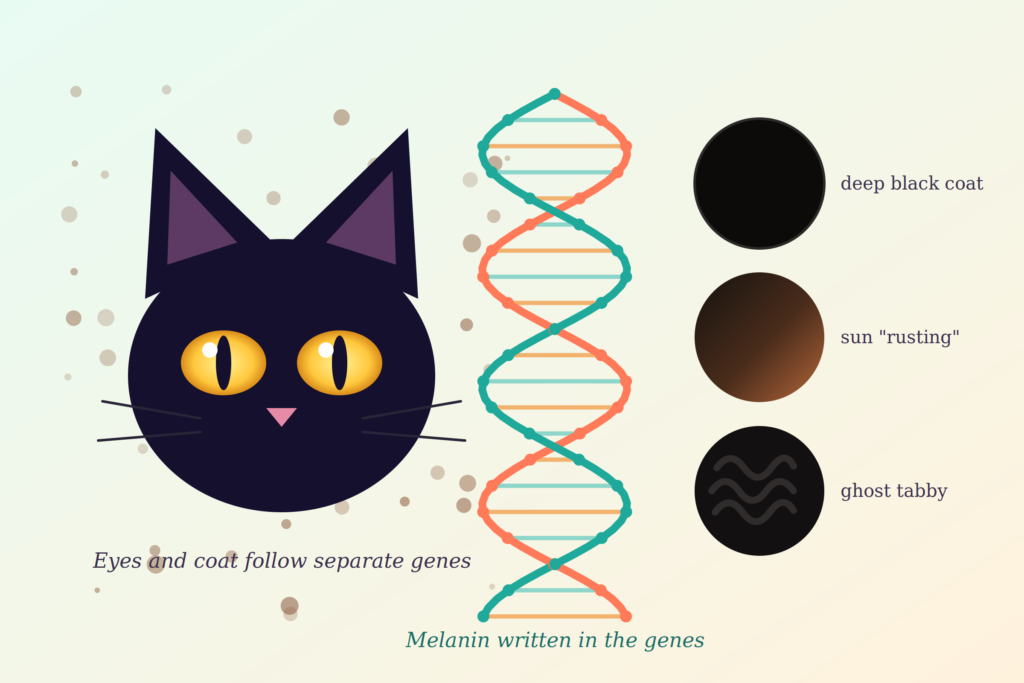
Melanin and genetics. Melanin is the pigment responsible for much of the color in the skin, hair, and fur of animals. Genetic factors influence how much pigment a cat produces and how it is distributed, and certain combinations produce predominantly black fur. Coat color is a physical trait. It does not tell you whether a cat is lucky, dangerous, or spiritually powerful.
Those striking eyes. Eye color is influenced by genes separate from those that govern coat color. Black cats may have yellow, copper, or green eyes, and the contrast against dark fur adds to their distinctive look.
Hidden patterns. Some cats that seem entirely black carry faint tabby markings, which can show up in bright sunlight. Prolonged sun exposure can also give black fur reddish or brown highlights, a change commonly called rusting.
Every one of these features comes down to pigmentation, coat patterns, and environmental exposure.
How Superstition Affects Real Black Cats
Old beliefs still have present-day consequences. Some people continue to link black cats with bad luck or negative energy, and this can quietly influence adoption decisions, even among people who do not consider themselves superstitious. Black cats may be overlooked in favor of cats with other coat colors.
There is a practical factor too. Black fur can make facial features hard to see in photographs, and poor lighting can flatten a black cat’s appearance in online listings. Shelter workers sometimes call this the black cat photo syndrome. Add a persistent myth that black fur signals aggression, and you have a recipe for black cats waiting longer for homes. Coat color does not set temperament. Black cats can be affectionate, playful, calm, or independent, exactly like any other cat.
Black Cat Appreciation Day, observed on August 17 in the United States, aims to challenge those stereotypes and encourage adoption. If you want to help, you can visit a shelter and ask to meet its black cats, share clear and well-lit photos of them, choose a companion by personality rather than coat color, and support responsible adoption efforts.
How to Respond When a Black Cat Crosses Your Path
The way you interpret the moment depends on the perspective you choose, and you can hold more than one at once.
If you lean toward tradition, you might simply note that cultures disagree. Some see prosperity and protection, others see misfortune, and some assign meaning to the cat’s direction. Treat these as cultural stories to enjoy rather than rules to obey.
If you lean toward spirituality, use the encounter as a prompt. Pause for a breath. Ask what you may be ignoring, what change is underway, where you need firmer boundaries, and whether fear or clarity is guiding your next step. Seeing a black cat can function like a bookmark in your day, a cue to check in with yourself.
If you lean toward science, enjoy the encounter for what it is. You saw an animal whose color comes from melanin, and the moment holds no hidden prediction.
Whichever lens you use, a few steps keep the experience grounded. Notice how you feel in the first second, because that reaction often reveals more about your current state than the cat does. Write down any question the moment raises, and revisit it later. Most of all, avoid making major life decisions based on an omen alone. A symbol can inspire reflection, but your choices deserve your full judgment.
One more thing is worth remembering. Whether you read it as luck, message, or coincidence, a black cat crossing your path is also a living animal that deserves kindness.
For daily insights on consciousness, clarity, and trusting yourself, explore Bahlon’s free daily transmissions. Subscribe here.
Related Readings:
- 11 Yellow and Black Butterfly Spiritual Meanings
- Seeing Bunnies Spiritual Meaning in Dreams and Beyond
Frequently Asked Questions
Is a black cat crossing your path good or bad luck?
It depends on the tradition. Many American and European folk beliefs call it bad luck, while British, Scottish, Irish, and Japanese traditions often treat it as good fortune. Science finds no link between the encounter and luck.
What does a black cat symbolize spiritually?
Contemporary spiritual interpretations connect black cats with intuition, protection, transformation, independence, mystery, and mindfulness. These are symbolic readings meant to encourage reflection rather than predict the future.
Why are black cats considered unlucky?
The reputation largely traces back to medieval Europe, where people associated black cats with witchcraft and the devil. Witch hunts between roughly 1450 and 1750 helped entrench the idea that they were omens of misfortune.
Does the direction a black cat walks matter?
In some folklore, yes. Some folklore says a cat walking toward you brings luck, while one walking away takes it, and certain European traditions treat a left-to-right crossing as unlucky. These beliefs vary by region and are not universal.
What does it mean if I keep seeing the same black cat?
In spiritual interpretations, repeated sightings may prompt reflection on something you are being asked to notice. Practically, the cat may simply live nearby. Either way, it can be a gentle cue to pause and pay attention.