The collective unconscious is, in Carl Jung’s theory, the deepest layer of the human psyche: a shared inheritance of instincts, images, and patterns that every person is born with rather than acquires through personal experience. Jung proposed it to explain why people in different cultures and centuries produce strikingly similar myths, symbols, and spiritual ideas. It remains one of the most influential and debated concepts in the history of psychology.
What Is the Collective Unconscious?
Carl Gustav Jung was born in Switzerland in 1875 and went on to found analytical psychology. Early in his career he worked closely with Sigmund Freud, and for a time the two shared a view of the unconscious as a hidden realm that shapes conscious life. The partnership ended around 1913, and one of the central points of disagreement was what the unconscious actually contains.
For Freud, the unconscious was largely personal. It held material from an individual’s own life, especially what had been forgotten or repressed. Jung came to believe this was only the upper floor of a much larger structure. Beneath it, he argued, lies a layer that no individual ever created, which he sometimes called the objective psyche.
Collective Unconscious vs. Personal Unconscious
The distinction is easiest to see side by side.
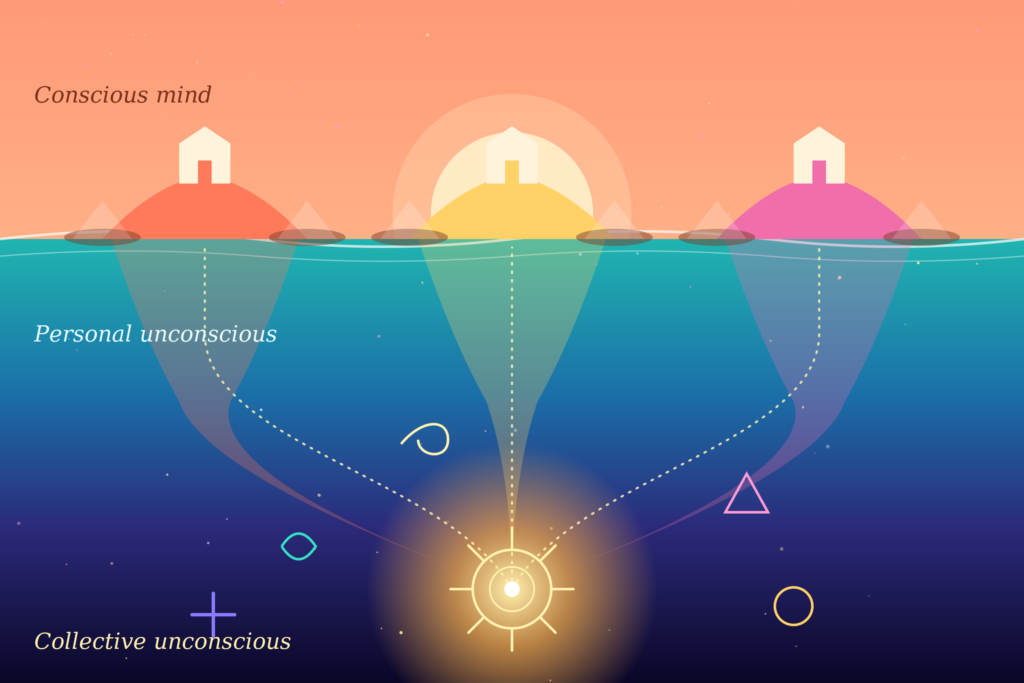
- The personal unconscious holds an individual’s forgotten, repressed, or simply unnoticed experiences. It is built over a lifetime and is unique to each person.
- The collective unconscious is present from birth and common to all human beings. Jung described it as inherited, a kind of psychological ground that precedes personal biography.
Jung did not claim that people are born carrying specific memories or ready-made ideas. In his later writing he was careful to say that what is inherited is the possibility of certain ideas and images, a predisposition to experience life in recognizably human ways. Think of it less as a stored library and more as the shape of the container.
How the Collective Unconscious Works: Jungian Archetypes
According to Jung, the collective unconscious cannot be observed directly. It makes itself known through archetypes, which are universal patterns of imagery, emotion, and behavior. He developed this idea most fully in the volume of his collected works titled The Archetypes and the Collective Unconscious.
An archetype is not a single fixed image. It is a pattern that takes different forms depending on the culture and the individual, which is why the same underlying figure can appear as a king in one story and a shaman in another. Jungian archetypes can also overlap and blend, so a single character or dream figure may carry several at once.
The Best-Known Carl Jung Archetypes
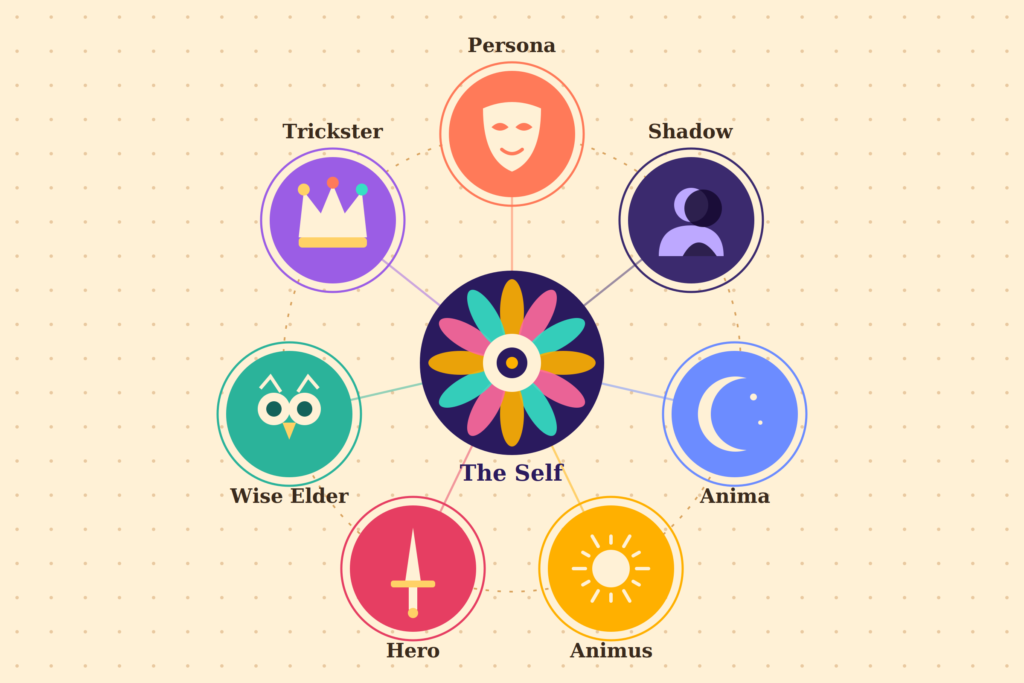
- Persona: the social mask a person presents to the world, shaped by roles and expectations.
- Shadow: the hidden or disowned parts of the personality, including traits a person finds unacceptable. Jung saw the shadow as holding creative potential as well as darkness.
- Anima and Animus: Jung’s terms for the inner feminine in men and the inner masculine in women. These concepts reflect the thinking of his era and are treated by many contemporary Jungians as symbolic rather than literal descriptions of gender.
- The Hero: the figure who leaves a humble or difficult beginning, faces great danger, and returns transformed.
- The Wise Old Man or Woman: the guide who represents insight, meaning, and accumulated wisdom.
- The Trickster: a playful, boundary-breaking figure who disrupts order, sometimes with comic and sometimes with troubling results.
- The Self: the archetype of wholeness, representing the totality of the psyche and the center toward which Jung believed personal growth tends.
In Four Archetypes, Jung also singled out the mother, rebirth, spirit, and the trickster as especially central to psychological development. The lists are not meant to be exhaustive. Jung treated archetypes as a living, open-ended field, not a fixed catalogue.
Dreams, Myths, and Crisis: Where Jung Saw It at Work
Jung’s evidence for the collective unconscious came largely from observation. He studied mythology, religion, alchemy, and the dreams and visions of his patients, and he noticed recurring motifs that his patients could not have encountered through ordinary learning.

Dreams. Jung regarded dreams as a primary doorway into the unconscious. He believed certain dream symbols carry shared meaning because they connect to archetypes. Yet he also insisted that dreams are deeply personal, and that interpreting one requires knowing the dreamer’s life. This set him apart from Freud, who tended to read particular symbols as standing for particular repressed wishes. Jung saw dreams as compensatory: they often bring forward what the waking mind neglects, helping restore balance.
Myth and religion. Jung proposed that the parallels across the world’s religious and mythic traditions, from creation stories to ideas of rebirth, may reflect common psychological roots. Many people of faith find this a respectful framing, since it treats spiritual experience as a real and meaningful dimension of being human. Others hold that their tradition’s truths rest on revelation or lived practice instead, and Jung’s theory does not require anyone to set those beliefs aside.
Fear and instinct. Jung also suggested that certain fears, such as fear of darkness, may appear without any obvious personal cause because they reflect inherited tendencies.
Crisis and transition. Jung observed that archetypal imagery often surfaces during life’s turning points: loss, illness, midlife upheaval, or spiritual awakening. In his view, the psyche may draw on these deeper patterns when ordinary ways of coping are not enough. His own confrontation with vivid inner imagery after the break with Freud, recorded in The Red Book, is often cited as the personal root of the theory.
What Does the Evidence Say About the Collective Unconscious?
This is where an honest account has to separate several kinds of claim.
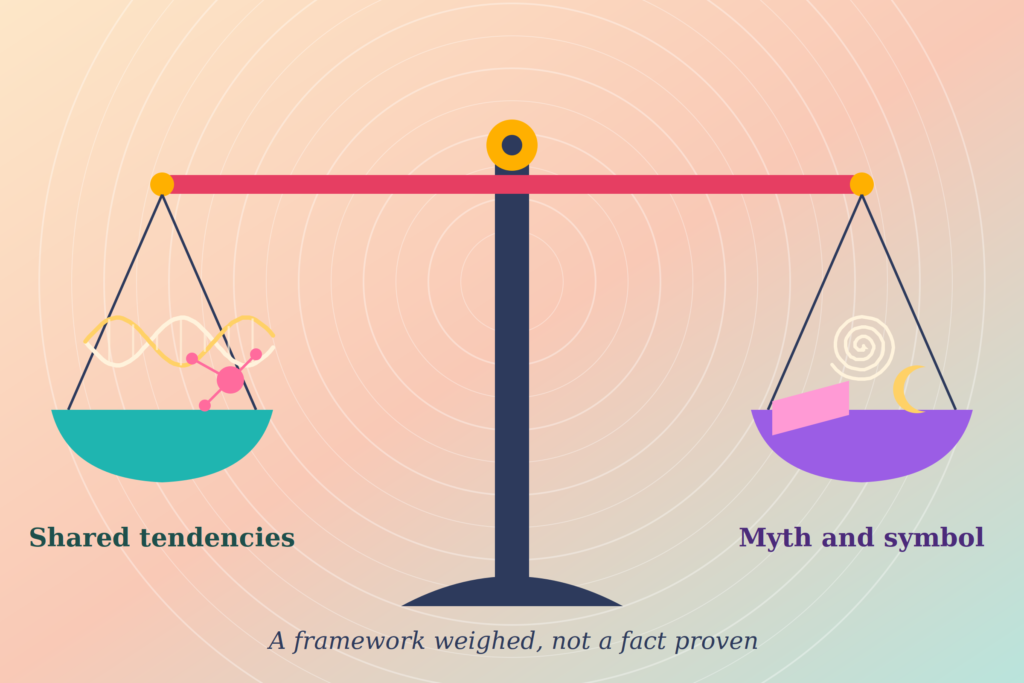
The literal reading. If the collective unconscious means that specific memories, myths, or symbols are genetically transmitted, mainstream science has not supported it. There is no known mechanism by which a particular image or story could be encoded and inherited, and the claim is difficult to test. For this reason it is often described as unscientific or pseudoscientific in academic circles.
The symbolic or predisposition reading. A more modest interpretation holds that humans share evolved psychological tendencies, and that these shape what we notice, fear, desire, and find meaningful. This has stronger footing. Research on prepared learning, for example, suggests humans may acquire fears of snakes or heights more readily than fears of modern hazards. Studies of infants also point to early sensitivities, such as attention to faces, that appear before extensive experience. Some evolutionary psychologists and Jungian analysts, notably Anthony Stevens, have argued that archetypes can be understood in this light, as inherited behavioral and perceptual patterns.
Cross-cultural patterns. Folklorists and comparative mythologists have documented recurring story structures across the world. Joseph Campbell’s popularization of the hero’s journey drew heavily on Jung. Critics point out, however, that similar stories may arise from shared human circumstances or from cultural contact and diffusion, without requiring a collective unconscious at all.
Ongoing research. Scientists continue to explore how unconscious processes influence behavior, from gut-brain signaling to the way people behave in online communities. Some of this work has been framed in relation to Jung’s ideas, though such connections remain exploratory and are not proof of the theory.
The fair summary is this: the collective unconscious is a theoretical and interpretive framework, not an empirically verified structure. It has proven enormously fruitful in therapy, literature, art, and the study of religion, even as its strongest literal claims remain unproven.
How to Work With the Collective Unconscious in Everyday Life
You do not need to accept every part of Jung’s metaphysics to find his ideas useful. Practitioners of Jungian psychology offer several accessible entry points.
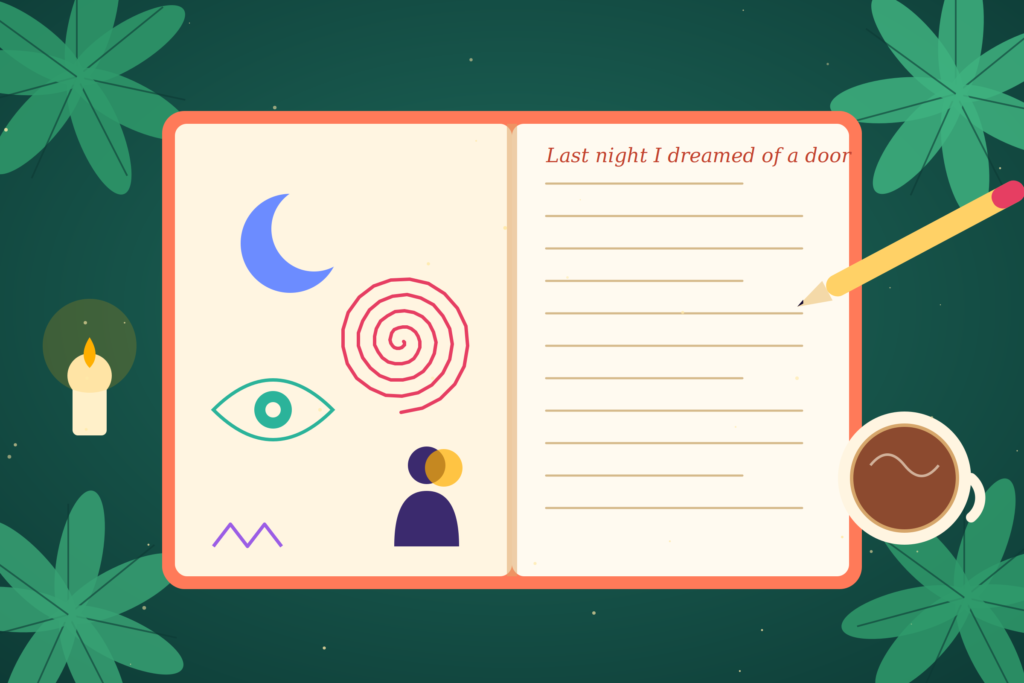
- Keep a dream journal. Record dreams immediately on waking, including images, emotions, and anything that feels strangely familiar. Over weeks, recurring figures and themes often become visible.
- Notice your archetypal patterns. Ask which stories you are drawn to and which characters you envy, fear, or judge. Strong reactions to a figure frequently point to something in yourself, which is the logic behind projection.
- Explore your shadow. Pay attention to traits that irritate you in others or that you work hard to hide in yourself. Journaling about these without self-judgment is a common starting point for what many call shadow work.
- Try active imagination. Jung’s method involves entering a relaxed state, letting an image or figure from a dream or fantasy appear, and engaging with it in writing, drawing, or dialogue.
- Engage with myth and symbol. Reading myths, fairy tales, and sacred stories with curiosity, and noticing what resonates, is itself a way of meeting archetypal material. Related practices such as dream interpretation and meditation can complement this work.
- Consider working with a trained analyst. If the material you encounter feels overwhelming, or you are navigating grief, trauma, or a major life transition, a qualified Jungian therapist or other mental health professional can offer structured support.
Common Misconceptions and Why the Theory Endures
“The collective unconscious is the same as collective consciousness.” They are different ideas. Collective consciousness, associated with sociologist Émile Durkheim’s conscience collective, refers to the shared beliefs and moral attitudes that bind a society together. Mass consciousness and shared consciousness are related everyday terms. The collective unconscious, by contrast, is a psychological concept about inherited patterns beneath awareness. One concerns social norms, the other concerns the structure of the psyche.
“It means we share one mind or can read each other’s thoughts.” Jung did not claim telepathy or a literally merged mind. He described shared structures, not shared contents of thought.
“Archetypes are stereotypes.” Stereotypes are fixed and cultural. Archetypes, in Jung’s sense, are flexible patterns that individuals and cultures fill with specific content.
“Jung proved it.” He built a rich body of clinical and comparative observation, but not a laboratory demonstration. Being clear about this does not diminish the theory’s value as a lens.
The collective unconscious endures because it addresses something people recognize in their own lives: the sense that certain stories, symbols, and feelings are older than we are. Whether read literally, symbolically, or spiritually, Jung’s idea invites a deeper kind of self-inquiry, and that invitation is a large part of why it continues to shape psychology, art, and the search for meaning.
For daily insights on consciousness, clarity, and trusting yourself, explore Bahlon’s free daily transmissions.
Related Readings:
- The Science of Consciousness: What We Know
- What Is a Collective Consciousness?
- Meditation for Beginners: How to Start (and Actually Stick with It)
Frequently Asked Questions
What is the collective unconscious in simple terms?
It is Carl Jung’s name for the part of the unconscious mind that is shared by all humans and inherited rather than learned. It is thought to express itself through universal symbols, images, and patterns called archetypes.
What is the difference between the personal and collective unconscious?
The personal unconscious contains an individual’s own forgotten or repressed experiences. The collective unconscious is common to everyone and exists from birth.
What are the main Jungian archetypes?
The most commonly cited are the Persona, Shadow, Anima, Animus, Hero, Wise Old Man or Woman, Trickster, and the Self. Jung also highlighted the mother, rebirth, spirit, and trickster as fundamental in Four Archetypes.
Is the collective unconscious scientifically proven?
No. The literal idea of inherited memories lacks scientific support. A symbolic reading, based on shared evolved human tendencies, has more grounding, but the theory as a whole remains interpretive and debated.
How did Jung’s view differ from Freud’s?
Freud emphasized a personal unconscious shaped by individual experience and repressed desires. Jung added a deeper, inherited layer and viewed the unconscious as potentially creative and guiding, not only a storehouse of repressed material.