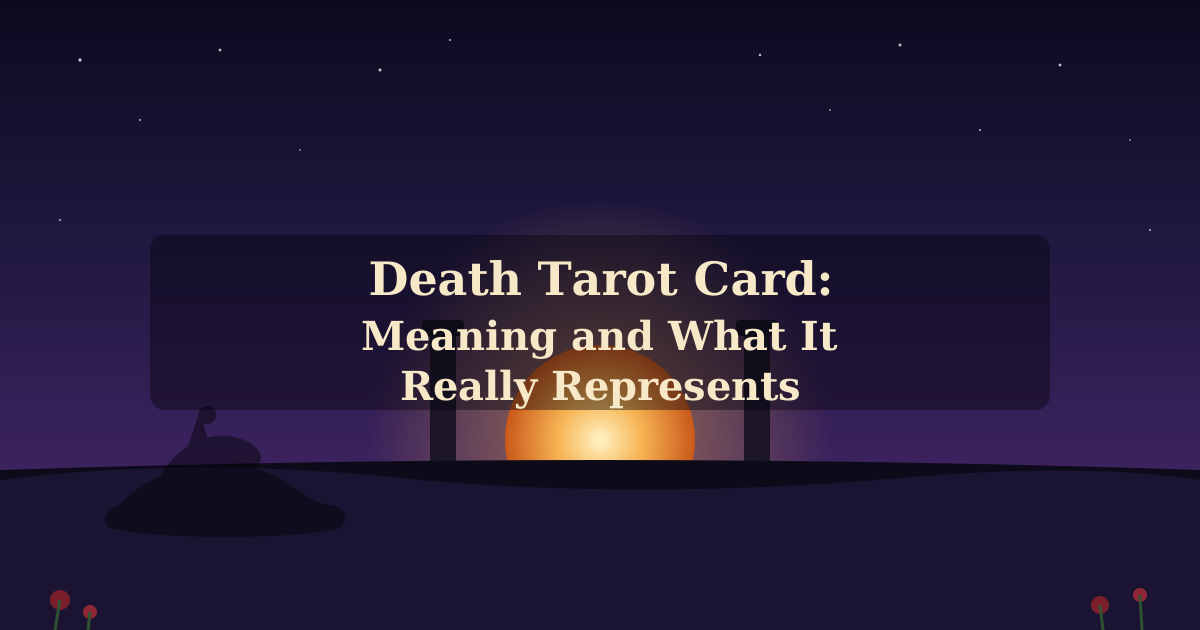
The Death tarot card is one of the most misunderstood images in the entire deck, and despite its ominous name, it almost never predicts physical death. In the language of tarot card meanings, Death is a card of transformation: it marks the close of one chapter and the quiet, often uncomfortable, opening of another. When it appears in a spread, it is usually asking you to notice what has already ended, even if you haven’t admitted it yet.
That single distinction, between literal death and symbolic ending, is the key to understanding almost everything else about this card. Once a reader grasps that Death speaks in metaphor rather than prophecy, the fear it inspires tends to soften into something more useful: recognition.
What the Death Tarot Card Actually Means
At its core, the Death card represents major transformation, the natural conclusion of something that has run its course, and the renewal that becomes possible once that ending is accepted. It can point to the end of a job, a relationship, an identity, or a way of thinking that no longer fits who you’re becoming.
This is a card that shows up during periods of real change, not necessarily change you chose, but change that has already begun whether you’re ready or not. It doesn’t punish. It reports. Something in your life may have reached its natural endpoint, and the card is simply naming that fact so you can stop pretending otherwise.
Reversed, the Death card shifts its message slightly. Rather than describing an ending in motion, it often describes resistance to that ending. When people fight the natural direction of change, tarot tradition suggests the result is rarely relief. It’s usually prolonged discomfort: stagnation, unresolved grief, or a sense of being stuck in a version of life that has already, in some sense, moved on without you.
How the Death Card Works Within a Tarot Reading

To understand how this card functions, it helps to step back and look at how tarot card reading works more broadly. A standard deck used for tarot card reading contains 78 cards, split into the Major Arcana (22 cards representing significant life themes and spiritual lessons) and the Minor Arcana (56 cards dealing with day-to-day matters). If you’ve ever wondered how many cards in a tarot deck exist in total, that 78-card structure is the traditional answer, refined over centuries of use.
Death belongs to the Major Arcana, which is precisely why it carries so much psychological and spiritual weight. Major Arcana cards represent large, often unavoidable forces: fate, growth, upheaval, and awakening. Minor Arcana cards tend to describe smaller, situational details. When Death appears, a reader is generally looking at something significant, not a passing mood but a genuine turning point.
Within a spread, context matters enormously. A reader will look at the cards surrounding Death to determine what, exactly, is ending. Paired with the Tower, it might suggest a sudden, forced collapse. Paired with the Star, it often signals that the ending is leading toward hope and healing rather than despair. This is one reason experienced readers resist giving snap interpretations. Any card taken from a broader tarot cards list has meaning that shifts depending on its neighbors, its position in the spread, and the question being asked.
The Symbolism Behind the Death Card Image
The traditional Rider-Waite depiction of Death is dense with imagery, and almost none of it is accidental.

The Skeletal Rider in Armor
The central figure is a skeleton dressed in knight’s armor, riding through the scene on a pale horse. The skeleton represents what remains after everything perishable has fallen away: the unchanging core of a person that survives even radical transformation. Beneath the surface layers we build, something essential persists.
The White Horse
The horse itself carries connotations of purity, quiet power, and unstoppable forward motion. It does not rush. It does not hesitate. Time, the imagery suggests, moves at its own pace regardless of human resistance.
The Fallen King
At the horse’s feet lies a fallen king, along with other figures kneeling or pleading. This detail carries a pointed message: transformation does not negotiate with wealth, status, or power. Kings fall like everyone else. Change is, in this sense, one of the few truly democratic forces in life.
The Rising Sun
Between two distant pillars, a sun rises. This is arguably the most important symbol on the card, because it reframes everything that comes before it. Endings, the image suggests, are not simply endings. They are the necessary darkness before a new day. The presence of that sunrise is what separates this card’s message from despair and moves it toward renewal.
Traditional and Spiritual Perspectives on Death and Endings

Tarot as a system draws on a long lineage of symbolic and mythological thought, and the Death card’s meaning becomes richer when placed alongside older traditions that wrestled with the same questions.
In Hindu mythology, for instance, the god Shiva holds the role of destroyer within a triad of divine functions that also includes creation and preservation. According to one well-known story, after the death of his wife, Shiva withdraws into prolonged grief and meditation, stepping away from his necessary work. Without his function of ending things, the wider order of the world begins to destabilize. Eventually, other divine forces work to draw him back into balance. The story does not present death or endings as evil. It presents them as essential, part of a cycle that keeps existence functioning. Removing that function, even temporarily, causes harm.
This mirrors a theme found across many spiritual frameworks: that death and endings are not adversaries to life but partners in its rhythm. The Grim Reaper figure, which visually echoes the tarot’s Death card, appears across numerous cultures carrying a scythe (symbolizing the cutting of the soul’s tie to the body) and an hourglass (symbolizing the finite nature of time). Even in traditions that personify death as frightening, the figure is often understood as a guide rather than a villain, someone tasked with a necessary transition rather than a punishment.
It’s worth being clear about what kind of evidence supports these interpretations. Tarot itself has no scientific basis as a predictive tool, and no peer-reviewed research validates it as a method of foretelling events. What can be said with more confidence is that tarot functions well as a reflective and psychological practice. Structured symbol systems like tarot cards meaning sets give people a framework for examining their own circumstances, similar in function to journaling prompts or narrative therapy exercises. The value, for many practitioners, lies less in mysticism and more in the act of pausing to genuinely reflect on a symbol and what it stirs up personally.
Practical Guidance: What to Do If You Pull the Death Card

If Death appears in your reading, the most useful first step is resisting the urge to panic. The card is rarely a warning about literal death. It’s far more often an invitation to notice what has already changed, or what desperately needs to.
A few grounded questions tend to be useful here:
- What am I holding onto that has already run its course?
- Where am I resisting a change that’s already underway?
- What identity, habit, or relationship no longer reflects who I am becoming?
- What am I trying to control that may actually require surrender?
The card also has a natural connection to grief. Endings, even necessary ones, can bring real sadness, and that sadness deserves space rather than suppression. Grief is often a sign that acceptance is beginning, not a sign that something has gone wrong. Many practitioners describe the Death card’s message as a three-part sequence: an ending, followed by acceptance, followed eventually by renewal. Skipping the middle step by forcing positivity too early tends to prolong the discomfort rather than resolve it.
There’s also a seasonal echo worth noting. In tarot card meanings traditions, Death is frequently associated with the mood of deep winter, particularly in the Northern Hemisphere. The dark, slow months of late autumn and early winter mirror the card’s themes: withdrawal, quiet, and letting go, in preparation for the eventual return of growth in spring. Approaching the card with that seasonal patience, rather than urgency, often produces a calmer and more useful reading.
Common Misconceptions About the Death Card
The single biggest misconception is the assumption that Death predicts physical mortality. In the vast majority of readings, and across nearly every reputable tarot card reading tradition, that is simply not the case. The card speaks in metaphor: endings of jobs, relationships, identities, dreams, and outdated ways of thinking.
Another common misunderstanding is treating Death as purely negative. Its imagery, particularly the rising sun, actively resists that framing. The card describes a transition, and transitions contain both loss and possibility at once. Reducing it to only fear misses half of its meaning.
Finally, some readers assume the reversed Death card is “worse” than the upright version. It isn’t necessarily. Reversed, it tends to describe resistance rather than a different kind of ending, which can actually be more useful information: it points directly at where you might be stuck, giving you something concrete to work with.
For daily insights on consciousness, clarity, and trusting yourself, explore Bahlon’s free daily transmissions. Subscribe here to start receiving them.
Related Readings:
- How to Read Tarot Cards for Yourself
- Tarot Reading: Everything You Need to Know
- Exploring The Power Of Psychic Tarot Card Reading
Frequently Asked Questions
Does the Death card mean someone is going to die?
No. In the overwhelming majority of readings, the Death card refers to symbolic endings, such as the close of a relationship, job, identity, or phase of life, rather than literal death.
What does the Death card mean in love or relationships?
It often signals that a relationship or relationship pattern has reached a natural turning point. This can mean an ending, but it can also mean a significant transformation within an existing relationship, such as moving into a new stage of commitment.
What does the reversed Death card mean?
Reversed, the card typically points to resistance against an ending that needs to happen. It can indicate stagnation or prolonged difficulty caused by refusing to let go of something that has already run its course.
How many cards are in a full tarot deck?
A traditional tarot deck contains 78 cards: 22 Major Arcana cards, which includes Death, and 56 Minor Arcana cards divided into four suits.
Is the Death card always a bad sign?
Not inherently. While it can point to a difficult ending, its symbolism, especially the rising sun in traditional imagery, frames that ending as the beginning of renewal rather than a purely negative outcome.