If you want to know how to astral project, the short answer is this: you relax your body completely while keeping your mind alert, ride that state to the edge of sleep, and then use a gentle exit technique to separate your awareness from your physical body. It’s a skill built on relaxation, patience, and calm attention rather than any special gift, and most people who practice consistently report some version of the experience within weeks. What follows is a full walkthrough of what astral projection is, how it works, what the evidence and traditions say about it, and exactly how to try it tonight.
What Is Astral Projection, Exactly?
Astral projection describes a deliberately induced out-of-body experience (OBE), one in which your awareness appears to leave your physical body while you stay conscious and alert. People who practice it often describe projecting a “subtle” or astral body that can move, observe, and travel independently of the physical one. This is the detail that separates it from a dream: the experience is typically described as lucid, vivid, and awake, not hazy or story-driven the way dreams tend to be.
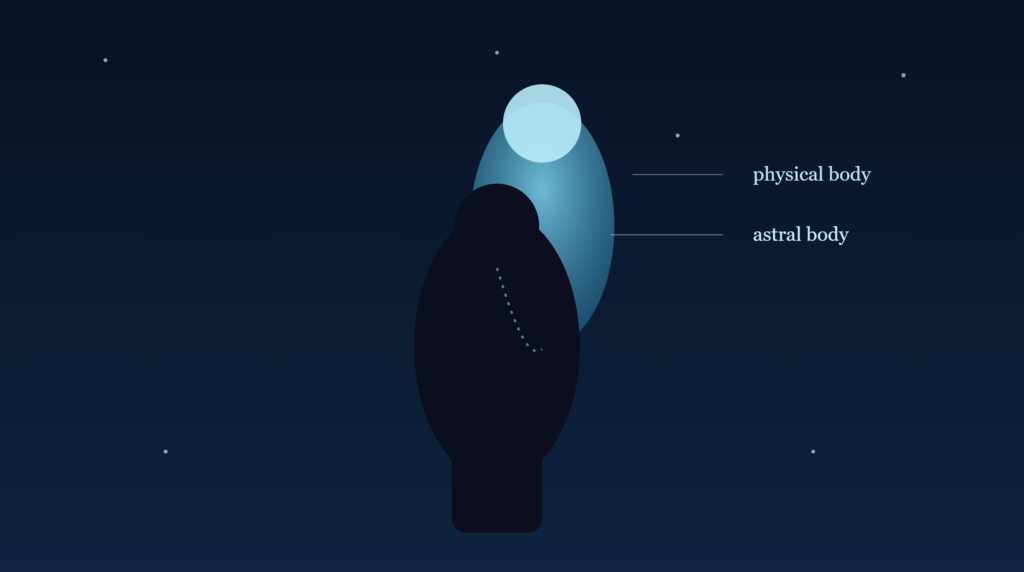
It helps to untangle a few terms that get used interchangeably, because they aren’t quite the same thing.
Lucid dreaming happens when you realize, mid-dream, that you’re dreaming. You may be able to steer the dream, but your awareness stays inside the dream world itself. Out-of-body experience is the broader umbrella term: any instance of perceiving your surroundings from a vantage point outside your physical body, whether it happens spontaneously (during illness, trauma, or deep meditation) or on purpose. Astral projection is a specific, intentional kind of OBE, one that’s usually understood through a spiritual or energetic framework rather than a purely psychological one.
All three tend to share the same doorway: the transitional zone between waking and sleep, sometimes called the hypnagogic state. That’s the territory this guide focuses on.
How Astral Projection Works: The Mind Awake, Body Asleep Method
The mechanics behind most beginner techniques follow a fairly consistent arc: relaxation, the hypnagogic state, vibrations, separation, exploration, and return. None of these stages should be rushed. The entire approach depends on allowing the experience to unfold rather than forcing it, which is a shift in mindset that trips up a lot of newcomers who are used to “trying harder” to get results.
Step 1: Relax the Body Completely
Lie on your back, close your eyes, and work through a slow, progressive relaxation, starting at your toes and moving upward toward your scalp. Breathing exercises or a guided Yoga Nidra track can help here. The goal is a body that feels heavy, loose, and essentially asleep, while your mind stays awake and observant.
Step 2: Reach the “Mind Awake, Body Asleep” State
This is the hinge point of the entire practice. Stay still, resist the urge to shift or scratch an itch, and simply watch whatever drifts across your closed eyelids, colors, shapes, fragments of thought, without engaging with it. You’re aiming for the state where your body has essentially fallen asleep but your awareness hasn’t gone with it.
Step 3: Notice the Vibrational State
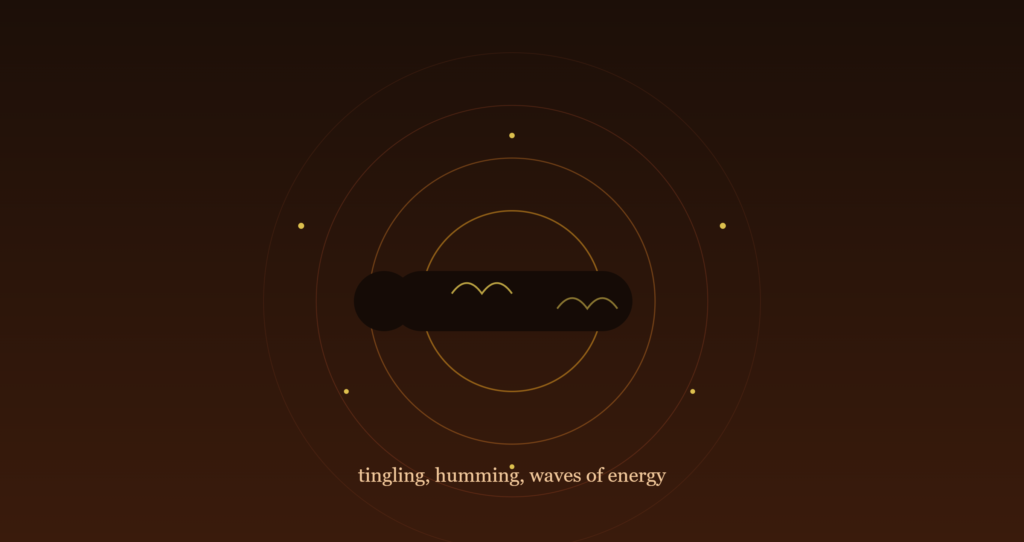
As relaxation deepens, many practitioners report distinct physical sensations: tingling, buzzing, humming, a sense of heaviness, or energy moving through the body. Some describe a loud internal sound, occasionally compared to a jet engine or a rush of wind, right before separation. These sensations can feel intense the first time they show up, but staying calm is essential. Reacting with fear or excitement tends to snap you straight back into ordinary waking awareness.
Step 4: Use an Exit Technique
Once the vibrations build, the classic move is to use imagination and intention, not muscle, to separate. Common approaches include imagining yourself rolling sideways out of your body, sitting up without physically moving, floating straight upward, or climbing an invisible rope hand over hand and letting the pulling sensation lift you free. Whichever method you choose, the physical body stays still throughout. Straining defeats the purpose; the separation is meant to feel effortless.
Step 5: Explore, Then Return
Once separated, take your time observing your surroundings. When you’re ready to come back, simply intend to return, or bring your attention to a specific part of your physical body, like a finger or toe. Awareness tends to snap back on its own. Lie still for a moment afterward and mentally review what happened before it fades.
Is Astral Projection Real, and Is It Safe?
This is where balance matters most, because the honest answer depends on what kind of claim you’re evaluating.
People across cultures and throughout recorded history have reported out-of-body experiences, and psychology treats these as genuine subjective phenomena worth studying, regardless of whether the “traveling self” is literal or a construction of consciousness. Researchers have documented OBEs in contexts ranging from meditation and sleep paralysis to near-death experiences, and some neuroscience work has even induced OBE-like sensations through targeted brain stimulation, which suggests at least part of the experience has a neurological basis. Whether that fully explains the phenomenon, or whether something beyond ordinary brain activity is involved, is a question science hasn’t settled and that spiritual traditions answer very differently than clinical researchers do. Both framings deserve to be taken seriously on their own terms.
What isn’t in dispute is that the techniques used to induce these states, deep relaxation, sustained focused attention, and working at the exact edge of sleep, are learnable skills that show up consistently across unrelated traditions and personal accounts.
As for safety: for healthy adults, astral projection is generally considered low-risk. It’s a self-induced state of relaxed awareness, and by every account, people return to ordinary waking consciousness on their own, the same way you wake up from an ordinary dream. There’s no credible evidence supporting the common fear of getting permanently “stuck” outside the body. That said, if you have a history of seizures, psychosis, or another significant mental health condition, it’s worth talking to a doctor or therapist before experimenting with altered states of consciousness like this one. For most beginners, the biggest obstacle isn’t physical risk at all, it’s fear itself, which is exactly why staying calm is emphasized at every stage of the practice.
How to Prepare: Timing, Environment, and Mindset
Preparation shapes the outcome more than most beginners expect.

Timing matters. The strongest window tends to be early morning, roughly four to six hours after falling asleep, when the body cycles back into lighter, dream-rich sleep. This is the foundation of the Wake-Back-to-Bed (WBTB) method: sleep for four to six hours, wake briefly, then return to bed while holding the intention to stay aware. Many practitioners consider it the most reliable timing technique available.
Your sleep rhythm matters too. A steady sleep schedule makes the waking-to-sleep transition more predictable, which gives you a cleaner shot at catching that hypnagogic window on purpose rather than by accident.
Some practitioners also track lunar timing, choosing to practice around the full moon or new moon, when rest rhythms and personal intention can feel heightened. This is a traditional and experiential preference rather than a scientifically established variable, but it’s a low-effort adjustment worth trying if it resonates with you. A quick check of the current moon phase is all it takes to plan around it.
Environment:
- A dark, quiet room where you won’t be interrupted
- Lying on your back, arms at your sides, legs uncrossed
- Loose, comfortable clothing
- A cool room temperature
- A calm, simple intention set before you begin, something like: “Tonight, I will stay aware as my body falls asleep.”
Above all, resist the urge to force it. This entire practice rewards patience over effort.
Popular Techniques for the Exit Stage
Once you’ve reached the vibrational stage, a few well-established methods can help carry you through separation.
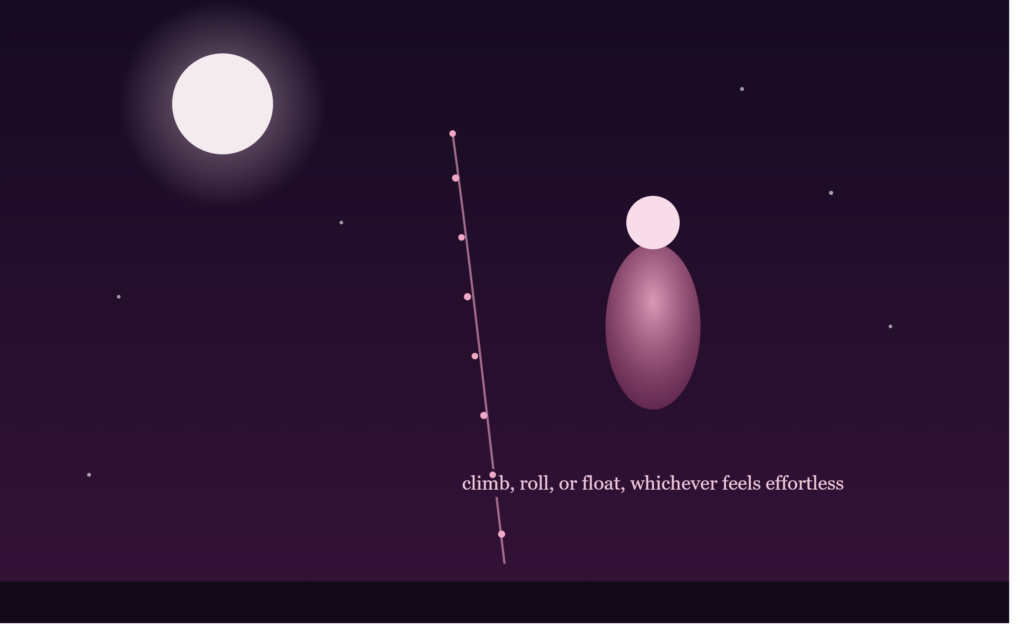
The Rope Technique: Picture a rope hanging above you and “climb” it hand over hand using awareness alone, focusing on the pulling sensation until it lifts you free.
The Roll-Out Technique: Imagine gently rolling sideways out of your body, the same motion as turning over in bed, but without using your actual muscles.
The Float or Lift-Out Technique: Imagine yourself growing lighter and drifting upward, toward the ceiling, until you feel free of the physical body.
Wake-Back-to-Bed: As mentioned above, this timing method (sleep, briefly wake, return to bed with intention) is widely considered the most effective entry point for beginners, since it works with the body’s natural sleep architecture instead of against it.
Common Mistakes and Misconceptions
A few patterns show up again and again among beginners.
Trying too hard. Effort creates tension, and tension tends to wake you up rather than carry you deeper. A relaxed, almost passive expectation works better than active striving.
Getting too excited when it starts working. The moment separation begins is exactly when many people jolt themselves back awake, simply because the excitement is hard to contain. Staying calm through that moment is a skill in itself.
Practicing at the wrong energy level. Too tired, and you’ll likely just fall asleep. Too alert, and you won’t drift into the hypnagogic state at all. The early-morning window exists precisely because it balances the two.
Giving up too soon. Timelines vary enormously. Some people have a first experience within days; for others, it takes weeks or months of consistent practice. Regular effort, patience, and a calm relationship with the edge of sleep matter more than any single technique.
It’s also worth naming a widespread misconception directly: the fear that you could become trapped outside your body. There’s no credible evidence for this. Every documented account describes a natural, sometimes even involuntary, return to ordinary waking awareness.
Recording the Experience
Keep a journal within reach of your bed. The moment you wake, before the details evaporate, write down everything you can recall: sensations, images, sounds, the sequence of events. Memory of these liminal states fades fast, often within minutes, so this single habit can be the difference between a rich personal record and a vague impression you can’t quite reconstruct later.
For daily insights on consciousness, clarity, and trusting yourself, explore Bahlon’s free daily transmissions. Subscribe here to receive them straight to your inbox.
Related Readings:
- Is Astral Projection Dangerous? What You Should Know
- Sleep Paralysis: Spiritual Meaning vs. Scientific Explanation
- Near-Death Experiences: What Science Actually Says
Frequently Asked Questions
What is astral projection?
It’s a type of out-of-body experience in which your awareness seems to separate from your physical body while you remain fully conscious, often described through the lens of a “subtle” or astral body that can move and perceive on its own.
Is astral projection real?
People across cultures and throughout history have reported out-of-body experiences, and psychology documents them as genuine subjective phenomena. Whether they reflect a state of consciousness alone or something beyond that is left open, and reasonable people land in different places on it.
Is astral projection dangerous, or can you get stuck?
For healthy individuals, it’s generally considered safe, and there’s no credible evidence of anyone becoming permanently stuck outside the body. People with a history of seizures, psychosis, or significant mental health conditions should check with a professional first.
How long does it take to learn how to astral project?
It varies widely. Some people have a first experience within days; others need weeks or months of consistent practice. Regularity, patience, and staying calm at the threshold of sleep matter more than talent.
What’s the best time to try it?
Early morning, after four to six hours of sleep, tends to be the most reliable window, since the body naturally returns to lighter, dream-rich sleep at that point, making the hypnagogic state easier to reach.