The law of assumption vs law of attraction question comes down to where creative power is said to sit. The law of attraction teaches that your thoughts and emotions create a vibration the universe answers, so experience flows from the outside in. The law of assumption teaches that your inner assumptions and self-concept shape your circumstances, so experience flows from the inside out. Both are manifesting frameworks, but they ask you to do quite different things.
What Is the Law of Attraction?
The law of attraction rests on the principle that like attracts like. Your thoughts and feelings are said to carry an energetic frequency, and the universe returns experiences that match it. Think and feel in alignment with what you want, and life arranges itself accordingly.
The idea has deep roots in the New Thought movement of the nineteenth and early twentieth centuries, and writers such as Wallace Wattles and Napoleon Hill carried it forward. It reached a mass audience in 2006 through Rhonda Byrne’s The Secret and its companion documentary. Many readers also know it through teachings such as those attributed to Abraham-Hicks.
In its usual form, the practice is receptive. You ask, you cultivate positive emotion, you practice gratitude, you release resistance, and you trust that the universe will deliver. Common tools include gratitude journaling, visualization, the “magic check” (writing a desired sum of money on a symbolic check), the “magic letter” (writing as though the wish has already happened), and structured affirmation exercises such as the 55×5 and 33×3 methods. Some practitioners add Ho’oponopono or Grabovoi codes, though these are personal choices rather than requirements.
A note on interpretation: these are common readings of the law of attraction, not rules every teacher agrees on. Some teachers say you should not try to attract a specific person because it would interfere with their free will. Others discourage very specific requests on the grounds that the universe knows what is best for you. Plenty of practitioners disagree with both.
What Is the Law of Assumption?
If you are searching for the law of assumption meaning, it is this: whatever you consistently accept as true within yourself eventually appears in your outer life. The short version is that your assumption of today becomes your reality of tomorrow.
The framework is most closely tied to Neville Goddard, a Barbados-born mystic and lecturer who taught widely in the United States from the 1940s until his death in 1972. Readers exploring the Neville Goddard law of assumption usually begin with titles such as Feeling Is the Secret and The Power of Awareness. Goddard drew heavily on his reading of scripture, and he treated imagination as the creative faculty in every person, sometimes using religious language for it. In his teaching, consciousness itself is the creator, so there is no separate universe that has to be persuaded. You are, in his phrase, the one doing the creating.
The practical instruction follows from that. Rather than wanting a thing and waiting, you assume the wish is already fulfilled. This is often called living in the end or living from the feeling of the wish fulfilled. You think, imagine, and feel from the position of someone whose desire has already come true.
Popular techniques include:
- SATS (State Akin to Sleep): imagining your desired scene in the drowsy moments before sleep, when the mind is relaxed and receptive.
- Mental diet: noticing and redirecting thoughts that contradict your chosen assumption.
- Self-concept work: rebuilding your beliefs about who you are so they match the life you want.
- Revision: mentally replaying a past event and imagining it going the way you wished.
- Affirmations and recorded affirmations: repeating statements, sometimes as background audio, until they feel natural.
- Question-based affirmations: asking questions that presume success, such as “Why do things work out so easily for me?”
- Writing as if it has happened: describing your desired experience in the past tense.
Law of Assumption vs Law of Attraction: The Core Differences
Seen side by side, the law of assumption vs law of attraction contrast shows up in several places.
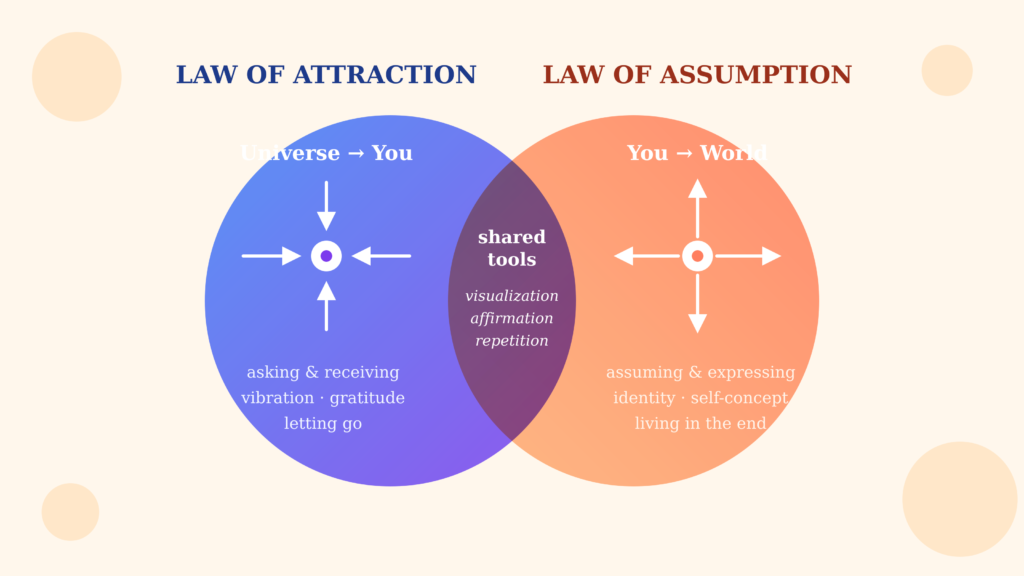
Where the power resides. The law of attraction places it in an external universe or energy field that responds to you. The law of assumption places it in your own consciousness and imagination.
Direction of flow. Attraction moves from the universe to you. Assumption moves from you to the world.
The role of emotion. The law of attraction emphasizes staying positive, grateful, and high in vibration, because mood is thought to set the frequency. The law of assumption cares less about your daily mood and more about the underlying assumption and the felt sense of the wish fulfilled. A person can be having a hard day and still, in this view, hold the assumption.
Attachment and letting go. Attraction teachings commonly advise detaching from the outcome. Assumption teachings say you may stay interested in your desire, provided you are living from the sense that it is already yours rather than from the sense of lack that wanting creates.
Specific desires and specific people. Attraction teachings often counsel openness, and some discourage targeting an individual. Assumption teachings generally encourage you to decide what you want and treat it as settled, including in relationships.
Current circumstances. Attraction practice tends to acknowledge present difficulties while working toward a better emotional state. Assumption practice asks you not to let present appearances dictate your inner state.
Identity. Self-concept is central to the law of assumption. It is present but less foregrounded in the law of attraction, which leans more on thoughts, emotions, and vibration.
In short, one is framed as asking and receiving; the other as assuming and expressing. People who study the law of attraction vs. the law of assumption often find that the two overlap in daily practice. Both use visualization, both use affirmation, and both stress repetition.
What Does the Evidence Say?
Here it helps to separate what has been studied from what is traditional or experiential.
Where research exists. No scientific evidence supports the idea that thoughts emit a vibration that draws matching events to you, and the quantum physics language sometimes attached to the law of attraction is not accepted by physicists. That does not make the practices meaningless to those who use them, but the mechanism as stated is a metaphysical claim, not an established finding.
Psychology does, however, offer findings that touch on parts of both frameworks:
- Expectation and self-concept. Research on self-fulfilling prophecies, from sociologist Robert Merton’s early work to studies of teacher expectations, shows that beliefs can change behavior, which in turn changes outcomes. Albert Bandura’s work on self-efficacy found that people who believe they can succeed tend to persist longer. This is a plausible psychological bridge to the law of assumption’s focus on identity.
- Gratitude. Studies by Robert Emmons and Michael McCullough found that regular gratitude journaling was associated with improved well-being, which supports one pillar of law of attraction practice.
- Visualization, with a caveat. Mental imagery is used in sport and rehearsal, and research by Lien Pham and Shelley Taylor found that students who pictured the process of studying did better than those who only pictured the outcome. Meanwhile, Gabriele Oettingen’s research on positive fantasies suggests that purely imagining success can reduce effort, while pairing a wish with a realistic look at obstacles tends to improve follow-through. Anyone using either method may want to hold that in mind.
- Selective attention. When you decide something matters, you notice more related opportunities. Psychologists often describe this as a change in what you perceive and act on.
Where claims are experiential or traditional. The idea that imagination shapes external reality is a spiritual and philosophical claim with a long history, in Goddard’s teaching and in other mystical traditions. These are lived traditions, and many people find real meaning and change through them. They are not demonstrated by controlled experiments, and it is fair to say so.
Practitioner accounts. Online communities, including the law of assumption Reddit forums, are full of stories about relationships, money, and jobs. One long-time practitioner describes using the law of attraction after reading The Secret around 2007 and getting partial or unfinished results, then returning to manifesting years later through Goddard’s writings. Starting with small experiments, such as a message from an old friend or a free coffee, this person reports bigger outcomes later, including a remote job with a company based abroad. Accounts like this are individual experiences. They are not proof that either method guarantees a result, and the same story can be read through selective memory or coincidence as easily as through manifestation. Both readings deserve a fair hearing.
How to Practice Each Approach
If you want to try one, the most useful step is to choose a single method and give it a fair run, rather than switching every week.

A simple law of attraction practice:
- Write down what you want in plain language.
- Keep a daily gratitude list of three to five specifics.
- Spend a few minutes visualizing the outcome, and add what you would do to move toward it.
- Notice resistance, such as worry or doubt, and soften it rather than fighting it.
- Act on any opportunities that appear.
A simple law of assumption practice:
- Decide on one clear assumption, such as “I am secure in my career.”
- Describe, in the present tense, how someone with that assumption thinks and behaves.
- Use SATS before sleep: replay a short scene that implies the wish is fulfilled, such as a congratulatory call, until it feels real.
- Run a mental diet. When a contradicting thought arrives, notice it and return to your assumption without drama.
- Repeat daily, because repetition is how an assumption becomes a belief rather than a hope.
Practitioners of the law of assumption often say that two things get in the way: hurry and heaviness. Hurry keeps your attention fixed on the fact that you do not yet have the thing. Heaviness turns the practice into a test you can fail. Several people report that results felt easier when they approached it with lightness and curiosity. As a psychological observation, that fits what we know about stress and persistence, so it is useful whichever framework you prefer.
Which Is Better for You?
There is no universal winner. Some people favor the law of assumption because it addresses identity and long-standing limiting beliefs head on, and because it does not demand constant positivity. Others find the law of attraction more approachable, since gratitude and positive focus feel familiar and make a gentle starting point.
A few questions can help you decide. Do you respond better to the idea of receiving or the idea of creating? Does it feel natural to imagine something as already true, or does that feel like pretending? Do you want guidance on emotions, or on identity? Your answers matter more than any teacher’s preference.
You can also borrow from both. Many people combine gratitude with the assumption of fulfillment, and they find the two supportive rather than contradictory. Whichever path you take, use outer action alongside inner work. The strongest case for any manifesting practice is that it changes how you think and how you show up, and those changes are within your reach.
Common Misconceptions
“You must feel happy all the time.” This is a common reading of the law of attraction. It is not a requirement in the law of assumption, and even many attraction teachers note that you cannot fake joy. Honest feeling is better than forced cheer.
“Manifesting means doing nothing.” Neither tradition says action is unnecessary. Most practitioners describe inspired action as part of the process.
“These are the same thing under different names.” They overlap in tools, but they differ in philosophy, as the comparison above shows.
“If it didn’t work, you did it wrong.” This framing can be unkind and unfalsifiable. A fairer view is that these are personal practices whose results vary, and that struggling with them does not make you a failure.
For daily insights on consciousness, clarity, and trusting yourself, explore Bahlon’s free daily transmissions.
Related Readings:
- Guide to the Law of Attraction: Manifesting Miracles
- The Law of Attraction and Manifestation – 5 Ways to Get What You Want
Frequently Asked Questions
What is the law of assumption in simple terms?
The law of assumption holds that what you consistently assume about yourself and your life shapes your outer reality. Instead of wishing, you adopt the state of already having what you desire, a method popularized by Neville Goddard.
Is the law of assumption the same as the law of attraction?
No. They share the goal of manifesting, but the law of attraction describes a universe responding to your vibration, while the law of assumption locates the creative power in your own consciousness and self-concept.
Who created the law of assumption?
Neville Goddard, a mystic and author who taught from the 1940s to the early 1970s, is the figure most associated with it. He described imagination as the faculty that creates experience.
Is there scientific proof for either one?
There is no scientific proof for the metaphysical mechanisms of either. Related psychological research on expectation, self-efficacy, gratitude, and mental rehearsal supports some of the practices, though not the claim that thoughts directly cause external events.
Can you manifest a specific person?
It depends on the teaching. The law of assumption generally says yes, while some law of attraction teachers advise against it because of free will. Considering the other person’s autonomy is wise in any approach.