A meditation guide for beginners is, at its simplest, a roadmap for learning to sit with your own mind on purpose. Meditation itself is the practice of training attention and awareness, usually by anchoring your focus on something steady like the breath, so that the mind settles into a quieter, clearer state. People come to it for very different reasons: stress relief, better sleep, spiritual exploration, or simply a few minutes of stillness in a noisy day, and almost all of them start in the same place, confused about where to begin.
This guide walks through what meditation is, how it works in practical terms, what the evidence does and doesn’t support, and how to build a sustainable practice even if you’ve never sat still for five minutes in your adult life.
What Is Meditation?
Meditation is a mental practice that involves deliberately directing your attention, most often toward the breath, a sound, a phrase, or a physical sensation, to cultivate calm, clarity, and present-moment awareness. It is not one single technique but a broad family of practices, and different traditions approach it with different goals and methods. Any thorough meditation guide for beginners should start here, with the definition, before moving into technique.
The roots of meditation stretch back thousands of years across multiple cultures. Contemplative practices appear in early Hindu and Buddhist traditions in South Asia, in Taoist practices in China, and in various forms of Christian, Jewish, and Islamic contemplative prayer. Buddhist meditation emphasizes mindfulness and insight as paths toward reduced suffering and greater clarity, and much of the secular meditation taught in the West today, often called mindfulness meditation, draws heavily from these Buddhist roots while removing explicitly religious framing.
It’s worth being honest here: meditation as practiced in a wellness app today and meditation as practiced in a monastery five hundred years ago are related but not identical. Secular mindfulness programs, many of which trace back to work done in clinical and academic settings in the late twentieth century, adapted older contemplative techniques into something more accessible for a general audience focused on stress reduction and mental health rather than spiritual liberation. Both lineages have value, and neither cancels out the other. Some people are drawn to meditation purely as a wellness tool, others see it as one part of a larger spiritual or philosophical path, and plenty of people move between the two over time.
What ties all this together is a simple, repeated motion: notice where your attention is, notice when it has wandered, and gently bring it back. Everything else, the postures, the chants, the apps, the cushions, is scaffolding built around that one core motion.
How Meditation Works
The mechanics of meditation are less mysterious than they sound. You choose a point of focus, usually your breath, and you try to keep your attention there. Almost immediately, your mind will drift toward a memory, a worry, a grocery list, or some half-formed thought you didn’t ask for. The moment you notice this drift; you label it gently (sometimes practitioners just think “wandering” or “thinking”) and bring your attention back to your point of focus. Then it happens again and again.
This cycle, noticing, releasing, returning, is the actual practice. A common misunderstanding is that meditation means achieving a blank, thought-free mind. It doesn’t. Even experienced practitioners report constant mental chatter; what changes with practice is the relationship to that chatter, not its volume. The skill being built isn’t the elimination of thought, it’s the recognition of when you’ve been swept away by a thought and the ability to come back without getting frustrated about it. This is the single point most meditation guides for beginners come back to again and again, because it’s the one that actually determines whether the habit sticks.
Physiologically, what tends to happen during a calm meditation session is a shift toward slower, more regular breathing and a reduction in the physical markers associated with the stress response, such as muscle tension and a racing heart. Over repeated sessions, many people describe a gradual strengthening of their ability to notice when their attention has drifted in everyday life, not just on the cushion. This is sometimes described as exercising attention the way you’d exercise a muscle: each time you notice wandering and return your focus, you’re reinforcing the same mental pathway, making it slightly easier to do the next time.
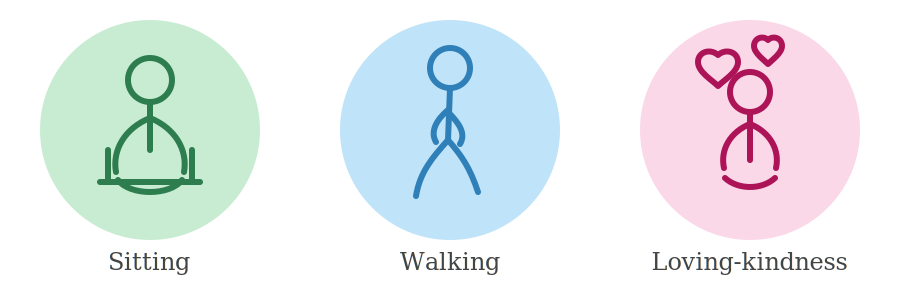
Different techniques work this same basic mechanism of meditation guide through different doors. In body scan meditation, you move your attention slowly through different parts of the body, noticing sensation without trying to change anything.In mantra meditation, a word or phrase replaces the breath as the anchor.In walking meditation, the sensation of each step becomes the focal point. In loving-kindness meditation, the “anchor” is a set of phrases directed first at yourself and then outward toward others, shifting the practice from pure attention training toward cultivating warmth and goodwill. None of these is more “correct” than the others; they’re different entry points into the same underlying skill.
Benefits of Meditation
People who meditate regularly report a consistent list of changes: lower stress, better focus, improved sleep, a calmer emotional baseline, and a stronger sense of self-awareness. This is usually the section any meditation guide for beginners gets asked about most, so it’s worth being precise about it. Some of these claims have meaningful research behind them, others are better described as widely reported personal experience that hasn’t been (or can’t easily be) tested in a lab.
On the more evidence-supported end, mindfulness-based practices have been studied extensively in relation to stress reduction, and several clinical and academic studies have found associations between regular mindfulness meditation and lower self-reported stress and anxiety symptoms. Research on attention has also found that consistent short daily practice, in some studies as little as roughly ten to twelve minutes a day across a working week, was associated with measurable improvements in sustained attention. Sleep researchers have likewise found associations between mindfulness practice and improved sleep quality for some practitioners, particularly those whose sleep difficulties are tied to racing thoughts or stress.
On the more experiential end, you’ll often hear practitioners describe benefits like deeper self-understanding, a greater sense of connection to others, reduced reactivity in difficult conversations, or a general feeling of being “more present.” These are real and meaningful to the people reporting them, but they’re harder to measure objectively, and it would be overstating things to call them scientifically proven in the way a controlled, measurable effect on attention or stress hormones can be. It’s also worth noting that meditation guide is not positioned by most reputable sources, traditional or clinical, as a cure-all. It does not replace medical or psychiatric treatment for serious conditions, and the research itself is generally framed in terms of association and modest improvement rather than guaranteed transformation.
What seems true across both the measured and the anecdotal evidence is this: meditation tends to create a small amount of space between a stimulus and your reaction to it. What you do with that space, whether it’s choosing not to snap at someone, noticing tension in your body before it becomes a headache, or simply feeling less swept along by your own thoughts, is where most of the reported benefit lives.
How to Get Started: A Meditation Guide for Beginners
You don’t need a cushion, an app subscription, or a quiet mountain retreat to begin. You need a few minutes and a willingness to feel a little awkward at first. Here’s a straightforward way to start.
1. Find a seat that works for you.
A chair with your feet flat on the floor is perfectly fine. So is sitting cross-legged on a cushion or kneeling, if that’s comfortable. The goal is stability, not a particular posture.
2. Settle your posture without forcing it.
Let your spine lengthen naturally rather than rigidly straightening it. Rest your hands on your legs or in your lap.
3. Pick a short, realistic time limit.
Beginners often do best start with two to five minutes and building up gradually to ten or twenty as the habit solidifies. There’s no prize for jumping straight to forty-five minutes on day one.
4. Choose an anchor, most simply the breath.
Notice the physical sensation of air moving in and out, whether that’s at your nostrils, your chest, or your belly rising and falling.
5. Expect your mind to wander, because it will.
When you notice, your attention has drifted to a memory, a plan, or a stray thought, that noticing is the practice working, not a failure of it. Gently bring your focus back to your breath.
6. Close with a moment of awareness.
Before you get up, take a few seconds to notice sounds around you, how your body feels, and your general state of mind.
If sitting still with your breath doesn’t click for you right away, that’s common, and there are other doors into the same practice. Most meditation guides for beginners list a few alternatives worth trying. A body scan, moving your attention slowly through different parts of your body, works well for people who find a single point of focus too restrictive. Walking meditation, where you slow down and pay close attention to each step, suits people who find stillness agitating. Guided audio sessions are also a reasonable way to start, since having a voice gently redirect your attention can make the early sessions feel less like flailing in the dark.
Consistency tends to matter more than duration. Five minutes a day for a month will generally build a more durable habit than one twenty-minute session followed by two weeks of nothing.
Common Misconceptions About Meditation
A few myths follow meditation around, often discouraging beginners before they really try it. Most good meditation guides for beginners spend as much time clearing these up as they do teaching technique.
“You’re supposed to clear your mind completely.” This is probably the single most common misunderstanding, and it sets people up to feel like they’re failing within the first thirty seconds. The goal isn’t an empty mind, it’s noticing when your mind is full and gently coming back to your point of focus, repeatedly. A wandering mind during meditation isn’t a sign you’re bad at it; it’s the raw material the practice works with.
“Meditation requires a particular religion or belief system.” Many meditation techniques have deep roots in specific spiritual traditions, and that history is worth respecting and learning about if it interests you. But secular mindfulness practice, as taught in most clinical, workplace, and wellness settings today, doesn’t require adopting any belief system. People of many faiths, and people of no faith, practice meditation for entirely different reasons and find value in it.
“It only counts if you do it for thirty minutes or more.” Short sessions are not a lesser, “starter” version of real meditation. A focused five-minute practice done consistently has real value, and for many beginners it’s a far more sustainable entry point than an ambitious hour-long sit that gets abandoned after three days.
“If I’m not feeling instantly calmer, it isn’t working.” Meditation guide is not always a relaxing experience in the moment, especially early on. Sometimes sitting with your own mind brings up restlessness, boredom, or unresolved emotions you’d normally distract yourself away from. That discomfort isn’t evidence that the practice has failed; it’s often exactly what the practice is designed to help you notice and sit with.
“You either have the kind of brain that can meditate, or you don’t.” Wondering whether you’re simply “bad” at meditating is something almost every practitioner experiences, often repeatedly. Noticing that doubt, and then gently returning your attention to your breath anyway, is itself the practice in action, not evidence that you’re exempt from it.
Meditation Guide for Beginners: Tips and Best Practices
Starting a meditation practice is less about discipline and more about designing your environment so the habit has somewhere to land. Here’s where most meditation guides for beginners agree.

- Anchor it to an existing routine. Practicing right after waking up or right before bed, rather than trying to find a random free moment, makes it far more likely you’ll follow through.
- Use reminders and refresh them. A meditation cushion left in plain sight, or a recurring phone reminder, works for a while until your brain starts ignoring it. Changing up your cues every so often, rather than relying on the same sticky note for months, keeps them effective.
- Don’t judge the quality of a session by how calm you felt. Some of your most valuable sessions will feel restless or scattered. The value is in the returning, not in achieving a particular feeling.
- Decide in advance whether your eyes will be open or closed. Both are completely workable. Closed eyes with a relaxed face suit many beginners; a soft, slightly downward open gaze works well for people who feel drowsy with their eyes shut.
- Treat interruptions calmly. A barking dog, a notification, an itch you’re tempted to scratch, none of these “ruin” a session. Noticing the urge, sitting with it for a moment, and then responding (or not) is part of the practice, not a deviation from it.
- Consider whether group or solo practice suits you better. Practicing with others can offer accountability and a sense of shared commitment, while solo practice builds independence and flexibility. Many people use both at different points.
- Be cautious with background music. Calming music can help some beginners settle in, but it also gives the mind something external to lean on rather than fully experiencing your own breath, body, and surroundings. It’s worth trying both silence and music to see which actually deepens your focus.
- Expect plateaus and rough patches. Like any skill, meditation rarely improves in a straight line. A few weeks of feeling stuck doesn’t mean the practice has stopped working.
If there’s one thing every solid meditation guide for beginners should leave you with, it’s this: the practice rewards patience far more than perfection.
If exploring this meditation guide for beginners has opened questions about your own path, you may find value in Bahlon’s free daily transmissions, brief insights for people seeking clarity. Subscribe here to receive them.
Frequently Asked Questions About Meditation
Is meditation the same as relaxation?
Not exactly. Relaxation is sometimes a side effect of meditation, but the actual goal is attention training and present-moment awareness, not necessarily feeling calm in the moment. Some sessions feel relaxing, others feel effortful, and both are normal.
Is this meditation guide for beginners useful if I already meditate occasionally?
Yes. While the steps are written for someone starting from zero, the sections on misconceptions, technique alternatives, and evidence-versus-anecdote are just as relevant to someone restarting a lapsed practice or troubleshooting an inconsistent one.
How long should a beginner meditate for?
Most meditation guides suggest starting with five to ten minutes, and even a single minute is a reasonable starting point if longer sessions feel overwhelming. Duration matters less than consistency in the early weeks.
Do I need to sit in a special posture to meditate?
No. A stable, comfortable seated position, in a chair, cross-legged, or kneeling, works fine. What matters is being able to hold the position without excessive discomfort, not following a particular traditional posture.
What if I genuinely can’t stop my mind from wandering?
Everyone’s mind wanders, including experienced practitioners. The moment you notice the wandering and return your attention to your breath is the practice working correctly, not a sign that you’re failing at it.
Can meditation replace therapy or medical treatment?
No. Meditation can support emotional regulation and stress management, and some research links it to modest improvements in mood and sleep, but it isn’t a substitute for professional mental health or medical care, particularly for serious or persistent conditions.