Mercury retrograde is the period when the planet Mercury appears, from our vantage point on Earth, to move backward through the sky. It happens three to four times a year, lasts around three weeks each time, and in astrology is linked to hiccups in communication, technology, and travel. The planet itself never actually reverses course; the “backward” motion is a trick of perspective, though the cultural and astrological meaning attached to it is very real for the people who track it.
That distinction, between what is happening astronomically and what is believed to happen astrologically, is the whole story of Mercury retrograde. Understanding both sides makes the phenomenon far less mysterious and, for many people, far less stressful.
What Is Mercury Retrograde, Exactly?
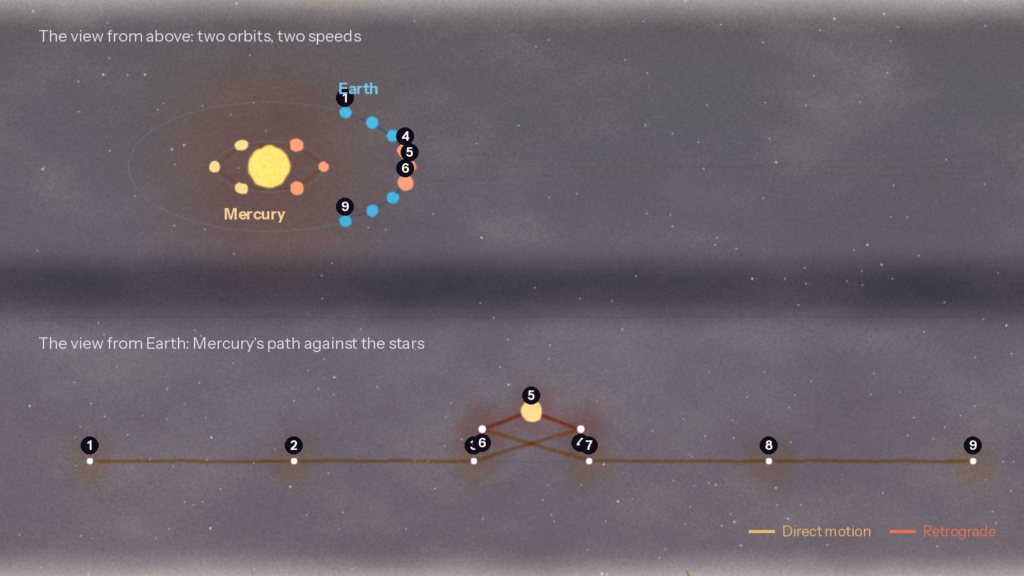
In plain astronomical terms, retrograde motion is an optical illusion. Mercury orbits the sun much faster than Earth does, completing a full lap in just 88 days. Because Mercury and Earth travel at different speeds and along different paths, there are stretches of time when Earth “overtakes” Mercury on the inside track, similar to passing a slower car on the highway. During that overtaking window, Mercury seems to slow down, pause, and briefly drift backward against the background stars before resuming its normal forward path.
This is called apparent retrograde motion, and it isn’t unique to Mercury. Every planet in the solar system appears to do it periodically, simply because of the mechanics of relative orbital speed. Mercury’s version gets outsized attention mainly because it happens more often than any other planet’s retrograde, roughly three times a year, and because astrology has long assigned Mercury rulership over communication, technology, contracts, and short-distance travel.
So when people ask what Mercury retrograde means, there are really two honest answers. Astronomically, it means Earth and Mercury have lined up in a way that changes our viewing angle. Astrologically, it means the areas of life associated with Mercury, talking, texting, emailing, commuting, signing things, are considered more prone to friction, delay, and miscommunication for a few weeks at a time.
How the Retrograde Cycle Actually Works
A full Mercury retrograde cycle unfolds in three parts, and understanding all three is useful because most of the disruption people report doesn’t start or stop on the official dates.
Pre-retrograde shadow. Mercury moves through a stretch of the zodiac, gradually slowing down as it approaches its retrograde station. Astrologers often compare this to preheating an oven: the effects are usually mild, but questions or small frustrations start to surface.
The retrograde itself. This is the main event, when Mercury appears to travel backward through the same zodiacal territory it just crossed. This is typically the roughly three-week window most calendars refer to when they cite Mercury retrograde dates.
Post-retrograde shadow. After the planet stations direct again, it spends another two to three weeks retracing the same ground a third time, moving forward. Residual glitches and unresolved loose ends tend to show up here before things settle.
Because of these shadow periods on either side, the felt influence of one retrograde cycle can stretch closer to two months, even though the “official” retrograde itself is about three weeks long. That’s part of why the question “when does Mercury retrograde end” can have two different honest answers: the date Mercury stations direct, and the later date when its shadow finally clears.
For reference, here are the confirmed 2026 and 2027 Mercury retrograde dates:
2026
- February 26 to March 20 (Pisces)
- June 29 to July 23 (Cancer, moving into Gemini)
- October 24 to November 13 (Scorpio)
2027
- February 9 to March 3 (Pisces into Aquarius)
- June 10 to July 4 (Cancer into Gemini)
- October 7 to 28 (Scorpio into Libra)
What the Evidence Actually Says
It’s worth separating the two lenses through which Mercury retrograde gets discussed, because both deserve honest treatment.
From a scientific standpoint, there is no established mechanism by which a planet’s apparent position in the sky would influence electronics, human moods, or travel logistics on Earth. Peer-reviewed research into astrology as a predictive system has not found reliable evidence for planetary influence on daily events, and mainstream science treats the planet’s shift in position as exactly what it is: a geometric effect of two bodies orbiting the sun at different speeds. Anyone approaching Mercury retrograde purely as a testable physical force will find the astronomical case thin.
From an astrological and cultural standpoint, the picture looks different. Practitioners who work with these cycles describe Mercury retrograde less as a curse and more as a seasonal check-in, a recurring nudge to slow down, double-check details, and revisit unfinished business. Many people who track these periods report noticing more typos in their texts, more scheduling mix-ups, or more old acquaintances resurfacing, though it’s fair to note that confirmation bias, where a person notices problems more because they’re primed to look for them, likely plays some role in how strongly this pattern is felt.
Neither view has to cancel the other out. Whether or not Mercury’s position causes anything, treating the retrograde period as a built-in reminder to pause, proofread, and reflect is a practice that can genuinely improve how someone communicates and plans, regardless of the underlying mechanism.
Who Tends to Feel It Most
Astrologers generally agree that Mercury retrograde touches everyone to some degree, but certain charts are considered more sensitive to it. Those with Mercury-ruled sun or rising signs, Gemini and Virgo in particular, are often described as feeling the classic symptoms most intensely: scattered thoughts, communication snags, and a pull to revisit old plans. (If you don’t already know your rising sign, our guide to calculating it walks through the basics.) People with natal Mercury placed near their ascendant, or in the third house traditionally tied to communication and short trips, are also thought to be more attuned to the shift.
That said, not every bump in the road during a retrograde is necessarily personal. Some astrologers frame certain transits as more collective, meaning the friction shows up around a person rather than directly to them, through a family member’s scheduling conflict, a coworker’s miscommunication, or a partner’s unresolved matter resurfacing.
How to Handle Mercury Retrograde in Practice
Whatever framework someone brings to it, there are concrete, low-effort habits that tend to make the retrograde period smoother.

Double-check before you send or sign. Proofread emails and texts before hitting send, confirm travel details twice, and back up important files. If a contract or major purchase can reasonably wait a few weeks, many astrologers suggest holding off, particularly on new electronics, software, or vehicles, since those fall squarely under Mercury’s traditional domain.
Build in extra time. Traffic delays, rescheduled meetings, and slower replies are common complaints during this window. Padding your schedule, rather than reacting to every delay as a crisis, tends to lower the frustration considerably.
Use the “re-” words as a checklist. The recurring theme across nearly every tradition that discusses this cycle is revisiting rather than launching. Reviewing old projects, reconnecting with people you’ve lost touch with, revising a plan that never quite worked, and reflecting on a decision from a calmer vantage point are all considered productive uses of retrograde energy, even by skeptics who simply appreciate a built-in prompt for reflection.
Turn inward when things slow down. Journaling, meditating, or simply sitting with a frustration instead of reacting to it immediately can turn an annoying delay into useful downtime. If you’re looking for a place to start, this piece on building a simple journaling practice is a good companion for retrograde season.
Keep your plans flexible. If an old friend or former colleague unexpectedly reappears, or a stalled project suddenly resurfaces, treat it as an invitation rather than an inconvenience. Many people describe their most meaningful reconnections happening precisely during these windows.
Common Misconceptions Worth Clearing Up
A few myths tend to follow Mercury retrograde around. The first is that Mercury physically stops or reverses in space; it doesn’t, the movement is purely a matter of perspective. The second is that every single mishap during a three-week window is somehow caused by the planet; delays, typos, and awkward conversations happen constantly regardless of what Mercury is doing, and attributing all of them to retrograde can obscure patterns worth examining on their own terms. The third misconception is that Mercury retrograde is something to dread. Even among astrologers who take it seriously, the framing has shifted in recent years toward viewing it as a built-in pause rather than a punishment, a recurring invitation to slow down in a culture that rarely encourages that on its own. It’s also worth noting that Mercury isn’t the only planet that does this: Venus retrograde follows a similar apparent-motion pattern but touches relationships and values rather than communication.
For daily insights on consciousness, clarity, and trusting yourself, explore Bahlon’s free daily transmissions. Subscribe here to receive them directly.
Related Readings:
- What Is Spiritual Discernment? A Complete Guide
- Synchronicity vs. Coincidence: Carl Jung’s Theory Explained
- Shadow Work Guide: Everything You Need to Know
Frequently Asked Questions
How long does Mercury retrograde last?
The main retrograde period lasts about three weeks, but including the pre- and post-retrograde shadow phases on either side, the full cycle’s influence is often felt for closer to two months.
How many times a year is Mercury retrograde?
Mercury typically goes retrograde three times a year, though in rarer years it can happen four times.
Is Mercury in retrograde right now?
This depends on the current date relative to the published retrograde windows for the year. Checking a current Mercury retrograde calendar against today’s date is the most reliable way to know, since the exact stations and shadow periods shift slightly each year.
What does it mean when Mercury is in retrograde?
Astronomically, it means Earth has passed Mercury in orbit, making Mercury appear to move backward from our point of view. Astrologically, it’s considered a period when communication, technology, and travel are more prone to delays and miscommunication, and when revisiting unfinished matters is favored over starting new ones.
When does Mercury retrograde end?
Each retrograde ends on its station-direct date, when Mercury appears to resume forward motion, but its lingering effects are generally thought to ease over the following two to three weeks as the post-retrograde shadow clears.