Oracle cards vs tarot cards is a question nearly every beginner faces before buying their first deck, and the short answer is this: oracle cards suit people who want simple, intuitive guidance without much study, while tarot cards suit people who want a structured system built for deeper, more analytical readings. Neither is “better.” They’re built for different purposes, and many longtime practitioners eventually use both. The right starting point depends less on which system is more powerful and more on how you naturally like to receive information.
This piece breaks down what separates the two, how each actually works, what research and practitioner experience suggest, and how to decide which deck deserves a spot on your shelf first.
Oracle Cards vs Tarot Cards: What Sets Them Apart
At the most basic level, tarot is a fixed system and oracle is a flexible one. Every traditional tarot deck contains 78 cards divided into two parts: the Major Arcana (22 cards representing significant life events and spiritual turning points) and the Minor Arcana (56 cards split into four suits, each tied to a different area of life). Cups relate to emotion and relationships, Wands to ambition and creativity, Swords to intellect and conflict, and Pentacles to material and financial matters. This structure has stayed largely consistent for centuries, which means the meaning of, say, the Three of Swords is broadly recognizable across most decks, regardless of who illustrated them.
Oracle decks don’t follow any of that. A creator can design an oracle deck with 36 cards or 100, built around a single theme like angels, animals, moon phases, or self-love, with no obligation to reference any external system. There’s no Major or Minor Arcana equivalent, no suits, and no universal card meanings. Each deck defines its own rules, which is precisely why oracle cards feel more approachable to newcomers: there’s nothing standardized to memorize.
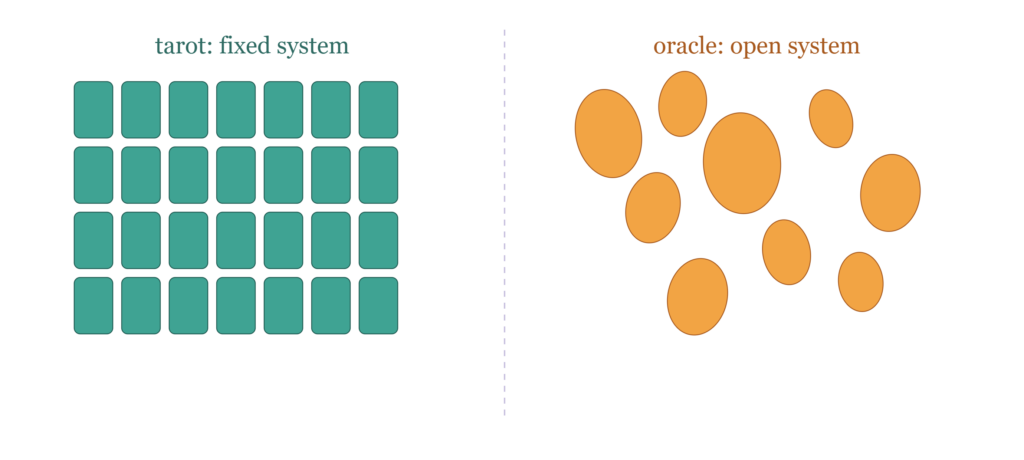
This structural gap is the reason most comparisons of tarot vs oracle cards start here. Everything else, the learning curve, the reading style, the depth of guidance, flows from this one difference.
How Each System Actually Works
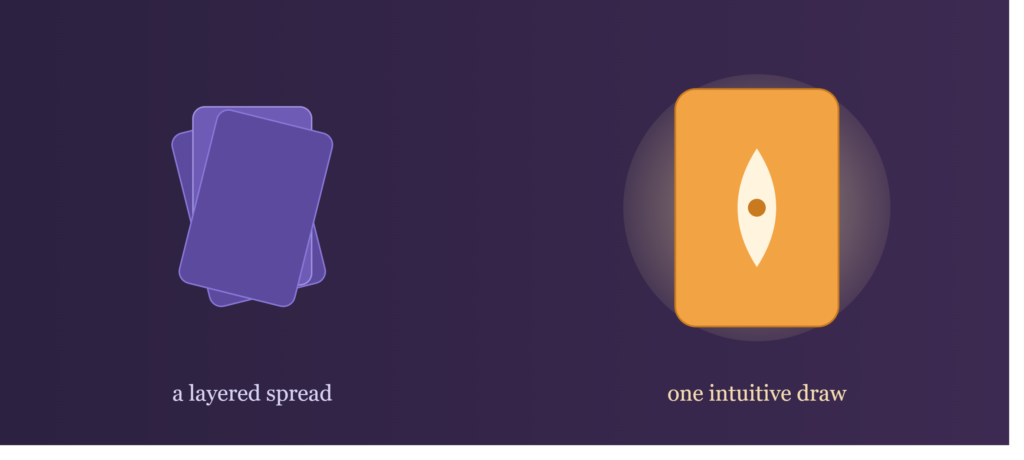
Tarot readings lean on a layered interpretation process. A reader considers the card’s traditional meaning, its position within a spread (a three-card spread for past-present-future, a Celtic Cross for a more detailed situation), its relationship to neighboring cards, and often symbolic details tied to numerology, astrology, or mythology embedded in the artwork. Getting comfortable with this takes time. Most people spend months, sometimes years, building fluency with all 78 cards and how they interact.
Oracle readings work more directly. Many oracle cards include a keyword or a short message printed right on the card, so a reader can draw one card, read the accompanying guidebook entry, and sit with the message without needing to cross-reference a spread or a secondary meaning. The emphasis is on immediate emotional resonance rather than technical interpretation. This is why oracle cards are so often used for a single daily draw: pull a card, read the prompt, carry the message into the day.
Neither approach is inherently more accurate or “correct.” They’re simply different tools calibrated for different kinds of questions, comparable to the difference between a detailed map and a compass. One gives you layered detail; the other gives you a direction to move in.
What Research and Practitioner Experience Suggest
It’s worth being direct about where the evidence stands. There is no peer-reviewed scientific research validating that either tarot or oracle cards predict future events or access information beyond what the reader already holds. Psychologists who have studied divinatory practices generally frame their value through the lens of projection and reflection: ambiguous imagery and open-ended prompts can help people articulate feelings or perspectives they hadn’t consciously organized yet, a mechanism similar to what’s documented in research on the Rorschach test and other projective tools, though tarot and oracle cards themselves haven’t been the subject of controlled clinical trials.
Where the evidence is more substantial is around reflective practices generally. Structured journaling, mindfulness exercises, and other tools that prompt self-examination have documented benefits for stress reduction and emotional clarity, and card-based practices function similarly for many people: as a structured pause for reflection rather than a mechanism of prediction.
Practitioner accounts, which are experiential rather than scientific, consistently describe tarot as valuable for working through complex or layered situations, such as a career decision with multiple competing factors, because the spread format naturally organizes different angles of a problem. Oracle cards, by contrast, are more often described as useful for emotional check-ins, encouragement, or grounding during an overwhelming day. Readers who’ve used both systems often say the honest answer to “which is better” is “it depends what you’re asking.”
Choosing Your Starting Deck: A Practical Approach
If you’re deciding where to begin, a few questions can clarify things quickly.
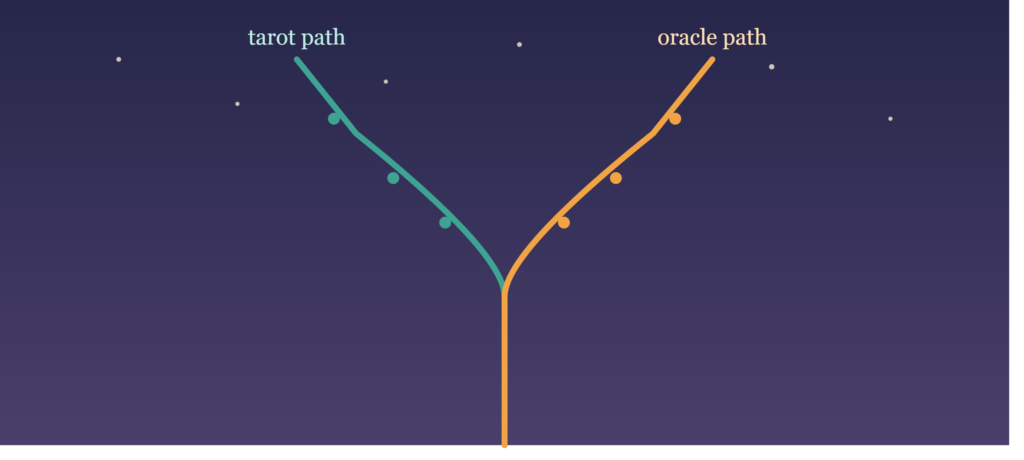
Do you want quick, low-pressure guidance, or deep analytical insight? If you’re drawn to short daily affirmations and don’t want to memorize anything, oracle cards are the more forgiving entry point. If you want to sit with a genuinely complex question and work through it methodically, tarot’s structure rewards that kind of engagement.
How much time do you want to invest before you feel competent? Oracle decks can feel usable within a single sitting, since most come with a guidebook that pairs directly with each card. Tarot has a real learning curve. Getting comfortable enough to read confidently, especially with multi-card spreads, typically takes consistent practice over weeks or months.
What kind of questions do you tend to ask? People drawn to “how do I feel about this” or “what do I need to hear today” tend to gravitate toward oracle. People drawn to “why does this pattern keep repeating in my life” or “what are the different angles of this decision” tend to find tarot more satisfying.
Beyond the practical questions, artwork matters more than people expect. A deck you feel genuinely drawn to visually is one you’ll actually pick up and use. Skimming card imagery online before buying, rather than choosing based on structure alone, is one of the most reliable ways to land on a deck that sticks.
Using Tarot and Oracle Cards Together
Many practitioners don’t treat this as an either-or decision for long. Combining both systems is common practice once someone has spent time with each individually. A frequent method is using an oracle card to open or close a tarot reading: drawing an oracle card first to set an emotional tone, then working through a tarot spread for detail, then closing with a second oracle card as a final takeaway message. Oracle cards are also used to clarify a tarot card that feels ambiguous, essentially acting as a second opinion within the same reading.
The logic behind combining them is straightforward: tarot supplies structure and depth, while oracle supplies emotional clarity and a softer landing point. Readers who use both often describe it as balancing the analytical and the intuitive sides of a practice, rather than choosing one mode of thinking over the other.
Common Misconceptions Worth Clearing Up
A few misunderstandings come up often enough to address directly. Oracle cards are sometimes dismissed as “less serious” or less legitimate than tarot because they lack a fixed structure, but simplicity isn’t the same as shallowness. A well-designed oracle deck can prompt just as much genuine reflection as a tarot spread; it’s simply doing it through a different mechanism.
On the other side, tarot is sometimes assumed to require special intuitive ability or a “gift,” when in practice it functions more like learning a symbolic language. Fluency comes from repetition and familiarity with the cards, not innate psychic talent, which is part of why many practitioners describe tarot as something that becomes easier and more personally meaningful with consistent use rather than something you either have or don’t.
For daily insights on consciousness, clarity, and trusting yourself, explore Bahlon’s free daily transmissions. Subscribe here to receive them directly.
Related Readings:
Frequently Asked Questions
Is it better to start with oracle cards or tarot cards?
There’s no universal answer, but oracle cards are generally the gentler starting point for beginners who want simplicity, while tarot suits those who want a structured system and don’t mind a learning curve.
Can oracle cards and tarot cards be used in the same reading?
Yes. A common approach uses oracle cards to open or close a reading, or to clarify a tarot card whose meaning feels unclear in context.
Do oracle cards have fixed meanings like tarot cards?
No. Oracle card meanings are defined by each deck’s creator, so they vary widely from deck to deck, unlike tarot’s broadly consistent 78-card structure.
How long does it take to learn tarot?
Most people need several months of regular practice to feel confident reading tarot spreads, though a basic understanding of the Major Arcana can come much faster.
Is there scientific proof that tarot or oracle cards work?
No controlled research validates predictive claims for either system. Their documented value, where studied indirectly through related reflective practices, tends to center on self-reflection and emotional processing rather than forecasting.