Simulation theory is the idea that reality as we experience it, including the physical universe and human consciousness, might actually be an artificial construct generated by an advanced computing system rather than a fundamental, “base level” reality. It is not a fringe conspiracy theory. It has been argued seriously by philosophers, physicists, and technologists, most notably in a 2003 paper by Swedish philosopher Nick Bostrom. Whether or not it’s true remains unknown and, by most accounts, unprovable with current tools, but the reasoning behind it draws on some of the oldest questions in philosophy and some of the newest findings in physics.
What Simulation Theory Actually Claims
At its core, simulation theory suggests that everything we perceive, from the chair you’re sitting in to the thoughts running through your head, could be the output of a program running on hardware far beyond anything humans have built. It doesn’t necessarily mean the world is “fake” in the sense of being meaningless. It means the substrate underneath it might be computational rather than physical in the way we assume.
The concept has a long philosophical lineage. Plato’s allegory of the cave imagined prisoners who mistake shadows on a wall for the whole of reality, never suspecting a truer world exists beyond their senses. Centuries later, René Descartes wondered whether an all-powerful deceiver could be feeding false experiences directly into his mind, making him doubt everything except the fact that he was doubting. Modern simulation theory picks up this same thread of radical skepticism and updates it with the language of computer science, quantum physics, and probability.
It’s worth being precise about terminology here, since the phrase gets used loosely. “Simulation hypothesis” and “simulation theory” are generally used interchangeably, though hypothesis is the more academically accurate term since it hasn’t been tested or confirmed. When people ask what simulation theory means in plain language, the short answer is this: it’s the proposal that our universe, including us, might be running inside something like an extraordinarily advanced version of a video game or virtual environment, designed and operated by an intelligence we can’t directly perceive.
Nick Bostrom’s Simulation Theory and the Trilemma
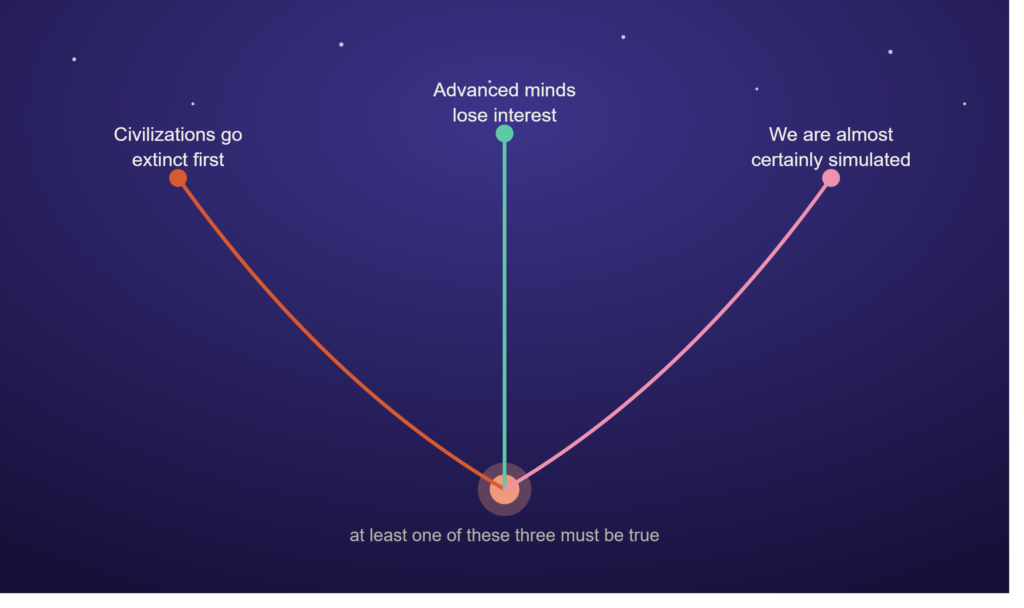
The modern version of this idea is closely tied to one name. Nick Bostrom’s simulation theory, published in a 2003 paper titled “Are You Living in a Computer Simulation?”, didn’t argue that we definitely are in a simulation. Instead, he built a logical trilemma, a set of three statements, at least one of which he argued must be true:
- Almost every civilization at our level of development goes extinct before becoming advanced enough to run detailed simulations of their ancestors.
- Civilizations that do reach that level of advancement choose not to run such simulations, perhaps for ethical or practical reasons.
- We are almost certainly living inside a simulation right now.
Bostrom’s reasoning was probabilistic rather than mystical. If even one sufficiently advanced civilization ran many simulations of ancestor-like minds, the number of simulated minds would vastly outnumber the number of “real” biological ones. Statistically, he argued, a randomly selected conscious mind would be more likely to be one of the many simulated ones than one of the few original ones.
Other thinkers have expanded on this. NYU philosopher David Chalmers described whoever or whatever might be running such a simulation as a kind of “programmer in the next universe up,” a figure some people might call god, though not necessarily in a religious sense. He’s noted that this entity could be something as mundane as, in his words, a teenager running background simulations, or something closer to an all-knowing, all-powerful presence in relation to our world. Author and technologist Rizwan Virk, who has written extensively on the topic, has framed conscious, human-like AI as an eventual likelihood rather than a certainty, suggesting humanity may be roughly halfway along a long technological road toward that capability.
How a Simulated Universe Could Actually Work
There are two broad scenarios researchers and writers tend to describe.
Scenario one: everything is simulated. In this version, every particle, every event, every sensation, including your own inner thought process, is generated by code. This would require processing power capable of modeling the physics of an entire universe down to the finest detail, essentially an unimaginably vast open-world program running on hardware beyond current human comprehension, possibly involving forms of quantum computing we haven’t yet developed.
Scenario two: only the environment is simulated. Here, human minds are assumed to be real and biological, but much of what surrounds them, from other “people” to entire landscapes, is generated. This is closer to the version depicted in The Matrix, where machines feed false sensory signals directly into real human brains. For this scenario to work, a few things would need to exist: technology sophisticated enough to convincingly trick human consciousness, simulated characters realistic enough to pass something like the Turing Test, and enough computing power to sustain it all convincingly.
Interestingly, humans are already building early, crude versions of the technological building blocks such a system might need. Virtual reality creates increasingly convincing sensory illusions. Brain-computer interfaces are being developed to send signals directly into neural tissue, bypassing the normal senses entirely. And artificial intelligence is edging closer, however slowly, toward systems that can hold convincing, humanlike conversations. None of this proves we’re in a simulation. It simply shows that the theoretical mechanics aren’t entirely science fiction.
The Evidence: What Science and Philosophy Say
This is where simulation theory gets genuinely interesting, and genuinely contested.
Several physicists have pointed to odd features of the universe that seem to echo the constraints of a computed system. The Planck length and the speed of light both function as hard limits, not unlike the resolution cap or processing ceiling of a video game engine. Some researchers in the field of digital physics go further, arguing that information itself, not matter or energy, might be the most fundamental building block of reality, with space and time emerging as outputs of ongoing computational processes rather than existing as a backdrop to everything else.
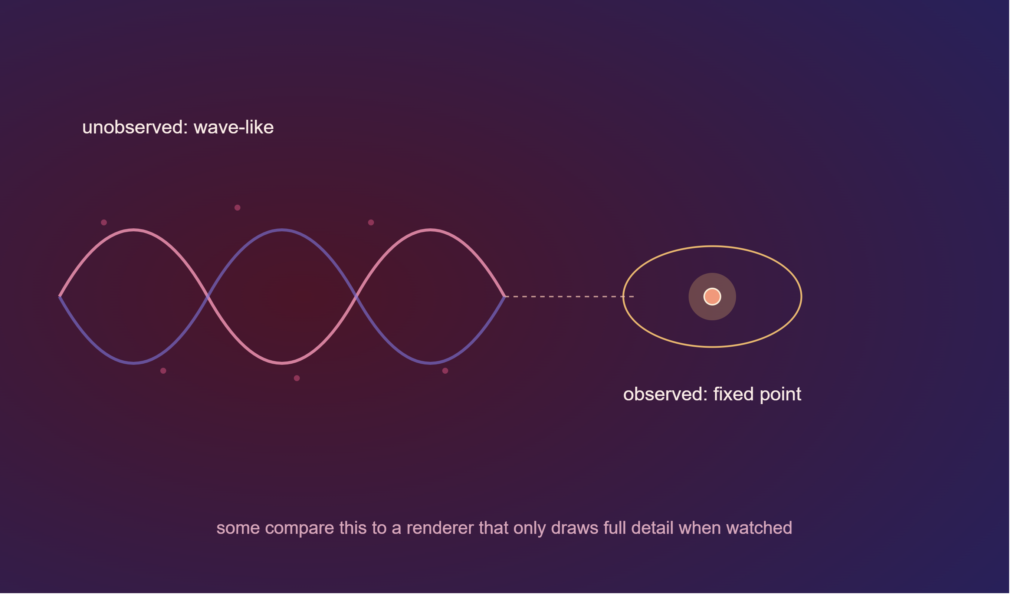
Quantum mechanics offers another point of discussion. Particles behave differently depending on whether they’re being observed, a phenomenon known as the observer effect. Some commentators have compared this to a rendering optimization in video games, where an engine only generates full detail for the parts of the world a player is actively looking at. It’s a compelling metaphor, though most physicists would caution against treating it as literal proof of anything.
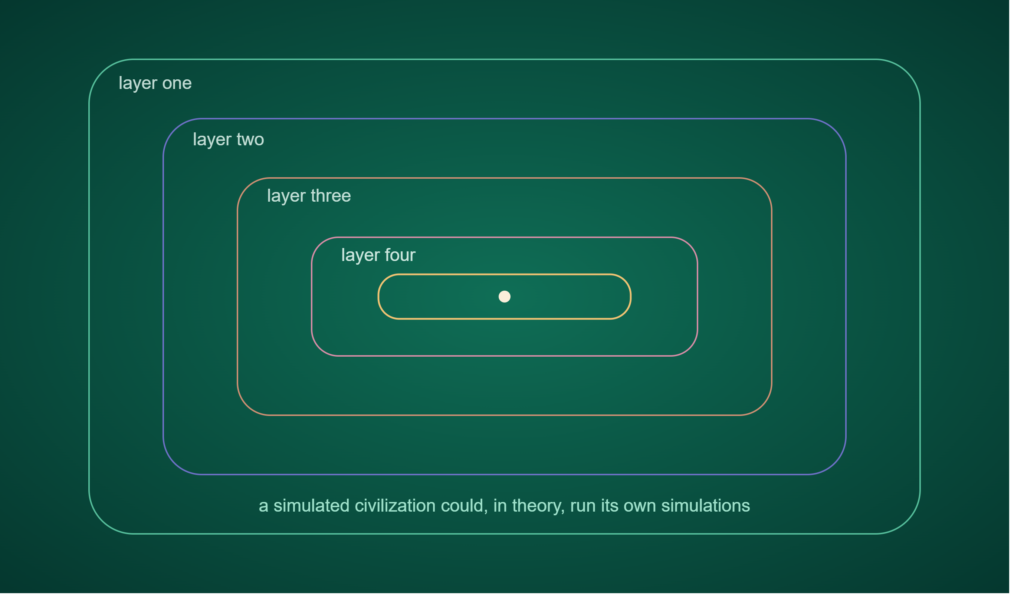
Cosmologist Paul Davies has written about the mathematical possibility of nested simulations, worlds simulating other worlds, which could in theory stack infinitely, meaning virtual universes might vastly outnumber “real” ones if even one civilization ever built the first one. Astronomer Martin Rees has raised a related point: humans already run enormous simulations, such as modeling colliding galaxies on supercomputers, and the open question is simply how far that computing power might eventually go for a sufficiently advanced civilization.
On the skeptical side, the criticisms are substantial. The theory isn’t falsifiable by any known experiment, which places it outside the normal boundaries of testable science. The raw computational cost of simulating every quantum state of every particle in a universe this large appears, by current physics, to exceed the resources available in any known physical system. Physicists Zohar Ringel and Dmitry Kovrizhi published research in 2017 showing that a classical simulation method called quantum Monte Carlo cannot be used to simulate a quantum computer, a real technical obstacle for the theory, though Ringel himself acknowledged that we simply don’t know the computing capabilities of whatever might be simulating us, if anything is.
At a well-known 2016 public debate featuring Chalmers, Neil deGrasse Tyson, Zohreh Davoudi, and Lisa Randall, Randall was the most openly skeptical, questioning why an advanced civilization would specifically choose to simulate humans among the near-infinite things it could choose to simulate instead. It’s a fair challenge to the probability logic Bostrom’s argument depends on.
There’s also a stranger, more unsettling angle. Philosopher Preston Greene has argued that proving we’re in a simulation could actually be dangerous, reasoning that if a simulation exists to study some foundational reality, discovering and publicizing that fact might render the simulation pointless to whoever built it, potentially prompting them to end it. Whether or not you find that persuasive, it illustrates how far this discussion extends beyond ordinary armchair speculation.
Living With the Question: A Practical Approach
Most people aren’t going to resolve simulation theory through personal contemplation, and that’s fine. What tends to be more useful is treating the question as a lens rather than a verdict.
If you find the idea intriguing, a grounded way to engage with it is to separate the parts that are testable from the parts that aren’t. The physics-based arguments (computational limits, the observer effect, digital physics) are genuinely part of ongoing scientific conversation, even if inconclusive. The philosophical arguments (Plato’s cave, Descartes’s demon, Bostrom’s trilemma) are about the limits of what we can ever know for certain, a much older and, in some ways, more honest kind of uncertainty.
For many people, the real value of the theory isn’t determining whether it’s literally true. It’s the way it reframes ordinary experience. If reality operates by consistent rules, whether those rules are physical laws or computational ones, then understanding those rules still matters for how you live inside them. Rizwan Virk has made roughly this point: the goal of exploring simulation theory is the same as the goal of good science generally, which is getting closer to the truth about our own existence, and if there are patterns or “rules” to notice, understanding them can meaningfully change how well someone navigates their own life.
Common Misconceptions About Simulation Theory
A few misunderstandings come up repeatedly. First, simulation theory doesn’t claim the world is meaningless or that nothing “counts.” Pain, relationships, and choices would still function the same way within a simulated system as they would in a purely physical one; the theory concerns the underlying substrate, not the value of experience itself. Second, it isn’t inherently a religious or anti-religious claim, even though the “programmer” framing echoes theological language for some people. Chalmers has explicitly noted that a simulator figure could resemble a god-like presence without being one in any traditional religious sense. Third, the theory doesn’t require believing in aliens, glitches, or deja vu as “proof.” Those are popular cultural add-ons, not part of the original philosophical argument.
For daily insights on consciousness, clarity, and trusting yourself, explore Bahlon’s free daily transmissions. Subscribe here.
Related Readings:
Frequently Asked Questions
What is simulation theory? It’s the proposal that what we experience as reality is actually a highly advanced computer simulation, possibly created by an intelligence beyond our own. It generally takes one of two forms: either the entire universe is simulated, or only the environment around otherwise-biological humans is simulated.
What is the probability we are living in a simulation? There’s no agreed-upon number. Nick Bostrom’s original paper implies roughly a one-in-three likelihood under his trilemma’s logic. David Chalmers, in his book Reality+, has estimated at least a 25% probability. Since the hypothesis remains untested, any figure should be treated as an informed guess rather than a scientific measurement.
Who first proposed simulation theory? Philosopher Nick Bostrom introduced the modern academic version in his 2003 paper, “Are You Living in a Computer Simulation?” Earlier philosophical precursors, like Plato’s cave allegory and Descartes’s deceiving demon, raised similar doubts centuries before computers existed.
Can simulation theory ever be proven or disproven? Not with current science. Because the hypothesis isn’t falsifiable through any known experiment, most physicists treat it as a philosophical framework rather than a testable scientific claim, even when it borrows scientific language and concepts.
Is simulation theory the same as saying reality isn’t real? Not quite. It questions the physical substrate of reality, not whether experiences, relationships, or choices matter. Most proponents argue that even inside a simulation, consequences and meaning would still function normally for anyone living within it.