The twin flame stages are the phases a twin flame connection is believed to move through: longing, recognition, honeymoon, crisis, separation, surrender, and union. Most teachers describe them as a spiral rather than a straight line, and they come from modern spiritual tradition rather than scientific research. Read as a map for self-reflection instead of a rulebook, they can offer real insight into love, attachment, and personal growth.
What Are the Twin Flame Stages?
The twin flame idea holds that a single soul divides into two bodies, and that the two people involved act as mirrors for each other. Each reflects the other’s strengths, wounds, and unfinished business. Unlike the popular notion of a soulmate, who is usually imagined as a harmonious companion, a twin flame is said to be a catalyst. The connection exists less to make life comfortable than to make a person more honest with themselves.
This is why the twin flame journey stages tend to focus on transformation more than romance. Followers of the tradition often say the relationship is a vehicle and personal growth is the destination. Whether or not you hold that belief literally, the emphasis is worth noticing: the framework treats intense relationships as places where we meet ourselves.
Teachers disagree on the details. Some outline three stages, others nine or more. This guide uses seven, because that division captures the common ground across most accounts. It is also worth being clear about the nature of the material. These stage models are not found in ancient scripture or in clinical literature. They emerged mostly from online communities, spiritual writers, and practitioners over the past few decades, and they are best described as experiential and interpretive.
The Seven Stages of Twin Flame Relationship, Explained
Stage 1: Longing and Preparation
Many people say the journey begins before the meeting. They describe a quiet ache, a sense that someone important is missing, even when life looks fine from the outside. This is often paired with a growing interest in meditation, therapy, or spiritual study, and with outgrowing old friendships and habits.
Teachers differ on how to read this feeling. Some treat it as the soul preparing for a meeting. A more grounded reading is that it is simply a person becoming ready for deeper intimacy. Spiritual author Matt Kahn has spoken about searching for his beloved from his teens and about turning longing from a feeling of lack into a feeling of welcome.
The common trap here is waiting to be rescued. If happiness is postponed until a particular person arrives, personal power is quietly handed away. This stage is better spent building friendships, health, work, and inner life.
Stage 2: Recognition and Awakening
The second stage begins at the meeting itself. People describe instant familiarity, as if they had known each other for years, along with a magnetic pull and a sense that time loosens. Synchronicities often get mentioned too: repeating numbers, songs, or vivid dreams. Carl Jung coined the term synchronicity for meaningful coincidences with no obvious causal link, and many people read these moments as confirmation of a deeper bond.
The caution is simple. Intensity is not proof. Strong familiarity can also appear in soulmate connections, karmic relationships, or with someone who echoes a person from your past. Near-death experiencer Scarlett Heinbuch, author of We Met on the Other Side, describes meeting her husband as recognition, yet also remembers feeling surprised and unsure when he spoke of marriage so quickly. Even a deeply fated story can include doubt. Let ordinary time and ordinary conversation tell you who this person actually is.
Stage 3: The Honeymoon Phase
Recognition often flows into a period of joy. Conversation runs for hours, attraction is vivid, and both people feel seen. Creativity and optimism frequently rise. Many describe it as a light switching on in every part of life.

The risk is merging. When two people lean entirely on each other, individual identity thins, and later disagreements feel catastrophic because neither has a steady footing. A useful guideline is to keep friendships, hobbies, and personal goals alive, including at least a couple of weekly commitments that do not involve the relationship. Pressure to cancel plans, drop friends, or rush commitment is not a spiritual test. It is a reason to slow down.
Stage 4: Crisis and Conflict
The twin flame crisis stage arrives when the closeness begins to bring old material to the surface: fear of abandonment, fear of being swallowed, jealousy, worthiness wounds, control patterns. Arguments can feel far bigger than their subject because they touch older pain.
In twin flame teaching, this is the mirror at work. Psychologically, it resembles what Jung called the shadow, the traits and feelings we have rejected in ourselves and tend to project onto others. Shadow work asks questions such as: What am I projecting? What emotion am I unwilling to feel? Am I expecting this person to heal something only I can tend?
Two traps appear here. One is pure blame, treating the other person as the whole problem. The other is excusing mistreatment because it is supposedly a spiritual lesson. A spiritual connection never requires anyone to tolerate cruelty, intimidation, or fear. If a relationship feels unsafe, stepping away and seeking support is the wise response.
Stage 5: Separation and the Runner and Chaser Dynamic
Among the twin flame separation stages, this is the one most often called the hardest. It can look like a breakup, silence, growing distance, or a connection that simply goes dormant. Closeness gives way to grief, confusion, and longing.
Twin flame communities describe a runner and chaser dynamic here. The runner withdraws, often because intensity or vulnerability feels overwhelming. The chaser pursues, seeking answers or reconnection. The roles are said to switch over time.
Psychology has its own vocabulary for something similar. Relationship researchers have long described a “demand and withdraw” pattern, and attachment theory, which grew from John Bowlby’s work and was extended to adult romance by Cindy Hazan and Phillip Shaver, describes how anxious and avoidant styles can pull against each other. Seeing the overlap does not cancel the spiritual reading, and the spiritual reading does not cancel the psychology. Each can illuminate the other.
One boundary matters above all. The labels must never become a reason to keep pursuing someone who has clearly asked for distance. Respecting a person’s no matters more than any framework.
Neuroscience also offers some comfort here. Brain imaging research by anthropologist Helen Fisher and colleagues found that people recently rejected in love showed activity in reward and craving regions of the brain. In plain terms, the pull toward someone who has left is biological as well as emotional, which is a reason to be gentle with yourself rather than a sign of spiritual failure.
Stage 6: Surrender and Inner Work
Eventually, many people report a quiet shift. They stop checking the phone first thing in the morning. They stop forecasting a return date. The relationship still matters, but it no longer controls their mood. Surrender in this sense is not giving up on love. It is releasing control over an outcome that was never fully in your hands.
The work of this stage is largely practical: forgiving yourself, building boundaries, journaling, meditation, breathwork, and honest emotional processing. Some teachers describe the deeper union as the one found within, a view Matt Kahn has expressed in discussing his own marriage.
The trap is spiritual bypassing, using phrases like “I’m detached” to avoid pain. A helpful test is to ask: can I still feel sadness while treating myself and others kindly? Real peace can hold grief. Numbness cannot.
Stage 7: Reunion and Sacred Union
The final stage is called reunion, sacred union, or integration. Importantly, it does not always mean a couple getting back together. Twin flame union can take three common forms: a physical reunion built on greater maturity, an emotional reconciliation marked by forgiveness without a romantic restart, or inner wholeness in which a person no longer needs anyone else to feel complete.
The trap is treating union as a prize for suffering well enough. Pain does not guarantee anyone’s return, and a reunion, if it happens, does not prove the earlier hardship was necessary. The healthier reading is that this stage is about loving without possession, honoring another person’s freedom, and carrying forward what the journey taught you.
How Long Do Twin Flame Stages Last?
There is no reliable timeline. A honeymoon can last weeks or years. A crisis may build gradually over months. Separation can last a season or a decade, and some connections never return to romance. Duration usually depends on ordinary things: self-awareness, willingness to face patterns, available support, life circumstances, and how readily someone stops forcing an outcome.
Be wary of anyone who promises a specific reunion date. No one can know that, and the promise tends to keep people waiting rather than living. A more useful question than “how long will this last?” is “what is this stage asking me to learn?”
Do Twin Flame Stages Happen in Order?
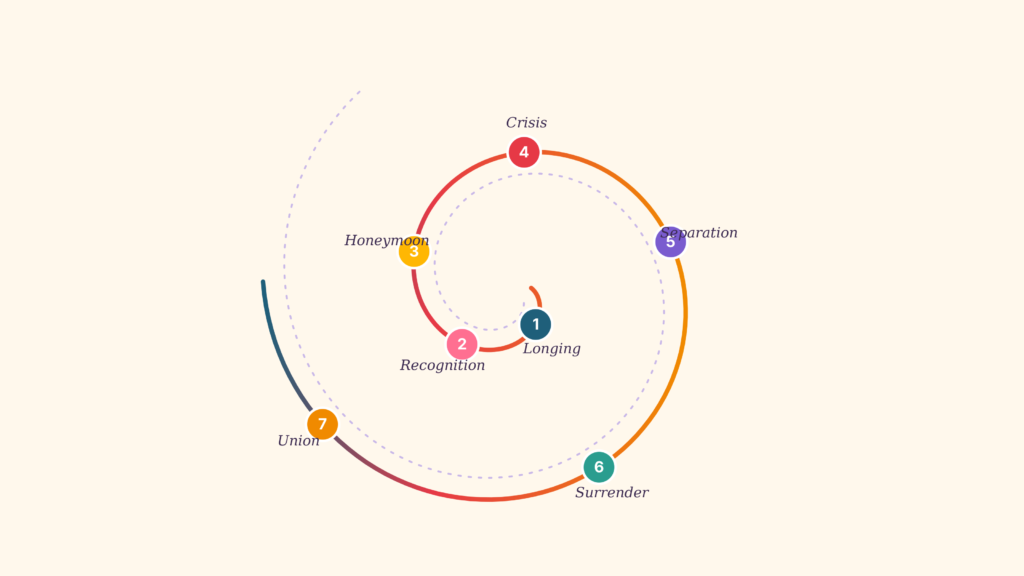
Not necessarily. Most teachers describe a spiral rather than a ladder. Early warning signs of conflict can appear during the honeymoon. Longing can return after a reunion. Someone who believes they have healed may meet a deeper layer of the same theme. Stages overlap, repeat, and sometimes get skipped. Each return tends to bring a fresh understanding, not a failure.
This flexibility is a strength of the framework. A long stage is not a sign that you are doing it wrong, and the stages of twin flame teaching are better treated as a loose set of themes than a checklist to complete.
How the Journey Compares With Other Growth Models
The twin flame journey echoes several older maps of change. Joseph Campbell’s Hero’s Journey moves through departure, ordeal, and return, much as longing, crisis, and union do. Jung’s individuation describes integrating shadow material into a more whole self. The “dark night of the soul” in Christian mysticism describes spiritual desolation before deeper understanding, which many people say resembles separation. Elisabeth Kübler-Ross’s five stages of grief, though developed for bereavement and not meant as a fixed sequence, also overlap with separation’s emotions of denial, anger, bargaining, sadness, and acceptance. Researchers have noted that grief does not follow a tidy order, which echoes the spiral idea above.
These parallels do not prove the twin flame model. They suggest that it draws on very old human patterns of facing difficulty and growing through it.
Practical Ways to Work With Each Stage
To work out which of the twin flame relationship stages you are in, look at what is loudest right now: an ache for someone unknown (longing), a startling new connection (recognition), joy (honeymoon), recurring triggers (crisis), distance and grief (separation), a turn toward self-care (surrender), or settled peace (union). You may relate to several at once.
A few simple practices help across the journey:
- Longing: Journal about what you want love to feel like, and build a life you enjoy now.
- Recognition: Give the connection time, and ask a trusted friend for an honest outside view.
- Honeymoon: Protect your friendships and independent routines.
- Crisis: Name an emotion before reacting. Try completing the sentence “What I am afraid of is…” in writing.
- Separation: Keep regular sleep, meals, movement, and sunlight. Write an unsent letter. Lean on supportive people.
- Surrender: Practice self-forgiveness, boundaries, and meditation or breathwork.
- Union: Let love exist without control, and respect the other person’s choices.
It is also important to know when spiritual frameworks are not enough. If you experience panic, prolonged sleeplessness, loss of appetite, thoughts of self-harm, or fear inside the relationship, please contact a doctor, licensed therapist, or someone you trust. In the United States, you can call or text 988 for crisis support, and the National Domestic Violence Hotline is 1-800-799-7233. Twin flame teachings can offer perspective, but they should never replace medical or mental health care.
For related reading, see our guides on , , and and how to recognize it.
For daily insights on consciousness, clarity, and trusting yourself, explore Bahlon’s free daily transmissions. Subscribe here.
Related Readings:
Frequently Asked Questions
What are the twin flame stages?
They are the phases a twin flame connection is believed to pass through: longing, recognition, honeymoon, crisis, separation, surrender and inner work, and union or integration. They form a spiritual framework, not a scientific model.
Which twin flame stage is the hardest?
Most people name crisis and separation. Crisis exposes old wounds, and separation brings grief and uncertainty. Many teachers also see these as the periods of greatest personal growth.
Is separation a required stage?
Most frameworks include it, but not every story does. Some connections never separate, and others never become relationships. Separation is better understood as a common possibility than a requirement.
What comes after twin flame separation?
Models usually place surrender and inner work next, followed by union or integration. Union may be a romantic reunion, a peaceful reconciliation, or an inner sense of wholeness.
Are the twin flame stages real?
The emotions people describe, including intense attraction, mirroring, grief, and growth, are real and meaningful to them. The specific stage systems come from modern spiritual teaching and are not scientifically established, so they work best as tools for reflection.