What are oracle cards? In short, they’re decks of illustrated cards, typically ranging from 30 to 60 pieces, designed to offer intuitive guidance, prompt self-reflection, and support daily decision-making. Unlike a structured divination system, an oracle deck follows no fixed rules: the number of cards, the artwork, and the meanings behind them are entirely up to the deck’s creator. That flexibility is precisely what has made oracle cards one of the fastest-growing entry points into modern spiritual practice, appealing to skeptics and believers alike as a low-pressure tool for introspection.
If you’ve ever watched someone pull a single card each morning before checking their phone or seen a wellness influencer flip a card on camera and pause thoughtfully before speaking, you’ve witnessed oracle cards in their most common form. But there’s more nuance to how they work, where they come from, and what a serious practice actually looks like than a thirty-second video can capture.
What Are Oracle Cards? A Closer Look at the Definition
At their core, oracle cards function as a visual and symbolic prompt for reflection. Each card typically pairs an image with a short word, phrase, or theme, things like “release,” “trust the process,” or “new beginnings.” The accompanying guidebook expands on that theme, offering a short passage the reader can apply to their current situation.
What sets oracle cards apart from other divination tools is their lack of standardization. A tarot deck, no matter who publishes it, adheres to a fixed structure of 78 cards split between the Major and Minor Arcana, each with an established (if debated) meaning built over centuries. Oracle decks answer to no such convention. A creator might design a deck around 44 cards focused on moon phases, or 65 cards centered on animal symbolism, or a slim deck of just 20 cards meant purely for affirmations. There are no wrong number and no required theme.
This openness is also why the oracle card market has diversified so widely. Some of the most searched deck types of online focus on angels, goddesses, spirit animals, moon cycles, or the work of specific authors known for their intuitive or metaphysical writing. Each deck carries its creator’s voice, so the “correct” way to read one deck may differ meaningfully from the next. Reading the accompanying guidebook isn’t optional if you want an accurate sense of what the deck’s author intended each card to mean.
Oracle Cards vs. Tarot Cards: Where the Confusion Comes From
Because both are shuffled, drawn, and interpreted through imagery, oracle cards and tarot cards are frequently mentioned in the same breath, and frequently confused. The distinction, though, is clean once you know what to look for.
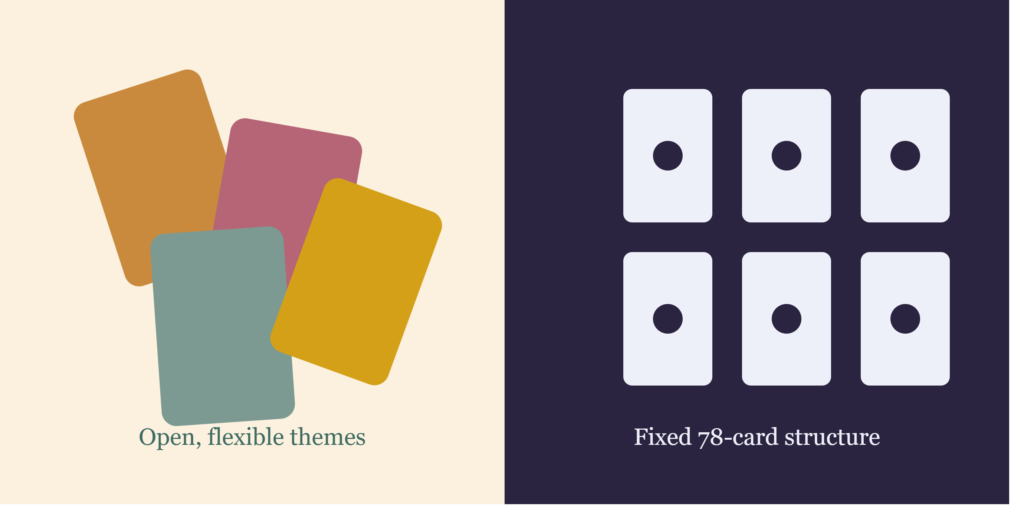
Tarot is a closed system. It has a consistent structure across nearly every published deck: the Fool’s Journey through the Major Arcana, four suits in the Minor Arcana, and centuries of accumulated symbolic meaning that readers can study and cross-reference. Learning tarot is, in some sense, learning a language with an established grammar.
Oracle cards, by contrast, are an open system. There’s no universal structure to memorize, no fixed number of cards, and no requirement that any two decks share a symbolic vocabulary. This makes oracle cards considerably more approachable for someone who has never worked with any kind of intuitive tool before. There’s no rulebook to violate. The tradeoff is that oracle decks tend to offer more general, mood-based guidance, while tarot can provide a more layered, specific reading once you understand its architecture.
Neither is inherently “better.” Many people use both, drawing an oracle card for a broad emotional theme and a tarot card for more specific situational insight.
How Oracle Cards Are Used: The Actual Mechanics
Using an oracle deck doesn’t require training, memorization, or ceremony. The process is intentionally simple, which is part of the appeal.
1. Find a quiet moment.
Most practitioners recommend a few minutes in a calm space, away from noise or distraction, with a few slow breaths to settle the mind before beginning.
2. Ask an open-ended question.
This is the step people most often get wrong. A yes-or-no question (“Will I get the job?”) tends to produce a frustrating, ambiguous answer, because oracle cards aren’t built for binary outcomes. Better questions sound like:
- “What energy should I focus on today?”
- “What do I need to know right now?”
- “What is this situation trying to teach me?”
3. Shuffle with the question in mind.
While shuffling, hold the question loosely in your attention. There’s no required number of shuffles or specific technique; stop whenever it feels natural, then draw a card either by pulling one intuitively or by using a card that happens to fall out of the deck during shuffling, sometimes called a “jumper.”
4. Read the card before you read the guidebook.
Look at the image first. Note the colors, the central figure, the keyword printed on the card, and your immediate gut reaction. That initial impression matters, since it reflects your own intuitive read on the question you asked. Only after registering that reaction should you turn to the guidebook for the deck’s official interpretation.
5. Try a simple spread once you’re comfortable.
A single card works well for a quick daily check-in. When a situation calls for more depth, a three-card spread is a common next step, often laid out as mind, body, and spirit, or past, present, and future. More elaborate spreads exist, but there’s no need to start there.
Evidence, Perspectives, and What the Research Actually Shows
It’s worth being direct about the evidentiary landscape here, because a balanced treatment of oracle cards must hold two things at once.
There is no scientific evidence that oracle cards possess predictive or supernatural power. No peer-reviewed research supports the idea that a shuffled card can access information about the future or an unknown outside reality. This isn’t a matter of interpretation; it reflects the current state of empirical research into divination tools broadly, tarot included.
What research does support, at least indirectly, is the psychological value of structured reflection. Techniques that resemble oracle card practice, journaling prompts, projective imagery exercises, and open-ended self-questioning, have documented benefits in cognitive and clinical psychology. Sitting with an ambiguous, evocative image and a loosely related question can prompt genuine insight, not because the card “knows” something, but because the exercise interrupts routine thinking and invites the reader to articulate feelings or intuitions they hadn’t consciously named. Psychologists sometimes describe this as a projective effect, similar in mechanism to how a Rorschach inkblot invites a person to project their own internal state onto an ambiguous stimulus.
Practitioners themselves generally describe the experience in these terms too, even without invoking clinical language. Long-time oracle card users tend to talk less about prediction and more about clarity: the card gave them permission to notice something they already suspected, or it reframed a problem they’d been circling for weeks. That experiential account deserves to be represented honestly, alongside the empirical caveat that the mechanism is almost certainly psychological rather than paranormal. Readers can hold both truths without contradiction: the practice can be genuinely useful for reflection while not being scientifically validated as predictive.
Practical Application: Getting Started with Your Own Practice
If you’re considering trying oracle cards for the first time, there are a few practical points worth knowing before you buy a deck.
Choose a deck that resonates visually.
Since there’s no standardized system to learn, the artwork and tone of a deck matter more than with tarot. Browse a few decks and notice which imagery you’re drawn to; that instinctive pull is a reasonable starting filter.
Start with one question a day.
The simplest version of this practice, drawing a single card each morning and asking, “what do I need to know today,” is also the most sustainable. It builds familiarity with your deck without requiring elaborate spreads or ritual.
Skip the ritual if it isn’t your style.
There’s no required setup: no specific number of shuffles, no mandatory candle or incense, no fixed way to cut the deck. Some people like to build a small ritual around their practice because it helps them settle into the right headspace, and that’s fine too, but it isn’t a requirement for the cards to “work.”
Keep a short log.
Writing down the card you pulled and your initial reaction, even in a few words, helps you notice patterns over time and builds your own internal reference for what specific cards tend to mean to you personally, beyond what the guidebook says.
Let meaning unfold over time.
Not every card will click immediately. Sometimes a message becomes clear later that same day, or days afterward, once context catches up. Resisting the urge to force an interpretation is part of the practice.
Common Questions and Misconceptions
One of the most persistent misconceptions is that oracle cards are meant to predict fixed, unchangeable outcomes, functioning like a fortune-telling device. A more accurate framing treats them closer to a forecasting tool: much like a business assessing risk before a decision, or an engineer running analysis before construction begins, oracle cards are best used to understand a present situation more clearly so you can move forward with better awareness, not to hand over a guaranteed script for the future.
Another common misunderstanding involves what to do when a card feels wrong. There’s an important difference between genuinely not understanding a message and dismissing it simply because it’s unwelcome. Cards can validate what you already feel, but they can also surface an uncomfortable truth you’ve been avoiding. Neither response, discomfort or confirmation, invalidates the exercise; both are worth sitting with rather than reflexively rejecting.
Finally, it’s worth remembering that oracle cards carry no binding authority. They’re not mandatory, and nothing obligates you to act on a card’s message if it doesn’t align with your judgment. Sometimes no clear meaning arrives at all, and that’s a normal, unremarkable part of the process rather than a sign you’re doing it wrong.
For daily insights on consciousness, clarity, and trusting yourself, explore Bahlon’s free daily transmissions. Join a growing community turning inward, one reflection at a time.
Related Readings:
Frequently Asked Questions
What is the difference between oracle cards and tarot cards?
Tarot follows a fixed 78-card structure with established symbolism across most decks. Oracle cards have no fixed number, structure, or shared meaning system; each deck reflects its creator’s individual design and themes.
How do you use oracle cards for beginners?
Sit somewhere quiet, ask an open-ended question rather than a yes-or-no one, shuffle while holding that question in mind, draw a card, and note your first reaction before reading the guidebook for a fuller interpretation.
Are oracle cards evil or against any faith?
Oracle cards are a personal reflection tool, not affiliated with any single religious or spiritual tradition, though views on their use vary across belief systems and individual comfort levels. Whether they align with your own beliefs is a personal decision worth making thoughtfully.
Can oracle cards actually predict the future?
There is no scientific evidence that oracle cards predict future events. Their documented value lies in prompting reflection and self-insight rather than forecasting specific outcomes.
What is the best oracle card spread for beginners?
A single-card daily pull is the most common starting point. Once you’re comfortable, a three-card spread covering past, present, and future, or mind, body, and spirit, is a natural next step.