Remote viewing is a structured mental practice in which a person, called a viewer, tries to describe a hidden or distant target without using the ordinary senses. Proponents and training organizations say that almost anyone can learn the basic skills with practice. Mainstream science, however, has not accepted that remote viewing works as claimed, so the honest answer to “can anyone learn it?” depends on what you mean by “it.”
That tension is what makes the subject worth a careful look. Remote viewing sits at an unusual crossroads of Cold War intelligence history, laboratory psychology, meditation culture, and personal curiosity about how perception works. This guide covers what the practice is, where it came from, what the research says, and what a beginner can realistically expect.
What Is Remote Viewing? Definition and Meaning
In plain terms, the remote viewing meaning is simple: a trained attempt to gather information about a target the viewer cannot access through sight, hearing, or any other physical sense. The target might be a distant place, an object sealed inside an envelope, or an event from the past.
What separates remote viewing from casual psychic claims is its emphasis on protocol. A typical session uses a blind target, meaning the viewer does not know what it is. The target is often represented by a random number or coordinate assigned by a third party. The viewer then writes down whatever impressions arise, usually starting with the most basic sensory fragments: a shape, a color, a texture, a temperature, a sense of motion or stillness.
Only after those raw impressions are on paper does the viewer attempt anything more interpretive. This ordering is the heart of the method. It is designed to keep a person’s analytical mind from rushing in with a confident guess like “that’s a lighthouse” before any actual impression has been recorded.
The remote viewer, in other words, is not asked to announce answers. The viewer is asked to observe, record, and hold back conclusions.
Where Remote Viewing Came From: SRI, Stargate, and the CIA
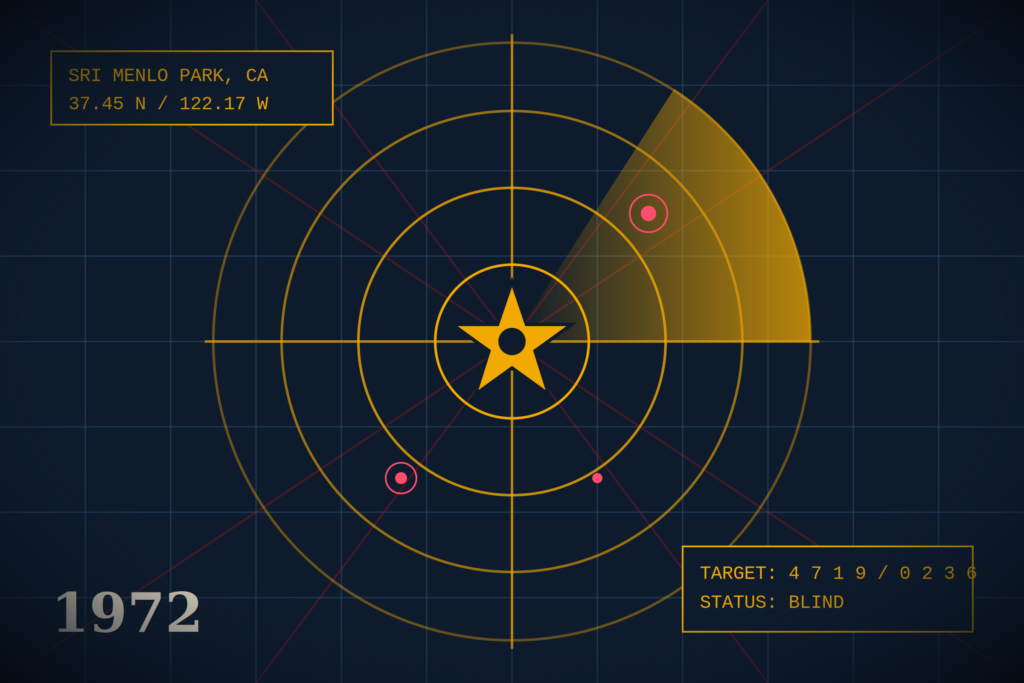
Modern remote viewing took shape in the early 1970s at the Stanford Research Institute (SRI) in California. Physicists Hal Puthoff and Russell Targ began investigating whether people could describe distant locations under controlled conditions. Two names became central to the story: Ingo Swann, an artist and gifted subject who helped develop an early structured method often called Coordinate Remote Viewing, and Pat Price, a former police commissioner whose reported sessions became some of the most discussed in the field.
Price’s accounts are a good example of how this history is told two ways. Supporters point to sessions in which he reportedly described details of a remote facility with striking accuracy. Skeptics note that the original records are open to interpretation and that vague or generous scoring can make almost any description look like a hit. Both readings are part of the record, and readers should hold them side by side.
Government interest followed. Over roughly two decades, U.S. military and intelligence organizations funded psychic research under a series of code names, eventually grouped under the Stargate Project. When people search for “remote viewing CIA” or “CIA remote viewing,” this is what they are usually asking about. The CIA took over oversight of the program in the mid-1990s and commissioned an outside review by the American Institutes for Research. The program was then closed and its files were declassified.
The review itself is worth understanding because it did not produce a simple verdict. Statistician Jessica Utts concluded that the laboratory results showed effects beyond chance and deserved further study. Psychologist Ray Hyman, reviewing the same material, argued that the findings had not been reliably replicated and that flaws in design could explain them. The agency’s conclusion was that remote viewing had not shown operational value for intelligence work. So the most accurate summary is this: the program existed, it was taken seriously enough to fund for years, and it was ultimately judged not useful enough to continue.
How Does Remote Viewing Work? The Mechanics of a Session
Whether or not one accepts the underlying claim, the mechanics of a session are easy to describe, and they explain why people find the practice compelling as a discipline.
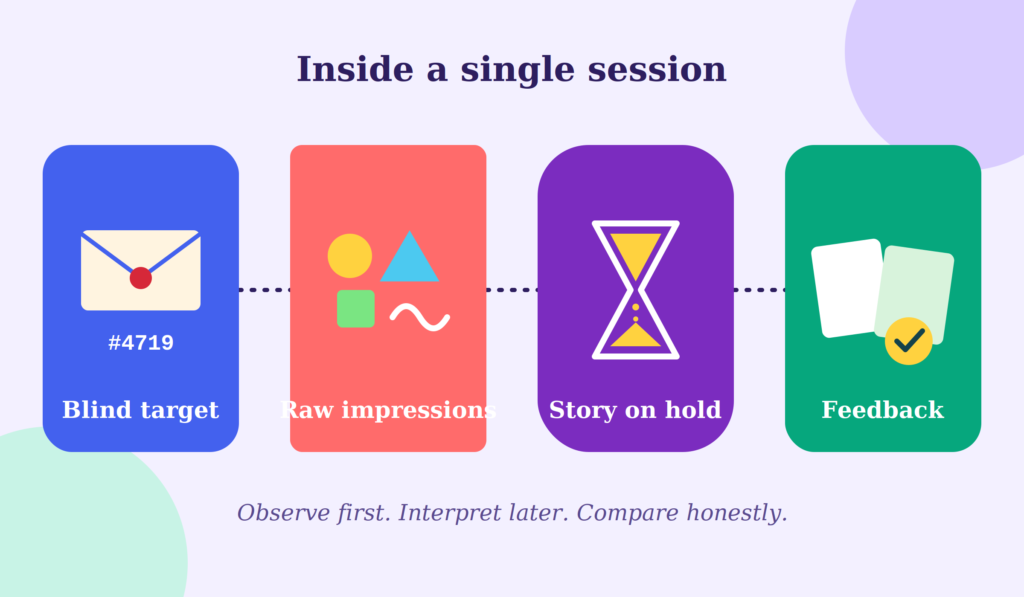
Blind targeting. A monitor or a random process selects the target so the viewer has no prior knowledge. This is meant to prevent both conscious guessing and unconscious cueing.
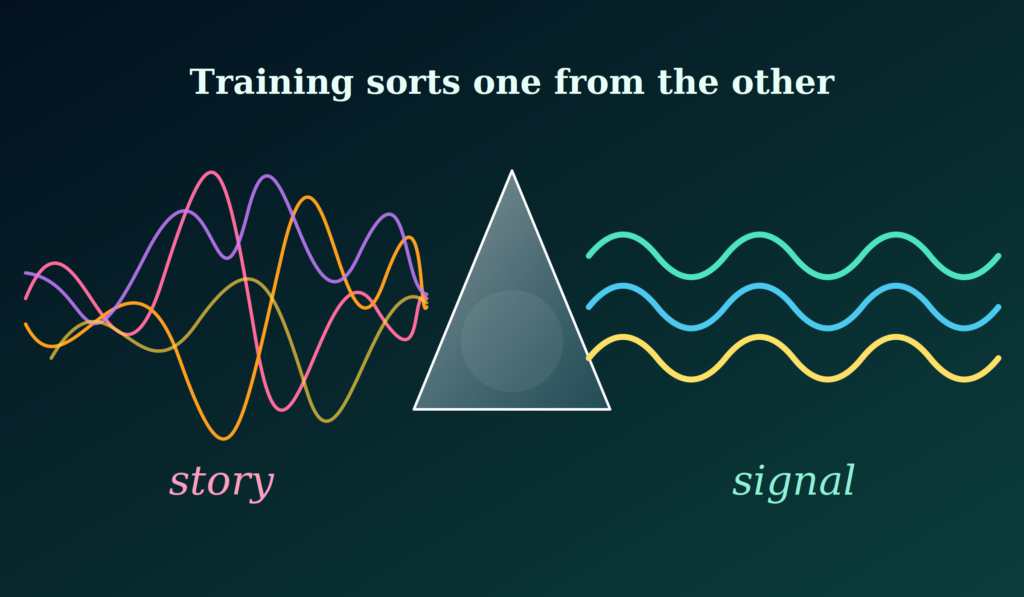
Raw impressions first. The viewer records elementary data: colors, surfaces, sounds, hardness or softness, hot or cold. These fragments are often called “signal.”
Delayed interpretation. Labels, stories, and conclusions are held back. Practitioners call the premature narrative “analytical overlay” or simply “story.”
Feedback. After the session, the viewer sees the actual target and compares it to the notes. This step matters because it shows where perception and imagination blurred together.
This separation of signal from story is probably the most useful idea the practice offers, even to people who remain agnostic about the paranormal. Anyone who has jumped to a wrong conclusion in a conversation understands how quickly interpretation can masquerade as observation.
Is Remote Viewing Real? Evidence and Perspectives
This is the question most readers arrive with, and it deserves a straight answer: it depends on whose standards you apply.
The scientific view. Mainstream science generally classes remote viewing as pseudoscience, mainly because strictly controlled, independently replicated evidence is considered lacking. Critics point to problems that plagued early experiments, such as sensory leakage, target-selection bias, and judging methods that allowed loose matches to count as successes. Under tighter protocols, results tend to shrink or disappear, which is what skeptics would predict if no real effect were present.
The proponent view. Researchers sympathetic to the field argue that some experiments showed statistically meaningful departures from chance, that publication and replication standards were applied unevenly, and that the phenomenon may be subtle and hard to capture in the laboratory rather than nonexistent. They also note that the program lasted as long as it did because some officials saw results they considered worth pursuing.
The practitioner and experiential view. Many viewers describe sessions as genuinely surprising, with impressions that later matched targets in ways they could not explain. These accounts are personal and cannot be independently verified, which is exactly why they should be described as experiences rather than proof. They are also not worthless. Experience is how most contemplative traditions have always begun their inquiries.
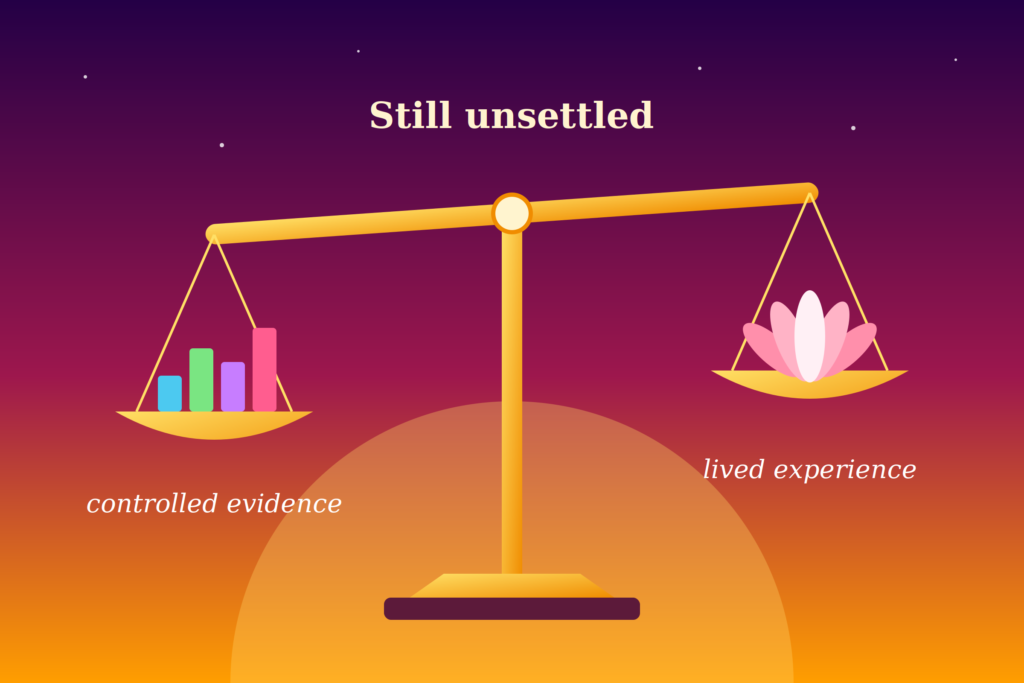
A balanced reader can accept all three facts at once: the controlled evidence is unsettled, the history is real, and many people find the practice meaningful. Anyone who tells you the question is fully closed in either direction is going further than the evidence allows.
Can Anyone Learn Remote Viewing?
Here the viewpoints split in an interesting way.
Organizations such as the International Remote Viewing Association and The Monroe Institute maintain that nearly everyone can learn the basic skills. A common comparison is to music. Almost anyone can learn to hum a tune or play a few notes, yet talent and years of practice shape how far a person goes. By this logic, ability varies, but the foundation is available to most people.
Within remote-viewing communities, opinion is genuinely mixed. Some practitioners hold that structured protocols can teach people to separate raw perception from analytical guessing. Others believe that accurate viewing depends on a natural, spontaneous gift, or on reaching a deep meditative state that not everyone enters easily.
The perceptual-training view offers a useful middle path. It argues that perception is not fixed. Attention, emotional state, habit, and interpretation all shape what we notice, and each can be refined. Seen this way, learning remote viewing is less about acquiring an exotic new sense and more about reducing interference with the perception you already have.
Notice that this framing makes a more modest claim than “anyone can become a psychic.” It says anyone can learn a disciplined way of observing. Whether that discipline yields accurate information about hidden targets is a separate question the evidence has not settled.
Remote Viewing Training: What Beginners Actually Learn
If you are curious about remote viewing training, it helps to know what the early stages look like, because they are not dramatic.
You learn to notice before you name. The first skill is observing a fleeting impression without instantly labeling it. Most people have never practiced this.
You will probably feel like you are guessing. Beginners commonly report that sessions feel like imagination or random noise. Within the training approach, this is considered normal, since perception and interpretation are tangled together in everyday life and take time to separate.
Structure does the heavy lifting. Written protocols slow the process down, delay conclusions, and make errors visible. Without structure, intuition tends to blend with narrative. With it, it becomes easier to see which parts of a session were impression and which were invention.
Consistency comes before accuracy. Serious training programs generally treat steady, repeatable observation as the early goal. Accuracy, if it improves at all, is expected to follow as clarity develops.
Many people notice side effects. Practitioners describe steadier attention, less reactivity, and a sharper sense of how their own perception forms. These benefits resemble those people report from meditation and do not depend on any paranormal claim being true.
Just as importantly, training does not require belief, ritual, a new identity, or a special background. You can approach it as an experiment and keep your skepticism intact. In fact, a skeptical, record-keeping attitude tends to suit the method well.
How to Do Remote Viewing: A Simple Starting Practice
If you want to try how to remote view in a low-stakes way, a basic exercise can be done at home with a friend.
- Ask a friend to choose a photograph or object and seal it in an opaque envelope, writing a random number on the outside. You should not see what it is.
- Sit somewhere quiet, write the number at the top of a page, and take a few slow breaths.
- Jot down only raw impressions: colors, shapes, textures, temperatures, movement. Avoid naming the target.
- After ten or fifteen minutes, stop and mark any impression you suspect came from imagination or logic rather than perception.
- Open the envelope and compare honestly. Note what matched, what missed, and what you invented.
- Repeat regularly, keeping every page so you can look for patterns over time.
The value of this exercise lies in the record-keeping. Over many sessions you will learn how your own mind generates stories, and that insight is useful whatever you conclude about the larger claims.
Common Misconceptions About Remote Viewing
“You either have the gift or you don’t.” This is the most persistent myth. Practitioners disagree about the role of natural talent, but even those who value it generally treat practice as important.
“It means leaving your body.” Remote viewing as a structured practice is usually described as a mental process of impression gathering, not an out-of-body journey, though some traditions and individuals interpret their experiences that way.
“The government proved it works.” The government funded it for years and then closed the program after concluding it lacked operational usefulness. That history does not amount to proof in either direction.
“It’s the same as intuition.” The two overlap, but remote viewing deliberately separates raw perception from interpretation, while everyday intuition usually blends them.
“If the evidence is unsettled, it’s pointless.” Unsettled science and personal value are different things. A practice can sharpen attention and self-awareness even while its larger claims remain debated.
The Takeaway
So, what is remote viewing, and can anyone learn it? It is a structured method for describing hidden targets that grew out of Cold War research, remains scientifically unproven, and continues to attract serious practitioners. Most people can learn the discipline itself: slowing down, recording what is perceived, and separating signal from story. Whether that discipline reaches beyond the ordinary senses is a question each reader can explore with patience, honest records, and an open but careful mind. Approached that way, remote viewing teaches something valuable even before it answers anything about the paranormal: how much of what we call perception is really interpretation.
Related readings:
- How to Trust the Timing of Your Life
- Meditation for Beginners: How to Start (and Actually Stick with It)
- The Science of Consciousness: What We Know
For daily insights on consciousness, clarity, and trusting yourself, explore Bahlon’s free daily transmissions. Subscribe here to receive them in your inbox.
Frequently Asked Questions
What is a remote viewer?
A remote viewer is a person who practices describing a hidden or distant target using structured protocols, recording raw sensory impressions before interpreting them.
Is remote viewing real?
Mainstream science considers it a pseudoscience because strictly controlled, independently replicated evidence is lacking. Proponents point to historical research and personal experience. The question remains contested.
Did the CIA use remote viewing?
U.S. intelligence and military organizations funded and evaluated psychic research for roughly two decades, including under the Stargate Project. The CIA’s final review concluded the work did not provide operational value, and the program was ended in the mid-1990s.
How long does it take to learn remote viewing?
Basic protocols can be understood in days, but consistent practice over months is typically recommended. Progress is usually measured by steadier observation first, not by dramatic hits.
Can anyone do remote viewing?
Training organizations say almost anyone can learn the basic skills, though talent and practice likely affect proficiency. Whether the method reliably yields accurate information is still unproven by mainstream standards.