Learning how to read tarot cards for yourself starts with a simple mindset shift: tarot isn’t a fortune-telling machine that spits out fixed destinies, it’s a reflective tool that helps you notice what you already sense but haven’t fully articulated. You shuffle a deck, pull a card, and use its imagery as a mirror for whatever question is sitting in your mind. With a bit of practice, the process becomes less about memorizing rulebooks and more about learning to trust your own read of a situation.
That’s really the heart of it. A tarot deck contains 78 cards loaded with centuries of symbolism, but the reading itself happens in the space between the card and the person looking at it. Below is a full walkthrough of how the practice works, what the deck is actually made of, what different perspectives say about its value, and how to start doing it yourself tonight if you want to.
What Tarot Reading Actually Is?
Tarot is a system of symbolic cards traditionally used for self-reflection, decision-making, and gaining perspective on personal circumstances. Each card depicts a scene, a character, or an object that carries layered meaning built up through generations of interpretation. Learning to read tarot cards for yourself simply means you pose a question, draw a card (or several), and interpret what’s shown in relation to your own life, rather than relying on someone else’s reading of it.
It’s worth being clear about what tarot is not claiming to do, at least in any serious contemporary practice: it does not predict a locked-in future. Most experienced readers describe it instead as a way of surfacing patterns, blind spots, or emotional truths that a person already carries but hasn’t consciously named. The cards act as a prompt. Your intuition does the rest.
This distinction matters because it shapes how you should approach a reading. If you treat tarot as a fixed prophecy, you may end up either anxious about “bad” cards or complacent about “good” ones. If you treat it as a structured reflection exercise, similar in spirit to journaling with visual prompts, it becomes a much more useful and less superstitious practice.
How to Read Tarot Cards for Yourself: A Step-by-Step Practice
If you’re ready to try it, here’s a practical sequence for how to read tarot cards for yourself that most beginner guides and experienced readers agree on.
1. Set your space and your intention
Find a quiet spot and take a few minutes to settle your mind. Some people do this with slow breathing, others with a short meditation or simply sitting in silence before touching the cards. The goal isn’t ritual for its own sake; it’s shifting out of autopilot so you can actually notice your reactions to what comes up.
2. Ask an open-ended question
Yes-or-no questions tend to produce flat, unhelpful readings. Instead, frame questions that invite reflection:
- “What do I need to know about this situation right now?”
- “What energy should I focus on today?”
- “Where is the hidden opportunity in this decision?”
- “What lesson am I working through at the moment?”
Open framing gives the cards room to say something more useful than a simple yes or no ever could.
3. Shuffle with intention
Hold the deck, think about your question, and shuffle however feels natural to you: an overhand shuffle, cutting the deck into piles and recombining them, or spreading the cards face-down on a table and mixing them by hand.There’s no official technique for how to read tarot cards for yourself at this stage. What matters is that you’re focused while you do it.
4. Pull your card or cards
Take the top card, cut the deck and draw from where it splits, or fan the cards out and pick whichever one catches your eye. For beginners, two simple layouts work well:
- One-card pull: a single card for daily guidance. Good question: “What’s the focus of my day?”
- Three-card spread: past, present, and possible future. Card one shows an influence from the past, card two reflects the present situation, and card three suggests a likely direction if things continue as they are.
5. Lay the cards out and observe
Place them face down first, then turn them over one at a time. Give yourself a moment before reaching for any book. Look at the colors, the mood, the characters’ expressions, and what’s physically happening in the scene.
6. Interpret intuitively before consulting a guidebook
This is the step most beginners skip, and it’s arguably the most important one. Before you look anything up, ask yourself what the image makes you feel or think about in relation to your question. Only afterward should you check a guidebook or a reference resource for the traditional meaning. Comparing your gut read against the “official” interpretation is often where the real learning happens, because it shows you where your intuition already lines up with tradition and where it diverges.
A quick shortcut while you’re building this skill: the four suits roughly map to different areas of experience. Swords relate to thoughts and communication, Cups to emotions and relationships, Wands to action and creative energy, and Pentacles to work, money, and material concerns.
7. Keep a tarot journal
Record the date, your question, the cards you pulled, and your first impressions before you looked anything up. Review these entries after a few days or weeks. Patterns tend to emerge, both in the cards you keep drawing and in how your interpretations evolve. This habit, more than any single reading, is what actually builds fluency, and it’s often the single biggest factor separating people who genuinely learn how to read tarot cards for yourself from people who lose interest after a week.
Understanding the Tarot Deck: Major and Minor Arcana Explained
A standard tarot deck has 78 cards split into two groups, and understanding this structure is a big part of learning how to read tarot cards for yourself, since it makes individual card meanings much easier to remember.
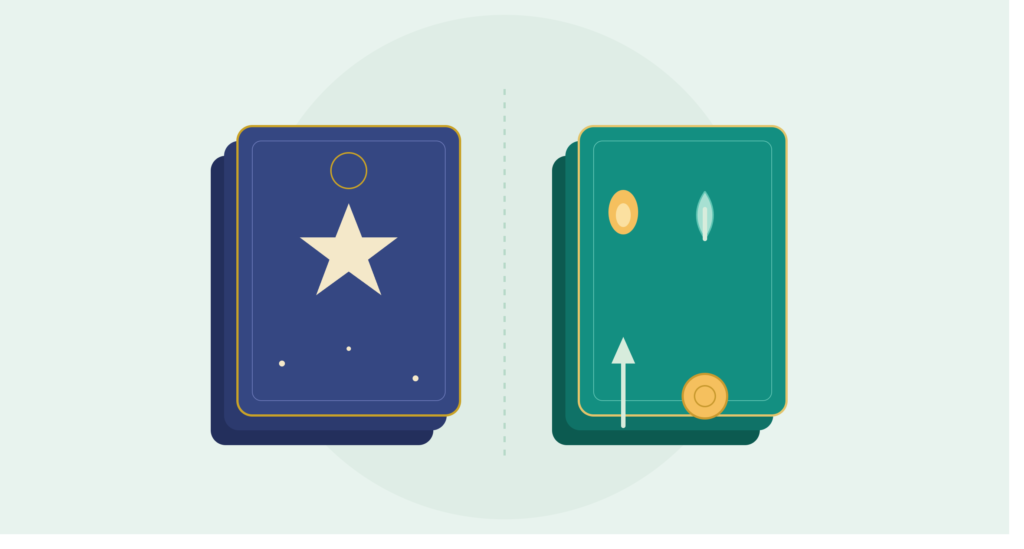
The Major Arcana consists of 22 cards, including 21 numbered cards plus the unnumbered Fool. These cards represent significant life themes: transformation, endings, love, ambition, and spiritual growth. The Fool is often described as moving through the entire sequence, a narrative device known as the Fool’s Journey, symbolizing a soul’s progression through major life experiences. When a Major Arcana card shows up in a reading, it tends to signal something with real weight behind it.
The Minor Arcana makes up the remaining 56 cards and reflects the more day-to-day textures of life: passing moods, minor decisions, everyday friction, and short-term circumstances. These 56 cards divide evenly into four suits of fourteen:
- Wands (Fire): passion, ambition, creative drive
- Cups (Water): emotion, intuition, relationships
- Swords (Air): thought, conflict, communication
- Pentacles (Earth): money, career, physical resources
Each suit also includes court cards: King, Queen, Knight, and Page. These can represent actual people in your life, personality traits you’re expressing (or need to express), or a particular energy the situation is calling for.
If you’re choosing your first deck, the Rider-Waite deck, first published in 1909, remains the most widely referenced starting point because so many modern guidebooks are built around its imagery. That said, dozens of other decks exist, and picking one that visually resonates with you matters more than picking the “correct” one. There isn’t a wrong choice here.
What Research and Practitioners Say About Tarot’s Value
It’s worth being honest about where the evidence stands. There is no scientific research supporting tarot’s ability to predict future events, and mainstream psychology does not treat card draws as a diagnostic or forecasting tool. Where tarot does show up in more academic conversations is as a projective exercise, similar in function to inkblot tests or open-ended journaling prompts, that can help people articulate feelings or perspectives they hadn’t consciously organized. Some therapists and coaches have experimented with tarot-style prompts specifically because the ambiguity of an image invites a person to project their own meaning onto it, which can surface useful material in a low-pressure way.
Long-time practitioners, meanwhile, describe the value in more experiential terms. They talk about tarot as a structured pause, a way of slowing down before a decision, and a method for accessing intuition that might otherwise get drowned out by daily noise. This is a subjective account rather than a measurable claim, and it’s presented honestly as such. Millions of people find real, lived value in the practice as a reflective and self-care tool, even without it being a predictive science.
Both framings can be true at once: tarot has no demonstrated predictive power, and it can still be a genuinely useful structured-reflection practice for the person using it thoughtfully.
Practical Tips for Building Your Own Practice
Once you understand the basic mechanics, the real work of learning how to read tarot cards for yourself happens through repetition. A few habits separate people who stick with tarot from people who try it once and put the deck in a drawer.
Start simple.
One card a day, morning or evening, asking something like “what do I need to know about today?” is enough to build familiarity without overwhelming yourself with complex spreads before you know the basics.
Trust your first impression.
Guidebooks are useful references, not rulebooks. If a card’s traditional meaning doesn’t match what you felt when you saw it, both readings are worth noting in your journal.
Don’t over-formalize it.
There’s no single correct way to read tarot. Different readers develop different personal shorthand over time, and that’s normal.
Treat it as reflection, not prescription.
The most grounded way to use tarot is as a tool for self-awareness, alongside practices like journaling or meditation, rather than as a substitute for actual decision-making research when the stakes are high (financial, medical, or legal matters, for instance).
Common Questions and Misconceptions
“Tarot predicts my exact future.” Most practitioners and serious guides reject this framing. The more accurate description is that tarot reflects likely patterns or energies based on current circumstances, not an unchangeable outcome.
“You need special psychic abilities to read tarot.” No particular gift is required. Anyone who wants to learn how to read tarot cards for yourself is really just learning an interpretive skill, built through practice and journaling, rather than accessing some rare talent a person is born with.
“Getting the Death card means something bad is coming.” This is one of the most common misreadings. In most traditions, Death symbolizes transformation and endings that make room for something new, not literal mortality.
“There’s one correct meaning for each card.” Card meanings shift depending on the question asked, the surrounding cards, and the context of the reading. A guidebook gives you a starting point, not a fixed answer key.
For daily insights on consciousness, clarity, and trusting yourself, explore Bahlon’s free daily transmissions. Subscribe here to receive them directly.
Related Readings:
Frequently Asked Questions
Do I need a special deck to start?
No. Any deck that feels visually appealing to you works. Many beginners start with the Rider-Waite deck because most guidebooks reference its imagery directly, but personal connection to the artwork matters more than which specific deck you choose.
How many cards should a beginner pull?
One card is plenty when you’re starting out. A three-card past-present-future spread is a natural next step once single-card pulls feel comfortable.
How long does it take to learn tarot?
There’s no fixed timeline. Many people develop a working intuitive fluency within a few months of consistent daily practice, though genuinely deep familiarity with all 78 cards, including reversals and combinations, can take years.
Can tarot replace therapy or professional advice?
No. Tarot is best used as a self-reflection tool, not a substitute for medical, legal, financial, or mental health guidance. Many people use it alongside professional support, not instead of it.
What’s the difference between reading for myself and reading for someone else?
Reading for yourself relies on context you already know, which makes intuitive interpretation easier. Reading for someone else requires more careful questioning and listening, since you’re working with a life you don’t have full context on.