Knowing how to let go of control means shifting your energy from forcing outcomes to trusting a larger process, whether you call that process the universe, a higher power, or simply the natural unfolding of life. In practice, it looks like doing your part fully and then releasing your grip on how, when, or whether things turn out a certain way. This is not the same as giving up. It is a deliberate redirection of effort, from managing everything to managing only what is actually yours.
Most people who search for ways to loosen their grip are not lazy or indifferent. They are often exhausted. They have spent years trying to predict, prevent, and perfect their way through uncertainty, and it has not made them feel safer. If that describes you, the spiritual approach to letting go offers something different from a productivity hack. It offers a framework for understanding why control feels so necessary, and what becomes possible when you stop treating every outcome as your personal responsibility.
What Letting Go of Control Actually Means
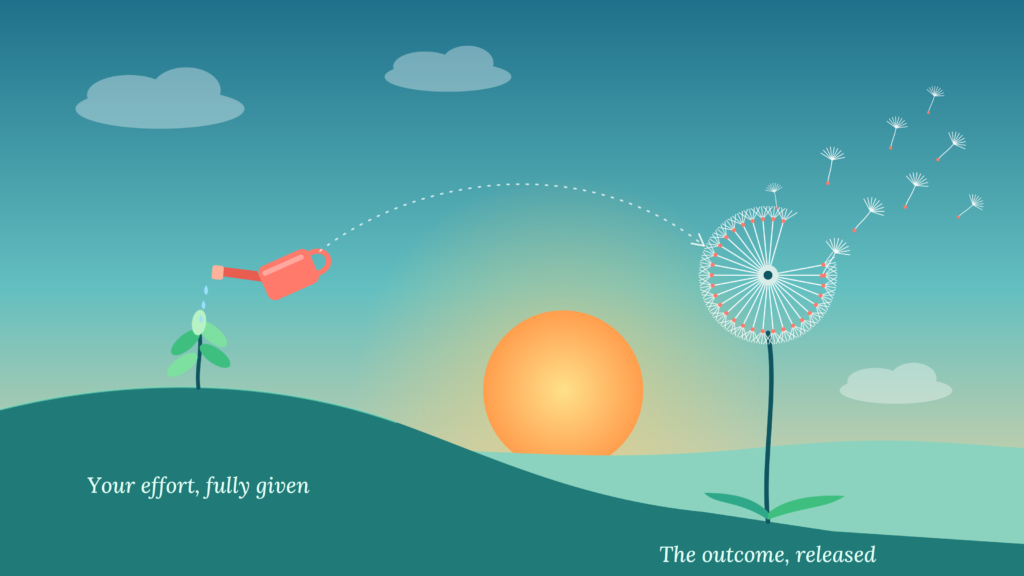
Spiritually speaking, letting go of control is the practice of distinguishing between effort and outcome. You still show up. You still act, plan, and care. What changes is your relationship to the result. Instead of white-knuckling a specific ending, you commit to doing what is within your ability and trusting that the rest belongs to something bigger than your own willpower.
Many contemplative traditions describe this using the language of surrender, though the word carries different connotations depending on the lens you bring to it. In a Christian framework, surrender might mean releasing a burden to God’s timing. In a Buddhist framework, it might mean loosening attachment to a preferred outcome altogether, recognizing that clinging itself is a source of suffering. In more secular, mindfulness-based language, it might simply mean accepting reality as it is in this moment, rather than the reality you wish existed.
What unites these views is a shared insight: there is a meaningful difference between what you can influence and what you cannot, and confusing the two is exhausting. Your actions, your words, your effort, and your reactions are yours to shape. Other people’s choices, the timing of events, and the ultimate outcome of a situation generally are not.
Why Control Feels So Necessary in the First Place
Understanding the mechanics of control helps explain why letting go can feel so unnatural. Control is frequently rooted in fear. Somewhere along the way, many of us learned that vigilance kept us safe, that anticipating problems prevented them, or that if we just planned hard enough, we could avoid pain. That belief is not irrational. It is often based on real experience. The trouble is that it generalizes poorly, and eventually we find ourselves trying to manage things that were never manageable to begin with, like another person’s feelings or the outcome of an event that hasn’t happened yet.
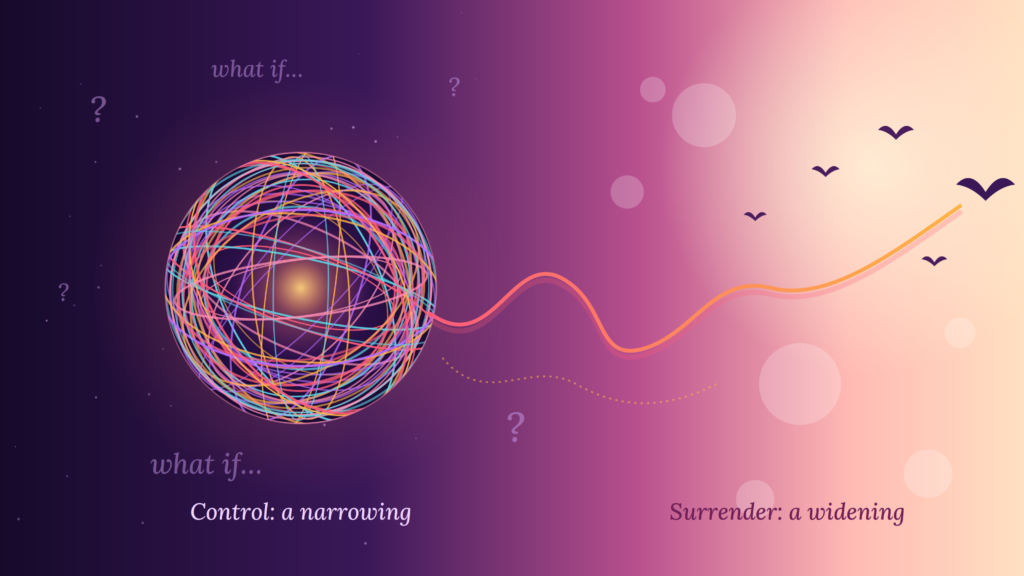
Attachment plays a role too. When we become convinced that one particular result is the only acceptable one, we narrow our field of vision. We stop noticing other paths that might also lead somewhere good, because we are too fixated on the single outcome we have decided is correct.
Physiologically, control mode has a recognizable signature. It often shows up as shallow breathing, a racing heart, narrow and highly focused attention, and a mind that keeps darting between past regrets and future what-ifs. People in control mode frequently report difficulty concentrating and a strange sense that despite all their effort, they still don’t feel in control. That is not a coincidence. The more energy goes into micromanaging details that cannot actually be managed, the less bandwidth remains for clear thinking.
Surrender, by contrast, tends to feel like a widening rather than a narrowing. Breathing deepens. The nervous system settles. There is more access to the present moment and, often, a broader perspective on the situation, one that includes options the anxious mind couldn’t see.
What the Evidence and the Experience Both Suggest
It is worth being honest about what is measurable here and what is not. Psychological research on locus of control, a concept developed by psychologist Julian Rotter, has consistently found that people who focus their energy on factors within their influence tend to report better stress management and higher wellbeing than those who fixate on external, uncontrollable factors. This lines up closely with the spiritual instruction to focus on your own actions and release what belongs to others.
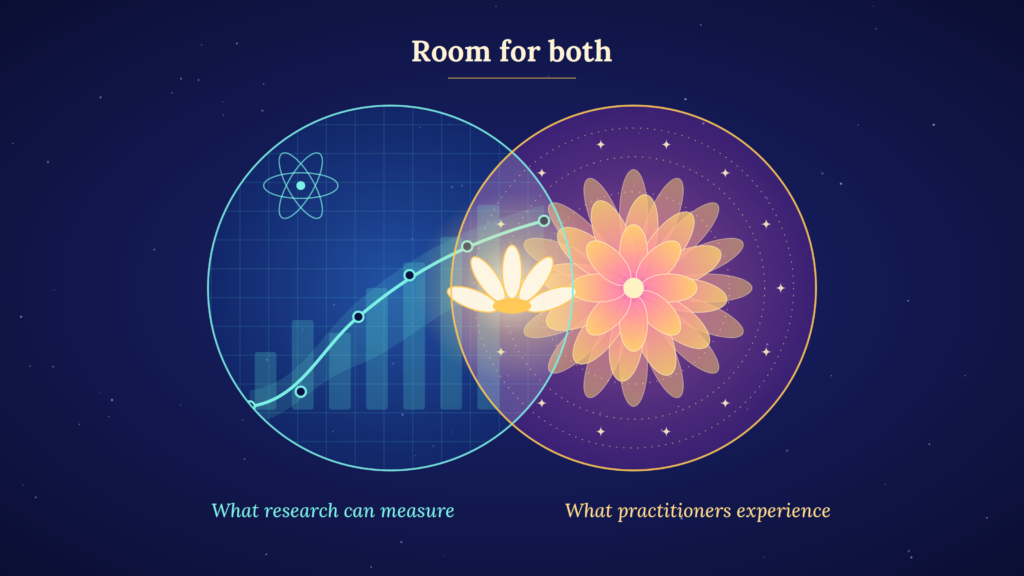
Research on acceptance-based approaches, including Acceptance and Commitment Therapy, has also found that resisting difficult internal experiences (thoughts, emotions, uncertainty) tends to increase distress, while acceptance is associated with better psychological outcomes. This offers a scientifically grounded parallel to the traditional idea that fighting reality causes more suffering than meeting it as it is.
What science cannot measure, and does not attempt to, is the metaphysical claim that a higher power or an intelligent universe is actively receiving what you release. That belief is experiential and traditional rather than empirical. Practitioners across many lineages describe a felt sense of support, of being met, of things working out in ways they could not have engineered themselves. That testimony deserves to be taken seriously as lived experience, even though it sits outside what a controlled study can confirm. A thoughtful approach to letting go of control makes room for both: the parts that psychology can verify, and the parts that remain a matter of faith.
How to Actually Practice Letting Go of Control
Learning how to let go of control is rarely a single decision. It’s a skill developed through repeated, small acts of releasing rather than one dramatic surrender.
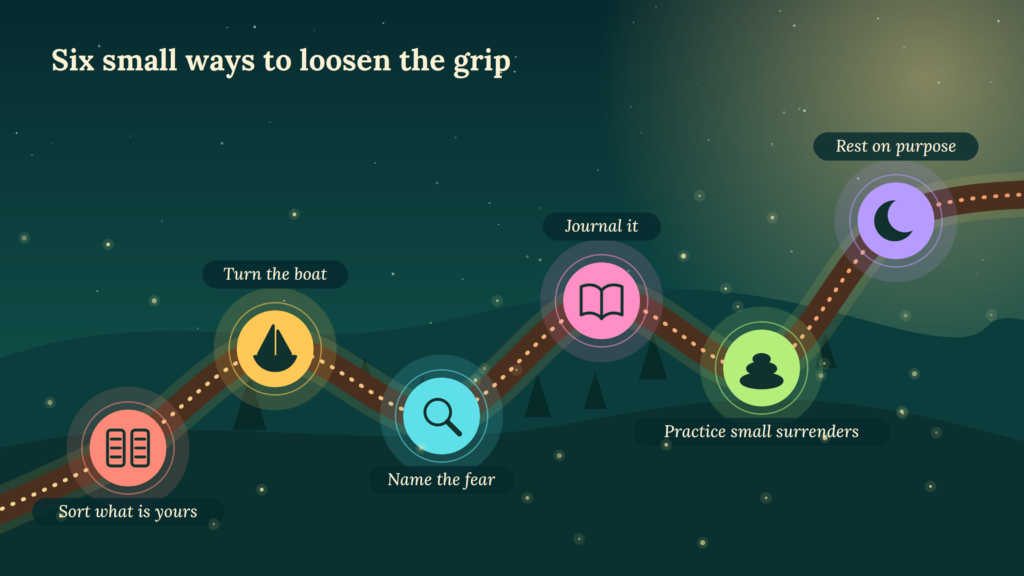
Sort your business from everyone else’s. When you notice yourself gripping a situation, ask a simple question: is this actually mine to manage? Your own actions, words, and effort are your business. Someone else’s mood, choices, or timeline generally is not. This single distinction, applied consistently, resolves a surprising amount of daily tension.
Use the boat metaphor. Picture yourself in a small boat, paddling upstream against a strong current. That is what control mode often feels like, constant effort against resistance. Surrender is turning the boat around, setting the oars down, and allowing the current to carry you. It doesn’t mean you stop steering entirely. It means you stop fighting the direction the water is already moving.
Interrogate the fear underneath the grip. Ask yourself directly: what am I afraid will happen if I let go? Then test that fear. Is it certain? Has it happened before? If the feared outcome did occur, would it really be as unbearable as it feels right now? Fear loses some of its grip once it is examined in daylight rather than left to run in the background.
Journal what is and isn’t yours. A simple two-column list, one for things you can change and one for things outside your control, can be clarifying on paper in a way it never quite is in your head. Let the second column stay on the page instead of carrying it around all day.
Practice small, low-stakes surrenders. Letting go of control doesn’t need to start with your biggest fear. Practicing with minor inconveniences, a canceled plan, a delayed train, a change of scenery, builds the muscle for bigger moments. Treat those small disruptions as low-risk training rather than personal failures.
Build in intentional rest. Stepping away from constant planning, even briefly, reminds the nervous system that life continues without your supervision. This is less about productivity and more about proving to yourself, experientially, that the world does not require your constant vigilance to keep functioning.
Common Misconceptions About Surrender
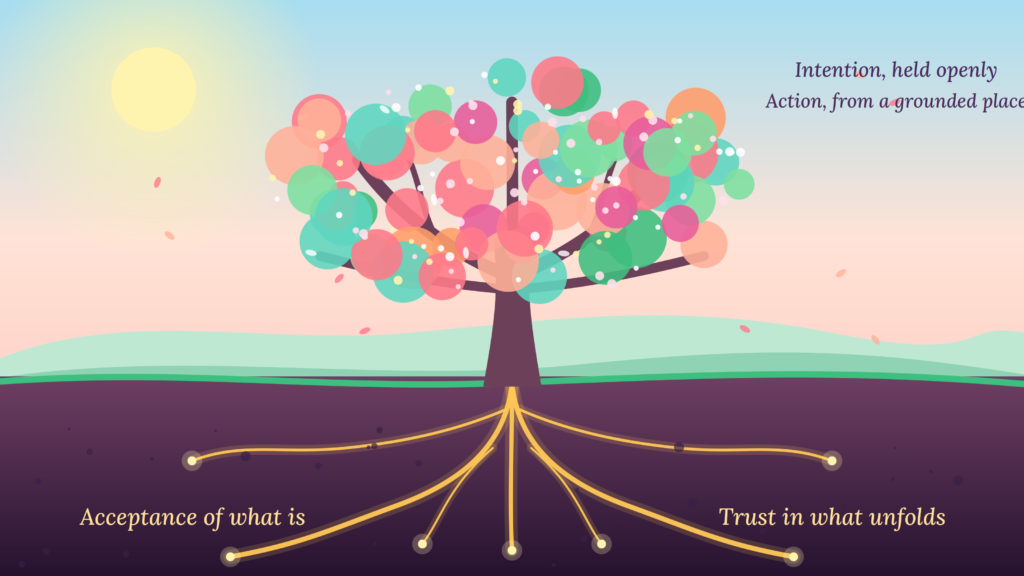
The biggest misconception is that surrendering means passivity, doing nothing and waiting for the universe to handle everything. That is not what the practice describes. Surrender is complete acceptance of what is, combined with a trust that things are unfolding as they should, but it still requires you to take appropriate action from that grounded place rather than from fear. The difference is not whether you act. It is why and how you act.
Another misconception is that letting go of control means abandoning your goals or preferences. It does not. You can hold a clear intention for what you want while releasing your grip on the exact mechanism by which it arrives. Intention paired with openness tends to produce better results than rigid demand, partly because it leaves room for solutions you hadn’t considered.
Finally, some people assume that if they are struggling to let go, they are doing something wrong or are spiritually behind somehow. In reality, the shift from control to surrender is rarely linear. It is a practice you return to again and again, not a switch you flip once. Progress often looks like noticing you’re gripping something a little sooner each time, not eliminating the grip.
For daily insights on consciousness, clarity, and trusting yourself, explore Bahlon’s free daily transmissions. Subscribe here to receive them directly in your inbox.
Related Readings:
- Spiritual Alchemy: Practices for Personal Growth
- 10 Signs You Are Going Through a Personal Transformation
- Select How to Integrate a Spiritual Awakening Into Daily Life
Frequently Asked Questions
Is letting go of control the same as giving up?
No. Letting go of control means releasing your grip on outcomes you were never able to fully determine anyway, while still taking full responsibility for your own actions and effort. Giving up implies withdrawing effort altogether, which is a different posture entirely.
How do I know what I can control and what I can’t?
A useful test is to ask whether something is happening inside you (your thoughts, actions, reactions, effort) or outside you (other people’s choices, timing, external events). The first category is generally within your influence. The second usually is not.
Why is surrender so hard even when I know it would help?
Because control is often a learned survival strategy, not a random habit. If vigilance once kept you safe, your nervous system may treat letting go as a genuine risk, even when the situation no longer calls for that level of alertness. Practicing surrender in small, low-stakes moments can help retrain that response over time.
Does letting go of control mean I have to believe in a higher power?
Not necessarily. Some people frame surrender around a personal understanding of God or the universe, others around trust in the natural unfolding of life, and others around a more secular acceptance of uncertainty. The mechanics of releasing what isn’t yours to carry apply across all of these frameworks.
What is a simple daily practice for surrender?
A short breathing pause paired with a phrase like “I do my part and trust the rest” can be enough to interrupt control mode in the moment. Pairing this with a brief journaling habit, sorting what is yours from what isn’t, reinforces the shift over time.