Generational trauma is the passing down of unresolved emotional, psychological, or physical stress from one generation to the next, through family behavior, the emotional climate of a home, and possibly changes in the body’s stress system. It is also called intergenerational or transgenerational trauma, and it means the effects of a painful experience can surface in children and grandchildren who never lived through the original event. These patterns can be recognized, understood, and changed.
What Is Generational Trauma?
Trauma is the mind and body’s response to an experience that feels overwhelming, unsafe, or deeply distressing. When that response is never fully processed or supported, its effects do not always stay with the person who lived through it. They can echo forward through the way a household handles fear, anger, closeness, and silence.
Researchers use several overlapping terms. To define transgenerational trauma in the strictest sense, it refers to effects that pass across multiple generations, sometimes including biological mechanisms. The definition of intergenerational trauma is slightly narrower, usually describing transmission from parent to child. In everyday conversation, people use “generational trauma” for all of it, and that is how this article uses the term.
The original harm can take many forms. Common generational trauma examples include:
- War, genocide, or forced displacement
- Physical, sexual, or emotional abuse
- Chronic neglect or growing up with instability
- Poverty and long-term economic hardship
- Racism, colonization, and other systemic oppression
- Sudden or serious loss
- Family or community violence
- Addiction or untreated mental illness in the home
Generational trauma does not require a single catastrophic event. Years of repeated stress can leave just as deep a mark. It can also be collective: a whole community can carry the weight of shared history, and individual families can carry private pain that was never spoken about.
How Does Generational Trauma Work?
There is rarely one mechanism. Most researchers and clinicians describe several pathways that operate together.
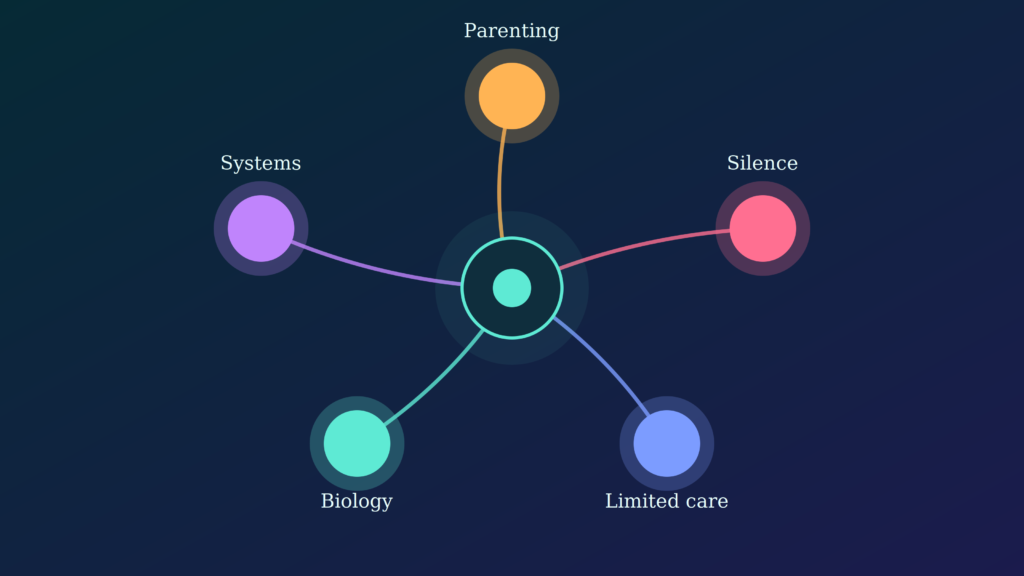
Learned behavior and parenting. Children learn what safety and love look like by watching the adults around them. A caregiver raised amid fear, harsh discipline, or emotional distance may, without intending to, become overprotective, emotionally unavailable, or quick to anger. This rarely means they do not care. Unresolved trauma can shape behavior even in someone who sincerely wants to parent differently.
Silence and secrecy. Many families do not talk about abuse, addiction, migration, incarceration, or loss. Silence can protect people in the short term, but children are perceptive. They often sense fear, shame, or grief without being told what happened. Without words for it, they may blame themselves or assume the tension is simply how life is.
Limited access to care. For decades, many families had no safe or affordable way to process trauma. Cost, stigma, geography, and cultural barriers all played a part. Without tools for repair, people managed pain through avoidance, control, substance use, or emotional shutdown.
Biological influences. Some research suggests that stress can influence how the body’s stress-response system functions, and that certain changes may carry forward. This is usually discussed under epigenetics, the study of how experience affects gene activity without altering the genes themselves. The evidence here is real but still developing, and we look at it more closely below.
Systemic and cultural conditions. Sometimes trauma continues because the conditions that caused it have not ended. A person may carry the echo of a past injustice while also living with present-day inequality. This is why generational trauma is best understood without blame. Families often built survival strategies in response to real danger or loss, and those strategies simply outlived their usefulness.
Is Generational Trauma Real? What Research and Tradition Say
Many people ask whether generational trauma is real or just a popular idea. The most honest answer is that the psychological and relational side is well supported, while the biological side is promising but debated.

Psychological evidence. Decades of research on attachment and family systems show that a parent’s unresolved trauma can affect their child’s emotional development, stress regulation, and sense of safety. Studies of children of Holocaust survivors, refugees, and veterans have repeatedly found higher rates of anxiety and stress-related symptoms in some offspring, though outcomes vary widely and many children show remarkable resilience.
Biological evidence. Some of the best-known findings come from studies of trauma survivors and their children. Rachel Yehuda and colleagues reported differences in stress-related gene regulation in Holocaust survivors and their adult children. Studies of people conceived during the Dutch Hunger Winter of 1944 and 1945 found long-term health differences linked to prenatal famine exposure. In animal research, a well-known 2014 mouse study found that offspring of mice conditioned to fear a particular scent showed heightened sensitivity to it.
These results are intriguing, but scientists urge caution. Human studies are small and hard to separate from other explanations, such as exposure during pregnancy, parenting style, or shared environment. The idea of trauma passed down through genes is better described as trauma possibly influencing how genes are expressed. The DNA sequence itself does not change. Researchers are still working out how much of this transmission occurs in people, and how much can be reversed.
Context and community. Intergenerational trauma in South Africa is a widely discussed example. Apartheid, forced removals, and violence disrupted families and communities for generations, and researchers and clinicians in the country have examined how that history continues to shape mental health, family life, and trust. As in other places marked by collective harm, the transmission is partly emotional and social, and partly tied to unequal conditions that persisted after the harm itself.
Traditional and spiritual perspectives. Many cultures have long held that the experiences of ancestors live on in their descendants. Indigenous scholars developed the concept of historical trauma to describe the cumulative wounds of colonization across generations. Numerous spiritual traditions practice ancestral healing, ritual, prayer, and remembrance to honor those who came before and to release burdens that feel inherited. These views are largely experiential and traditional rather than laboratory-tested, and they deserve to be held with respect. For many people they offer meaning, belonging, and a language for pain that clinical terms alone do not fully capture. They can also sit comfortably alongside therapy and science.
Signs You May Be Carrying Generational Trauma
Generational trauma is easy to miss. People often mistake its effects for personality, ordinary stress, or “just the way our family is.” No single sign proves anything, and many of these experiences have other causes, so they are best treated as prompts for reflection rather than a diagnosis.
Chronic anxiety and hypervigilance. You feel constantly on edge, scan for danger, or carry a sense of dread with no clear personal cause.
Unexplained shame or guilt. You struggle with persistent self-blame or feelings of worthlessness, or you feel undeserving of good things. Your own needs may bring guilt.
Emotional numbing. When things become overwhelming, you disconnect, shut down, or find it hard to identify and express what you feel.
Relationship and attachment struggles. You fear abandonment, push people away, find closeness uncomfortable, or keep repeating patterns you never chose.
Habitual coping strategies. You rely on perfectionism, overwork, overgiving, anger, isolation, or substances to manage pain.
Identity and self-worth patterns. You feel responsible for other people’s emotions, struggle with boundaries, or feel “too much” or “not enough.” Choices that differ from family expectations trigger guilt.
Generational trauma can also appear in the body. Long-term stress may be associated with sleep problems, headaches, muscle tension, digestive issues, fatigue, and higher risk of conditions such as high blood pressure and heart disease. Trauma is not the only cause of any of these, and medical symptoms deserve proper medical attention.
How to Heal Generational Trauma and Break the Cycle
Healing does not require blaming earlier generations or reconstructing your entire family history. It starts with noticing patterns and choosing different responses, repeatedly, over time.

1. Name the pattern. Identify what may have been handed down: fear, emotional distance, harsh conflict, family secrets, survival habits. Recognizing that a parent’s behavior may have come from their own unhealed pain, rather than being a blueprint you must follow, creates room for choice. Naming is about clarity, not blame.
2. Work with your nervous system. Grounding exercises, breathwork, and somatic practices can help your body feel safer in the present. Try noticing tension or shutdown, tracking your triggers, and pausing before you react. Steady sleep, food, and rest support all of this.
3. Seek trauma-informed therapy. A trauma-informed professional helps you connect current struggles to older patterns, build coping tools, and process painful experiences safely. Research-supported approaches include EMDR and trauma-focused cognitive behavioral therapy. The right fit depends on your history, symptoms, and what feels manageable. Therapists and psychologists offer talk therapy and, in some cases, specialized treatment or testing, while psychiatrists can evaluate whether medication might help with depression, anxiety, or PTSD.
4. Set boundaries. Limits around yelling, insults, substance use, or other harmful dynamics create the space recovery needs. Sometimes that means distance, sometimes firm limits within the relationship.
5. Build secure attachment, especially as a parent. Parents do not need to be perfect. Children need caregivers who notice their needs, respond with care, and repair after conflict. That can look like apologizing, allowing feelings without punishment or shame, keeping routines predictable, and offering steady warmth. Repair after a hard moment often matters more than never having one.
6. Create new family patterns. Speak directly instead of avoiding conflict, make time for check-ins, choose calmer discipline, and refuse to keep harmful secrets. New habits feel unfamiliar at first, and repetition is what makes them ordinary.
7. Seek community and cultural healing. When trauma has roots in shared history, individual therapy may not be the only path. Cultural organizations, peer groups, faith communities, and community-based healing practices can restore connection, language, and identity that trauma disrupted. For many people, ancestral and spiritual practices are a meaningful part of this work.
If you are in distress or struggling to cope, please get in touch with a qualified mental health professional or local crisis service.
Common Misconceptions About Generational Trauma
“It means I’m damaged.” Carrying inherited patterns says nothing about your worth. It says something about what your family survived.
“It’s my parents’ fault.” Most parents are repeating what they learned, often with limited support. Understanding is not the same as excusing harm, but blame rarely leads to healing.
“It’s in my genes, so nothing will change.” Even where biology plays a role, it is not destiny. Supportive relationships, stable environments, and effective treatment can make a real difference.
“I need to know my whole family history first.” Helpful, but not required. You can work with the patterns you experience today.
“If I didn’t experience the event, it can’t affect me.” Effects can reach people through behavior, atmosphere, and silence, even without knowing the story.
For daily insights on consciousness, clarity, and trusting yourself, explore Bahlon’s free daily transmissions. Subscribe to receive them directly.
Related Readings:
- Healthy Boundaries in Relationship: Protecting Your Peace
- Nervous System Regulation: Key to Health
- Inner Peace Meaning: What It Actually Is and How to Find It
Frequently Asked Questions
What is an example of generational trauma?
A grandparent survives war and never speaks of it. Their child grows up in a home marked by tension and emotional distance, and the grandchild struggles with anxiety and trust without knowing why. Other examples include cycles of abuse, addiction, or neglect passed through a family.
Is generational trauma real?
The psychological transmission through parenting, attachment, and family environment is well documented. Biological transmission through epigenetic changes is supported by some human and animal studies but is still being researched, and scientists disagree about how far it extends in people.
How does generational trauma work?
It works through several routes at once: learned behaviors, family silence, limited access to care, stress-related biological changes, and ongoing social conditions such as discrimination or poverty.
Can generational trauma be healed?
Yes. Awareness, trauma-informed therapy, nervous system practices, healthy boundaries, secure parenting, and community or cultural support can all help interrupt long-standing patterns.
What is the difference between generational and intergenerational trauma?
The terms are often used interchangeably. Intergenerational usually refers to transmission between parents and children, while transgenerational can imply effects across more distant generations.