What does it mean when a butterfly lands on you? Across spiritual traditions, it is most often read as a sign of transformation, comfort, or good fortune, and sometimes as a visit from a departed loved one. Biology offers its own answer: the insect may be after salt, warmth, or a place to rest. Both explanations can be true at once, and understanding each is the best way to decide what the moment means for you.
Why the Butterfly Carries So Much Symbolic Weight
Few creatures have been given as much meaning as the butterfly. Its life cycle is the reason. A caterpillar builds a chrysalis, dissolves and reorganizes itself inside, and emerges with wings. For thousands of years, people watching this process have seen a picture of change that feels almost impossible, and the symbolism has grown from there.
In ancient Greece, the word psyche meant both “butterfly” and “soul,” a pairing that shows how early the link between this insect and the inner life was drawn. In Mexico, monarch butterflies arrive each autumn around the time of the Day of the Dead, and many families understand them as returning souls of the departed. In parts of Japan, a butterfly drifting into a home has been read as the visit of a spirit. In Christian imagery, the butterfly has long stood for resurrection.
This is the background to any butterfly spiritual meaning you will come across. The traditions differ in detail, but they keep returning to the same cluster of ideas: change, the soul, renewal, and hope. A butterfly landing on you takes that large symbol and makes it personal. It is no longer a butterfly somewhere in a garden. It has chosen, in some sense, to rest on you.

What Does It Mean When a Butterfly Lands on You Spiritually?
Spiritual readings are experiential and traditional rather than scientifically established, and the people who hold them generally say so themselves. Still, certain themes appear again and again.
Transformation and new beginnings. The most common interpretation ties directly to metamorphosis. A butterfly landing on you may be read as a nudge that a chapter is closing or opening, and that you are in the middle of becoming someone slightly different. People often report these encounters at crossroads: a move, a career change, the end of a relationship, the start of a new one.
A message from a loved one. For many people who are grieving, this is the interpretation that matters most. A butterfly that lingers on a shoulder or hand during a hard week can feel like reassurance that someone is near. Whether you understand this as a literal visit or as a comforting symbol that your mind and heart reach for, the comfort itself is real, and nothing about the experience requires you to explain it away.
Good luck and joy. In many cultures, a butterfly is a lucky omen. Its landing may be taken as a sign of coming opportunity, good news, or simply that you are on a fitting path.
Love and renewal. Butterflies are woven into weddings, anniversaries, and celebrations of new chapters, which is why the encounter is sometimes read as a sign of affection arriving or deepening.
Presence and peace. A butterfly rarely stays long. Some people take the visit as an invitation to slow down, breathe, and notice the moment before it passes. In this reading, the lesson is less about prediction and more about attention.
What the Color of the Butterfly Can Signify
Many people look closely at the specific butterfly that visited them. Color-based symbolism is not universal and varies by tradition and by person, but the following associations are widely shared.
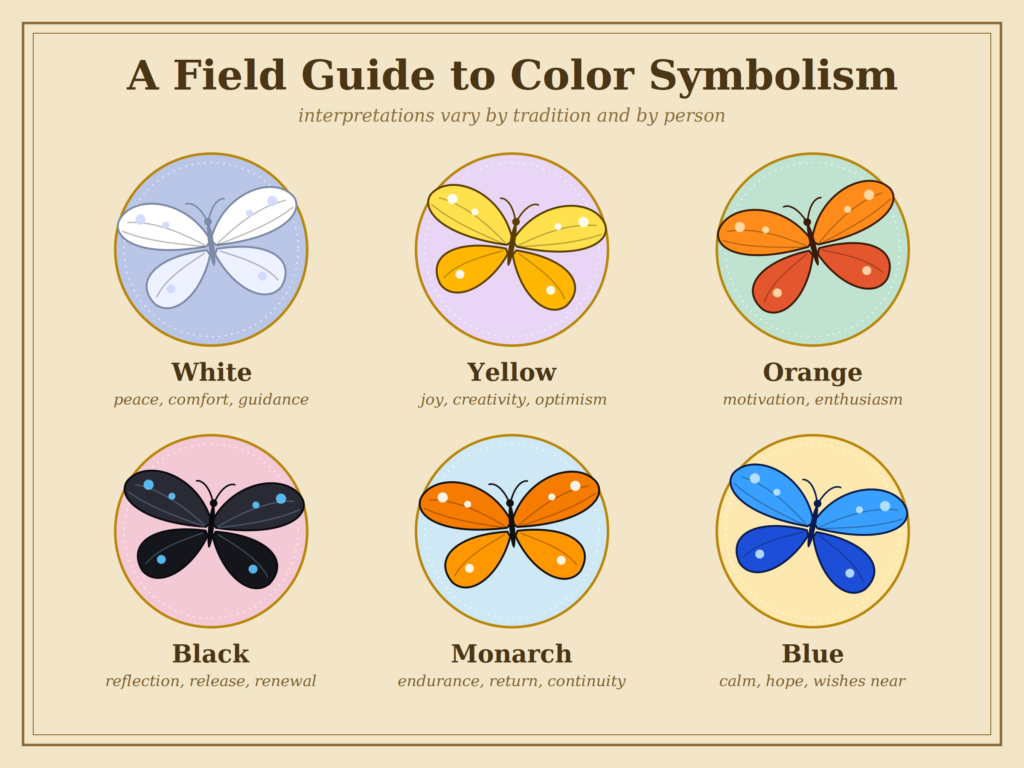
White butterfly meaning. White is the color most often linked to peace, purity, and spiritual guidance. When people ask what it means when they see a white butterfly, the answer given most often is comfort, and frequently a sense of connection with someone who has died. Because white butterflies are common in gardens and fields, the interpretation tends to be strongest when the timing feels personal, such as a sighting on an anniversary or after a sorrowful thought.
Yellow butterfly spiritual meaning. Yellow carries the warmth of sunlight. Its symbolism leans toward joy, creativity, optimism, and prosperity. A yellow butterfly landing on you may be read as encouragement to follow a spark of inspiration or to trust a hopeful turn of events.
Orange butterfly meaning. Orange is often associated with motivation, emotional balance, and enthusiasm. Some people read an orange butterfly as a prompt to act on a goal they have been circling.
Black butterfly meaning. Black butterflies have an undeserved reputation for gloom. In most contemporary interpretations, a black butterfly symbolizes inner work: facing fear, releasing the past, or moving through a heavy emotion toward renewal. Rather than a warning, it is often framed as an invitation to reflect and let go. This is also true of many black and yellow butterfly sightings, where the darker tones are read as depth and the yellow as hope arriving alongside it.
Monarch butterfly spiritual meaning. Monarchs add a layer of their own. Their extraordinary multigenerational migration, and their link to the Day of the Dead in Mexico, make them symbols of endurance, return, and the continuity between the living and the departed.
Blue butterfly symbolism. Blue, a rarer color in nature, tends to be tied to calm, hope, and the feeling of a wish coming within reach.
Does Where the Butterfly Lands Matter?
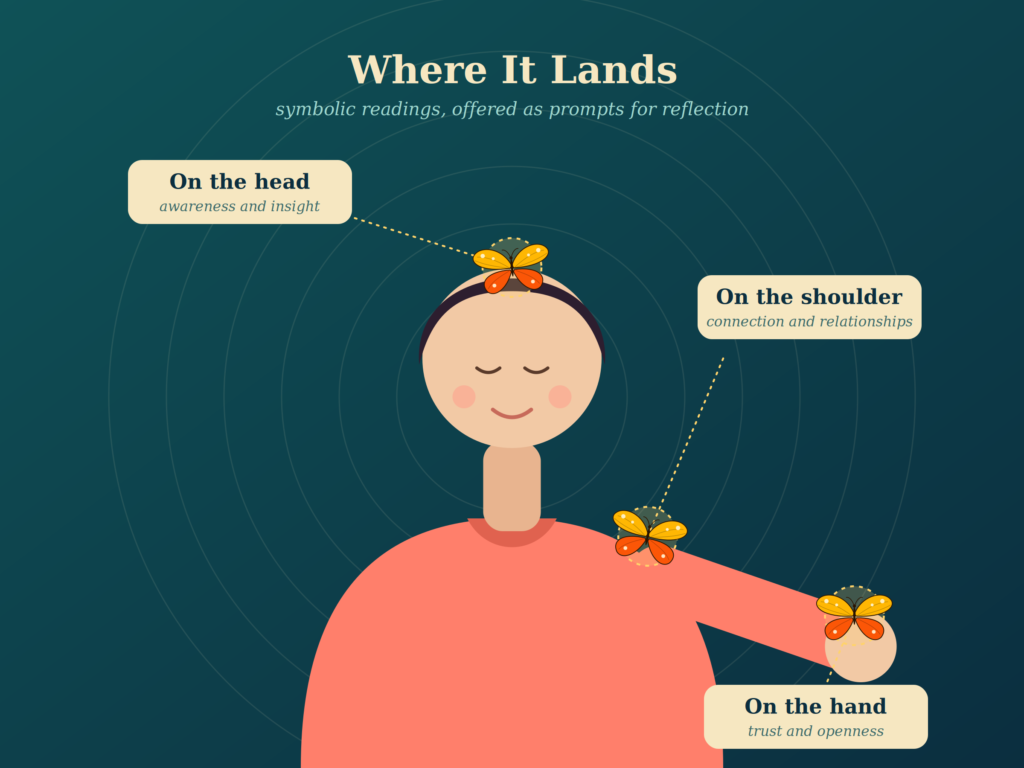
Some interpretive traditions assign meaning to the place on the body where a butterfly settles. These readings are symbolic, not factual, and they are best treated as prompts for reflection.
A butterfly on your hand is often read as trust, safety, and openness to receiving something good. On your head, it may suggest a growing awareness or a new way of seeing something. On your shoulder, it is sometimes connected to relationships, whether a new connection or a change involving other people.
If one of these resonates, it can be a useful lens. If none of them do, that is fine too. A symbol is only as useful as the insight it gives you.
Why Do Butterflies Land on People? The Natural Explanation
Biology answers the same question from a different direction, and the explanation is fascinating in its own right.
Salt and minerals. Butterflies feed mainly on nectar, which contains almost no sodium. To make up the shortfall, many species visit damp soil, animal droppings, and sweat in a behavior known as puddling. Human skin, especially after a warm walk, is a convenient source of salt. Puddling is most common among males, which in many species pass sodium on to females during mating. So the butterfly on your arm may well be doing something quite purposeful.
Warmth. Butterflies are ectothermic, which means they rely on their surroundings to regulate body temperature. A cool morning can leave one sluggish and in need of a warm surface, and a person standing in the sun can serve as exactly that.
Color and pattern. Butterflies navigate by sight, and bright or floral clothing can pass for a flower. A butterfly may approach, investigate, and settle before realizing there is no nectar to be found.
Simple rest. Sometimes an insect needs to pause. You were close, and you were still.

None of this reduces the encounter. Knowing that a butterfly came to you for salt or warmth does not erase the fact that, for a moment, a wild creature trusted you enough to stay.
Can Both Explanations Be True?
A common assumption is that you must choose between the scientific and the spiritual reading. In practice, most people hold both. They know the butterfly may have been drawn by sweat and sunlight, and they also find the timing, the stillness, and the feeling of the moment meaningful.
There is a thoughtful way to think about this. Science explains the mechanism: how and why the butterfly came to rest on you. Spirituality, tradition, and personal reflection address the meaning: what the moment says to you, and what you choose to do with it. These are different kinds of questions, and each tradition of answering them has something to offer. The mechanism does not cancel the meaning, and the meaning does not need to override the mechanism.
How to Make Sense of the Experience
If a butterfly has landed on you and the moment stayed with you, there are a few gentle ways to work with it.
- Notice what you were thinking or feeling. Symbolic encounters tend to feel most significant when they meet an existing question or emotion. Ask what was on your mind just before.
- Consider where you are in your life. If you are in a period of change, the transformation reading may speak to you. If you are grieving, the comfort reading may matter more.
- Write it down. A short note about the date, the setting, the butterfly, and how you felt gives you something to return to later.
- Act on the meaning, not just the sign. If the moment reminded you to slow down, slow down. If it reminded you of someone, reach out or honor their memory. The value of a symbol lies in what it moves you to do.
- Hold your interpretation lightly. You do not need certainty to be moved. Meaning that is held with openness tends to be more nourishing than meaning that is forced.
Common Misconceptions
“A butterfly landing on me means I am special.” The encounter can feel intimate, but it is better understood as an invitation to attention than a ranking of any kind.
“A black butterfly is a bad omen.” In most modern readings, black butterfly symbolism points toward reflection and release, not misfortune.
“If there is a scientific explanation, the spiritual meaning is invalid.” Natural causes and personal meaning operate on different levels. Many people find that understanding the biology deepens their appreciation.
“There is one correct meaning.” Butterfly symbolism varies widely by culture, tradition, and individual. The most reliable guide is how the experience lands for you.
For daily insights on consciousness, clarity, and trusting yourself, explore Bahlon’s free daily transmissions. Subscribe to receive them directly in your inbox.
Related reading:
- 11 Yellow and Black Butterfly Spiritual Meanings
- Why Do You Keep Seeing Butterflies? The Spiritual Meaning Explained
Frequently Asked Questions
What does it mean when a butterfly lands on you?
Spiritually, it is commonly interpreted as a sign of transformation, comfort, good luck, or a message from a departed loved one. Scientifically, the butterfly is most likely seeking salt, warmth, or rest. Many people find meaning in both.
What does it mean when a white butterfly lands on you?
A white butterfly is traditionally associated with peace, purity, and spiritual guidance, and many people link it with a loved one who has passed. It also happens to be one of the most common butterflies, so personal context matters when interpreting it.
Is a butterfly landing on you good luck?
In many cultures, yes. Butterflies are widely seen as symbols of joy, hope, and favorable change. These are cultural and personal beliefs rather than predictions, but they offer an encouraging frame for the moment.
Why do butterflies land on people?
Butterflies often land on people to collect salt and minerals from sweat, to warm themselves, to rest, or because bright clothing resembles a flower. This behavior is well documented and entirely natural.
What does it mean when a butterfly follows you or flies around you?
Spiritually, it may be read as a persistent reminder or encouragement to pay attention to something in your life. Practically, butterflies often investigate colors, scents, and warmth, so a butterfly circling you may simply be curious about what you offer.