Kundalini awakening symptoms show up as a mix of physical sensations, emotional shifts, and spiritual experiences that emerge as dormant energy is said to rise through the body. There is no single checklist that confirms it is happening, since the process looks different for nearly everyone who goes through it. What follows is a grounded look at what people commonly report, what’s rare, and how to tell the difference between a spiritual process and something that needs medical attention.
If you’ve spent the last few weeks convinced something has shifted inside you, you’re in good company. Search interest in this topic has climbed for years, largely because the experience resists tidy explanation. It doesn’t announce itself with a diagnosis. It arrives in fragments: a strange current running up your spine during meditation, a sudden crying jag with no clear trigger, a night you can’t sleep because your whole body feels electric. This piece pulls together how the tradition describes the process, what practitioners actually report, and where the evidence stands on Kundalini awakening symptoms specifically.
What Is a Kundalini Awakening, Exactly?
In the yogic and tantric traditions that first described it, Kundalini refers to a latent form of spiritual energy said to rest at the base of the spine, often depicted as coiled like a serpent. A Kundalini awakening is the term used for the moment (or, more often, the long stretch of time) when that energy begins moving through the body, typically along a central channel called the Sushumna nadi, activating the chakras as it travels toward the crown of the head.
It’s worth pausing on the word “symptoms” itself. It’s the word most people search, because it’s the word that fits how the experience feels when you’re inside it: unfamiliar, sometimes uncomfortable, and hard to name. But within most contemplative traditions, these aren’t symptoms of a disorder. They’re described as signs of transformation, the visible edges of an internal process that touches the body, the emotions, the mind, and what some would call the soul.
Not everyone who goes through this experiences the same combination of signs. Some people notice a handful of subtle shifts over months. Others describe something closer to an internal storm. Both are considered legitimate versions of the same underlying process, and both fall under the broad umbrella of Kundalini awakening symptoms.
How the Process Is Said to Work
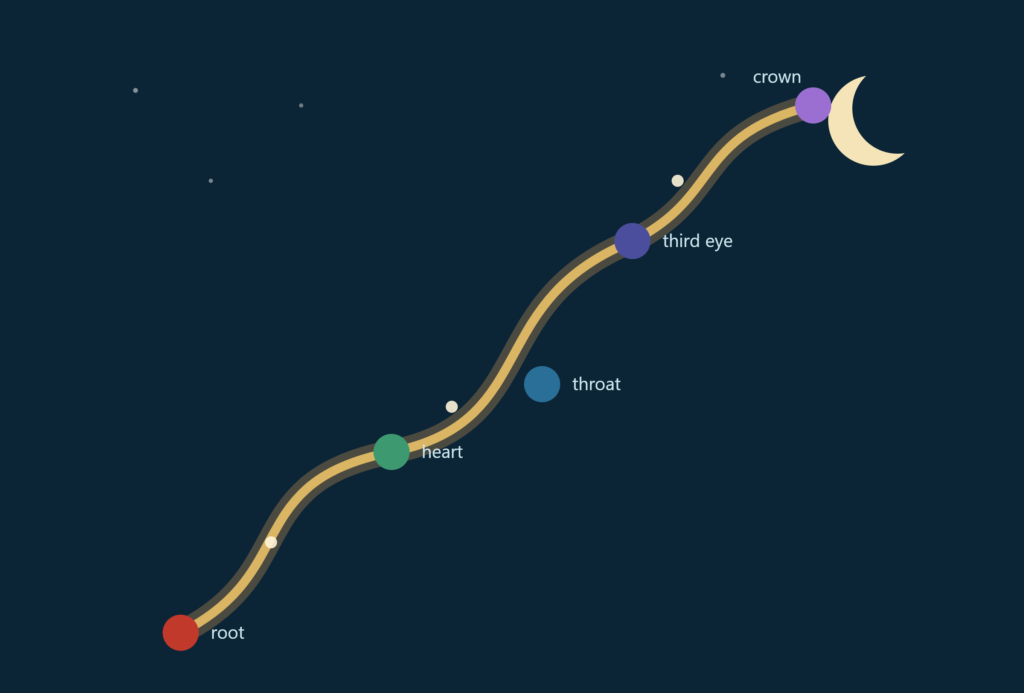
The classical model describes Kundalini energy rising from the root chakra at the base of the spine, moving upward through the energetic centers of the body, and eventually reaching the crown. When this happens suddenly and intensely, people sometimes describe it as an inner explosion, a wave of energy that produces extreme bliss, a sense of oneness with everything, or what’s often called ego death, a temporary dissolving of the usual sense of “I.”
That dramatic version is the one that shows up most often in stories and spiritual folklore, but it’s actually the least common form. Most people who go through a Kundalini process report something far more gradual and far less cinematic.
There are other patterns worth knowing about. Some describe a top-down awakening, where energy seems to flow from the crown downward through the body rather than starting at the base of the spine. Others experience it as centered mostly in the heart, showing up as waves of warmth, emotional opening, or a felt sense of expansion in the chest. These heart-centered or crown-down experiences are often linked to periods of intense practice, emotional upheaval, or deep emotional healing work, rather than appearing entirely out of nowhere. Each variation still counts as part of the wider range of Kundalini awakening symptoms people report.
Kundalini Awakening Signs Across the Body and Mind
Because the process is described as touching every layer of a person’s experience, Kundalini awakening symptoms tend to cluster into a few broad categories. None of these lists should be read as a diagnostic checklist. They’re better understood as a map of what others have reported.
Physical sensations.
Heat or cold that seems to come from nowhere, tingling across the skin, a feeling of electric current or energy moving through the limbs, tremors, spontaneous shaking, sudden jolts, and pressure around the head or heart are among the most commonly described Kundalini awakening symptoms. Research from smaller studies, including work published by the BioMedical Institute of Yoga & Meditation, has catalogued similar physical experiences among practitioners, including tingling, shaking, heat, headaches, and even bouts of tears or nausea during intensive practice.
Sensory and mystical experiences.
Some people report seeing flashes of light, auras, or symbolic imagery, either with their eyes open or during meditation. Others describe hearing spontaneous mantras, ringing or buzzing sounds, or an inner voice that offers something like guidance. Smell and taste can shift too, with some describing fragrances that have no external source or an unexpected sweetness in the mouth. Synchronicities, those uncanny coincidences that feel meaningful, often become more frequent and, for some, almost overwhelming.
Emotional release.
Old grief, fear, and buried trauma can surface without warning. This might show up as sudden crying, unexpected laughter, or a physical urge to move or dance the feeling out. Among emotional Kundalini awakening symptoms, this kind of release is one of the most consistently reported, and the range can swing from deeply uncomfortable to genuinely blissful, sometimes within the same hour.
Involuntary movements, or kriyas.
One of the more distinctive signs is the spontaneous urge to move the body in specific ways, known as kriyas. These can include unplanned yoga postures, shaking, spontaneous vocalizations or mantras, hand gestures known as mudras, and unusual breathing patterns. People sometimes find themselves moving into advanced postures they’ve never had the flexibility or strength for. Within the tradition, kriyas are viewed as a natural, even healthy, part of a well-supported process rather than something alarming.

Changes in appetite, sleep, and libido.
Sudden shifts in diet, ranging from an urge to fast to unusual cravings, are common. Sleep patterns can become erratic, with people waking suddenly in the night or struggling with insomnia. Libido may spike to unfamiliar intensity or drop off almost entirely, and both are considered part of the normal range of Kundalini awakening symptoms.
Shifts in meditation and inner states.
A noticeably deeper, sometimes spontaneous, ability to enter stillness is often cited as one of the clearer signs. People describe touching states of “no-mind” or deep peace during ordinary moments, not just formal practice, and sometimes developing a pull toward meditation that feels as urgent as hunger.
Spiritual and relational shifts.
A stronger draw toward nature, a renewed or entirely new sense of devotion (even in people who previously identified as atheist), a loss of interest in material pursuits, and a growing desire to help or serve others are all frequently reported. Relationships often shift too, as old patterns built on unconscious habits start to feel unsustainable, sometimes creating friction before things settle into something more aligned.
What the Evidence and Different Perspectives Actually Say
This is where honesty matters most. Kundalini awakening is, at its core, an experiential and traditional concept, and most of what’s written about Kundalini awakening symptoms comes from lived accounts rather than lab data. It comes from centuries of yogic, tantric, and contemplative literature, not from controlled clinical trials. That doesn’t make the experiences less real to the people having them, but it does mean the framework is different from a medical diagnosis.
Some researchers in transpersonal psychology and consciousness studies have taken these reports seriously enough to study them descriptively, cataloguing physical and psychological patterns among long-term meditators and practitioners. Small institutes focused on yoga and meditation research have documented recurring physical experiences, including the heat, tingling, and tremors mentioned above, among people who identify as having gone through a Kundalini process. This is useful as descriptive evidence of what people report, but it isn’t the same as proof of an underlying energetic mechanism, which sits outside the scope of what science currently measures.
Traditional teachers, meanwhile, tend to frame the entire process as a form of healing. Past trauma and conditioning are said to rise into awareness specifically so they can be released rather than repeated. Psychic phenomena, sometimes called siddhis, such as flashes of precognition or a felt sense of reading another person’s emotional state, are acknowledged within the tradition but are also treated with caution. Teachers generally warn against chasing these abilities, since attachment to them is considered a distraction from the deeper point of the path, which has more to do with self-understanding than acquiring powers.
Practitioner accounts, collected across forums, teacher trainings, and oral tradition, tend to agree on one thing: comparing your experience against a list of Kundalini awakening symptoms is a poor substitute for guidance. Because many of these signs, from anxiety to insomnia to sudden mood shifts, can also overlap with mental health conditions or ordinary physical illness, most experienced teachers recommend working with someone knowledgeable before assuming every unusual sensation is spiritual in origin.
Kundalini Rising Symptoms: What You Can Actually Do
If several of these signs sound familiar, the most useful next step isn’t panic or self-diagnosis. It’s grounding.

Traditional guidance consistently points toward practices that stabilize the nervous system without shutting the process down entirely:
- Spending time outdoors, ideally with bare feet on natural ground
- Eating warm, nourishing, easily digestible food rather than skipping meals or over-restricting
- Protecting a regular sleep schedule, even when the mind feels wired
- Gentle movement, such as slow yoga or stretching, rather than intense exertion
- Journaling to track patterns in sensations, dreams, and emotional waves
- Connecting with a community or teacher who has direct experience with the process
None of these practices are meant to suppress what’s happening. They’re meant to make an intense internal shift more livable day to day, the same way pacing yourself through any major life transition makes it easier to integrate.
It’s also worth knowing that Kundalini awakening symptoms rarely reverse entirely once the process has clearly begun. What tends to change instead is intensity. Active phases where sensations and emotions run high are often followed by quieter stretches of integration, where the nervous system and psyche catch up with what’s shifted. Expecting a rhythm of intensity and rest, rather than one continuous climax, tends to make the experience easier to move through.
Common Misconceptions Worth Clearing Up
A few misunderstandings come up again and again.
The first is the assumption that awakening always requires years of formal practice. It doesn’t. Spontaneous experiences have been linked to major stress, trauma, near-death experiences, and even sudden creative breakthroughs, not just dedicated meditation or yoga. Practice can help prepare and stabilize the nervous system for what follows, but it isn’t always the trigger.
The second misconception is that every intense or unusual experience must be Kundalini. Some experiences genuinely overlap with anxiety disorders, thyroid or hormonal issues, sleep disorders, or other medical conditions. The traditional advice here is consistent: don’t assume, investigate, and get input from someone with real experience on the path before locking in an interpretation.
The third is that Kundalini is primarily about dramatic mystical events, angels, visions, out-of-body experiences. Those things do get reported, but the more common signs are quieter: shifting priorities, a pull toward solitude or nature, changing appetite, and a slow reordering of what actually matters to you.
For daily insights on consciousness, clarity, and trusting yourself, explore Bahlon’s free daily transmissions. Subscribe here to receive them directly.
Related Readings:
- Spiritual Awakening Guide: Everything You Need to Know
- What Is Kundalini Awakening? A Complete Guide
Frequently Asked Questions
What does a Kundalini awakening actually feel like?
It varies enormously, but common Kundalini awakening symptoms include waves of heat or tingling moving through the body, sudden emotional release, unusually vivid or symbolic dreams, and unpredictable swings between bliss and discomfort. A smaller number of people describe a dramatic, sudden surge of energy up the spine, though this classic version is considered relatively rare.
Are Kundalini awakening physical symptoms dangerous?
Most physical sensations, like tingling, warmth, or spontaneous movement, are considered a natural part of a well-supported process. That said, intense anxiety, mania, feeling completely disconnected from your body, or symptoms that overlap with a medical condition deserve professional attention rather than being assumed to be purely spiritual.
Can Kundalini awakening happen without meditation or yoga?
Yes. Spontaneous awakenings have been associated with major life stress, trauma, near-death experiences, and intense creative periods, not only formal spiritual practice. Practice tends to help stabilize the process rather than always being the cause of it.
How long do Kundalini symptoms and ascension symptoms last?
There’s no fixed timeline. The process can move in cycles, with active, intense phases followed by quieter periods of integration. Many traditional teachers describe the process as ongoing rather than something that resolves after a single event.
Is it possible to stop a Kundalini awakening once it starts?
According to traditional teachings, the energy rarely returns to a fully dormant state once it has clearly activated. The intensity can rise and fall, though, and grounding practices can make the experience more manageable without shutting it down entirely.