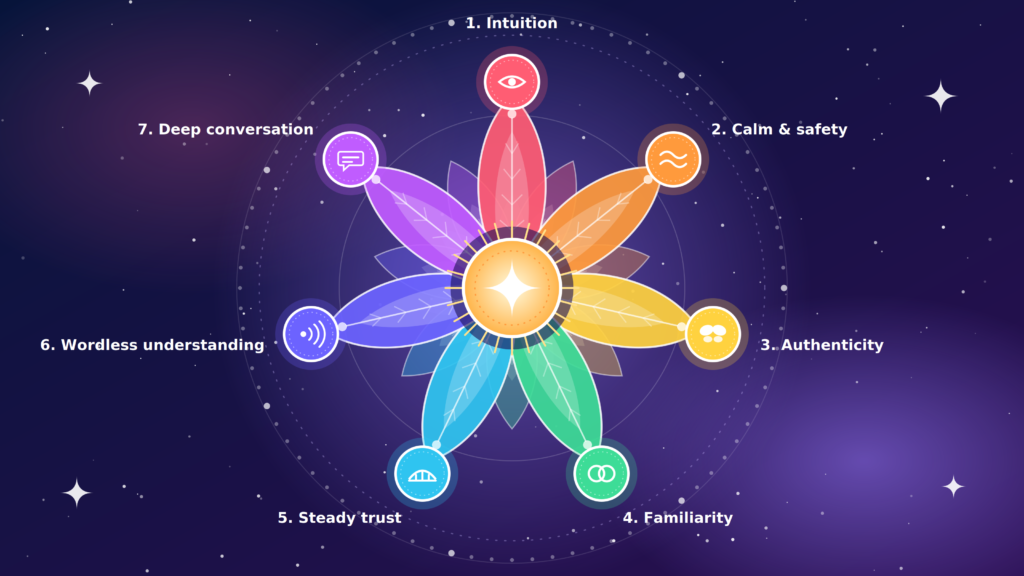
The 7 signs you are spiritually connected with someone include a strong intuitive pull, deep calm in their presence, freedom to be yourself, instant familiarity, steady trust, wordless understanding, and conversations that change how you see things. Traditions describe this bond in different ways, and psychology offers its own explanations, so the most useful question is not only whether the connection exists, but whether it is good for you.
What Is a Spiritual Connection? The Soul Connection Meaning
A spiritual connection is a bond that feels larger than ordinary friendship or attraction. People describe it as recognition, resonance, or a sense that two lives were meant to intersect. The soul connection meaning varies by tradition. Some see it as karmic, a thread carried across lifetimes. Others frame it as a meeting of kindred energies, or simply as rare, deep compatibility that the language of the everyday cannot fully hold.
The idea is ancient. In Plato’s Symposium, Aristophanes tells a story of humans once being whole and spending life searching for their other half. Hindu and Buddhist traditions speak of past-life ties and relationships shaped by accumulated karma. Modern spirituality has added terms such as soul family and twin flame, and Christian communities use the phrase soul ties, which we will return to below.
It helps to be honest about what kind of claim is being made. The felt experience of connection is real and widely reported. The metaphysical explanations, such as past lives or energetic bonds, are matters of belief and tradition rather than something laboratory science can confirm or rule out. You can hold the experience seriously without needing one explanation to be the final word.
7 Signs You Are Spiritually Connected With Someone
No checklist can prove a spiritual bond, and no single sign is decisive. Taken together, though, these seven patterns appear again and again in the accounts of people who describe a deep connection.
1. A Strong Intuitive Pull and Sense of Knowing
You feel drawn to this person before you can say why. There may be a quiet certainty that they matter, even when logic offers little support. Your instincts often feel sharper around them, as if you are paying attention on a deeper channel.
Psychologists often describe intuition as rapid pattern recognition that happens below conscious awareness. Spiritual traditions read the same experience as inner guidance. Either way, the sensation is distinctive: a settled knowing, not a frantic craving. If you want to explore this faculty further, our piece on how to trust your intuition is a good companion read.
2. Calm and Safety in Their Presence
Being near them lowers the volume of your worries. Your shoulders drop, your breathing slows, and challenges feel more manageable. This is among the most consistent markers people report.
There is genuine research behind the body’s side of this. In a 2006 study by James Coan and colleagues, women anticipating a mild electric shock showed reduced threat-related brain activity when holding the hand of a trusted partner. Feeling safe with someone appears to change how the nervous system responds to stress.
3. You Can Be Fully Yourself
You do not rehearse what to say or edit your personality. Your quirks, doubts, and unpolished thoughts are welcome. The result is a feeling of liberation rather than performance.
Authenticity is one of the clearest differences between a deep bond and a merely exciting one. Excitement can survive pretending. Real connection usually cannot, and it does not ask you to.
4. Instant Familiarity
You meet, and it feels as though you already know each other. Closeness arrives without the usual slow build, and it can seem hard to believe you met recently.
Some traditions read this as soul recognition from earlier lives. Psychology offers other explanations, including shared values, similar attachment styles, or someone resembling a figure from your past. Both readings can be held with curiosity, since the experience itself is what matters here.
5. Steady Trust
You are not constantly auditing their intentions. You rely on them without bracing for disappointment, and their word carries weight. Trust that comes easily is often a sign of mutual reliability, which is the reason it feels so natural.
Note the word steady. Trust that swings between certainty and panic is a different experience, and we will look at that distinction shortly.
6. Understanding Without Words
You read each other’s moods through a glance, a pause, or a shared silence. They seem to know when you are anxious or elated, and you can sit together without filling every moment with conversation.
Research on interpersonal synchrony, including work by Ruth Feldman, shows that close partners often coordinate heart rhythms, gestures, and tone. Long familiarity and deep attunement produce this naturally, and many people experience it as something almost telepathic.
7. Conversations That Change You
You rarely stay on the surface. Together you explore fears, meaning, memory, and possibility, and you leave with a clearer sense of yourself. Psychologist Arthur Aron’s 1997 research on closeness found that gradually deepening, reciprocal self-disclosure builds intimacy quickly, even between strangers. In a spiritual bond, that kind of sharing tends to feel effortless and mutual.
How Are Soul Ties Created?
Soul ties is a term popular in Christian and wider spiritual circles for a strong emotional and spiritual bond between two people. Understanding how soul ties are created depends on whose framework you use.
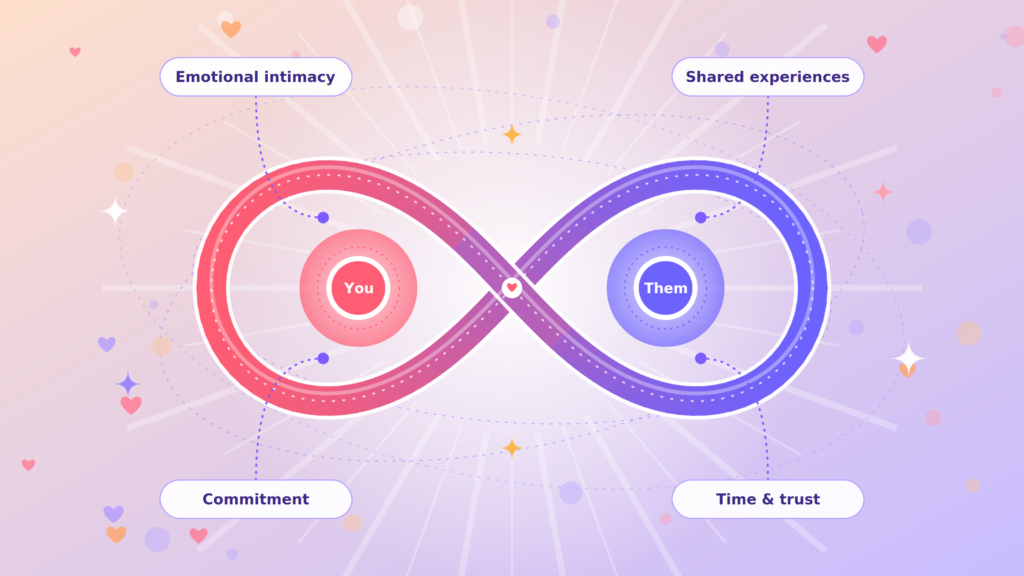
In many faith-based teachings, soul ties form through deep emotional intimacy, shared vows, sexual union, or profound shared experiences. They are often described as either blessed, such as marriage, family, and devoted friendship, or harmful, when a bond keeps someone entangled in a damaging relationship.
Psychology describes overlapping processes without using the same vocabulary. Attachment theory, developed by John Bowlby and Mary Ainsworth, shows that early experiences shape how we bond as adults. Closeness, vulnerability, touch, and shared stress all strengthen attachment. Neurochemicals such as oxytocin and dopamine are involved in bonding and romantic desire, as shown in Helen Fisher’s brain imaging studies of people in love.
Neither account cancels the other. A tradition can name something sacred while psychology maps the pathways through which it unfolds.
What Does the Bible Say About Soul Ties?
The exact phrase soul tie does not appear in the Bible. Teachers usually draw on related passages. First Samuel 18:1 describes the soul of Jonathan being knit to David’s, often cited as an example of deep, positive bonding. Genesis 2:24 speaks of two becoming one flesh, and 1 Corinthians 6:16 connects physical union with a profound joining.
Interpretations differ across denominations, and some theologians caution that the modern soul tie framework is a later development rather than explicit scripture. If this question matters to you, speaking with a trusted pastor or scholar in your own tradition is worthwhile.
How to Tell Whether the Connection Is Healthy
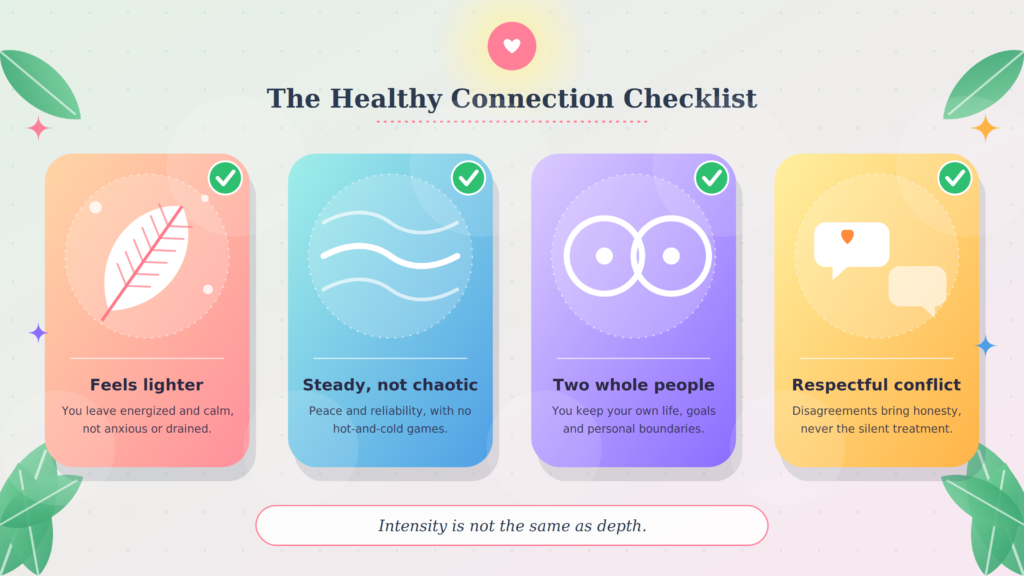
Intensity is not the same as depth. A spiritual connection can be confused with limerence, a term coined by psychologist Dorothy Tennov in 1979 for an involuntary state of obsessive longing, idealization, and fear of rejection. Limerence feels electric, but it is driven by uncertainty and fantasy more than by knowing the person.
A healthy bond tends to show these qualities:
- It leaves you feeling lighter. You feel grounded, encouraged, and more like yourself. A connection that regularly leaves you anxious, depleted, or emotionally bruised deserves a closer look.
- It is consistent, not chaotic. Real depth does not require hot-and-cold behavior, constant drama, or emotional games. A relationship does not need a painful dark night of the soul to prove it matters.
- You remain two whole people. You keep your friendships, goals, and boundaries. You do not feel incomplete or unable to function without them.
- Conflict is handled with respect. Disagreements involve honesty and accountability, not manipulation, punishment, or the silent treatment.
If your experience matches the second list of worries more than the first, that does not make the connection meaningless. It may mean the bond is real but the relationship needs boundaries, support, or distance. A licensed therapist can help if you feel trapped, obsessed, or unsafe.
Can You Feel a Spiritual Connection With Someone You Have Never Met?
According to several spiritual views, yes. The twin flame concept holds that some people sense a counterpart’s energy before meeting in the physical world, and the idea of a soul family suggests deep bonds that exist before people cross paths in this life.
These are belief-based ideas rather than scientifically established ones. There is real research on parasocial bonds, where people feel close to someone they know only through writing, media, or online contact, so a felt connection without meeting is a recognized human experience. What it means is open to interpretation.
How to Nurture a Healthy Spiritual Connection
A connection, once noticed, still needs tending. A few practical habits help:
- Check in with your body. Notice whether time with them leaves you more settled or more on edge. Your body often registers truth before your mind does.
- Slow down. Let trust be earned by behavior over time, not by the strength of the first impression. Our guide to recognizing healthy emotional boundaries can help.
- Keep your own life full. Maintain friendships, solitude, and personal practices so the relationship adds to your life rather than replacing it.
- Talk plainly about what you feel. Mystery is lovely, but honest conversation prevents projection.
- Return to your own center. Reflection, meditation, or journaling keeps your sense of self steady. See also our article on practices for inner clarity.
For daily insights on consciousness, clarity, and trusting yourself, explore Bahlon’s free daily transmissions. Subscribe here.
Related Readings:
- What Are Soul Ties? Meaning, Signs, and How to Break Them
- Why Inner Clarity Matters More Than Motivation
- Emotional Boundaries in Relationships: Protect Your Peace
Frequently Asked Questions
What does soul ties mean?
Soul ties refer to a deep emotional or spiritual bond between two people. Depending on the tradition and context, it can describe a positive connection, such as devoted friendship or marriage, or an unhealthy attachment that is hard to leave.
What is a soul tie in popular culture, such as songs or Love Island?
The phrase has spread beyond religious settings into music and reality television, where it usually means a powerful romantic or emotional bond. Popular usage is usually looser than its faith-based meaning.
What is the energy connection between people called?
There is no single accepted term. People use soul connection, soul tie, energetic bond, twin flame, or kindred spirit, depending on their tradition. In psychology, the closest concepts are attachment and emotional attunement.
Can a spiritual connection be unhealthy?
Yes. An intense bond can overlap with anxious attachment or limerence. If the connection consistently brings fear, confusion, or loss of self, it is worth examining no matter how meaningful it feels.
How do I know if it is a soul connection or just attraction?
Attraction often fades or fluctuates with novelty. A soul connection usually brings calm, trust, and growth that deepen with time, and it holds up when the initial spark settles.