Spirit guides are non-physical presences that many spiritual traditions describe as sources of wisdom, protection, and quiet support along a person’s path. They are not typically encountered through sight or sound in the ordinary sense. Instead, most people describe the experience as intuitive: a thought that feels different from the usual mental chatter, a symbol that keeps reappearing, or a sense of knowing that arrives without explanation.
For centuries, cultures around the world have held some version of this idea, whether framed as ancestors, animal totems, angels, or unseen teachers. What unites these traditions is not a shared theology but a shared practice: quieting down enough to notice what is already trying to be heard.
What Is a Spirit Guide, Exactly?
At its simplest, a spirit guide is understood as a consciousness or presence that exists outside the physical body but maintains some form of connection to a person’s life. Different traditions describe this relationship differently. Some frame guides as departed loved ones who continue to watch over the living. Others describe them as archetypal energies, deities, animal spirits, or beings without a fixed human history at all.
There is no single, universally agreed-upon definition, and that is worth saying plainly rather than glossing over. What spiritual guidance means to one practitioner may look quite different from what it means to another. A person raised in a tradition built around ancestor veneration will likely describe their experience differently than someone drawn to Norse mythology, Egyptian deities, or angelic hierarchies. The common thread is the felt sense of being supported by something beyond the purely rational mind, and a willingness to pay closer attention to the subtler signals of daily life.
It is also worth distinguishing spirit guides from the broader idea of spiritual guidance itself. Spiritual guidance can come from books, mentors, communities, or one’s own accumulated wisdom. A spirit guide, in the more specific sense used here, refers to a particular presence or entity that a person comes to recognize and build an ongoing relationship with over time.
How Spirit Guide Communication Is Believed to Work
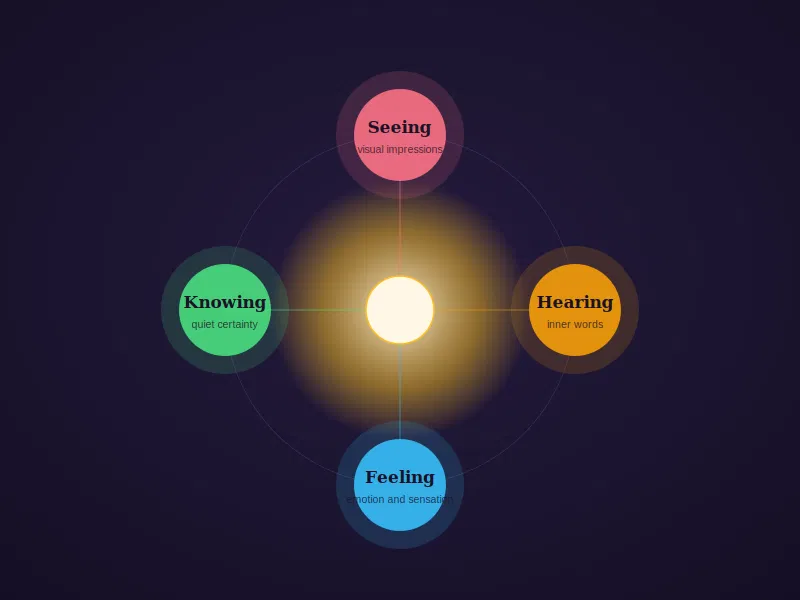
Communication with a spirit guide is almost never described as verbal in the way two people speaking to each other would be. Instead, practitioners tend to describe four broad channels through which guidance seems to arrive.
Some people are primarily visual, meaning they receive impressions as mental images or flashes of scenery that seem to appear from nowhere in particular. Others are more auditory, describing an inner voice or a phrase that surfaces mid-thought, distinct from their usual internal monologue. A third group experiences guidance through feeling, meaning emotional shifts or physical sensations that seem to carry meaning. And a fourth group simply knows, arriving at a certainty about something without being able to trace the reasoning behind it.
Most people lean more heavily toward one of these channels than the others, and recognizing your own dominant style is often described as the first real step in learning how to connect with your spirit guides. Someone who is naturally more visual may struggle for months trying to “hear” a message that was never going to arrive that way in the first place. For a deeper look at how these four styles show up day to day, see this breakdown of how to strengthen your intuition.
Beyond these four channels, many practitioners describe a layer of communication built on repetition. Recurring numbers, particular animals appearing at unlikely moments, feathers found in odd places, or the same word or name surfacing again and again across unrelated contexts. On their own, any one of these could be coincidence. It is the pattern of repetition, especially around significant life moments, that tends to catch a person’s attention and prompt them to look closer.
What Research and Tradition Each Say About Spirit Guides

It is worth being direct here: there is no peer-reviewed scientific evidence confirming the existence of spirit guides as independent, non-physical entities. Mainstream psychology and neuroscience do not currently have a framework that treats spirit communication as an empirically testable claim in the way, say, a medical treatment can be tested.
That said, there is a meaningful and growing body of research into adjacent territory, namely the psychological effects of meditation, intuition, and practices involving a felt sense of guidance. Studies on mindfulness and contemplative practice consistently show measurable effects on stress reduction, emotional regulation, and self-reported wellbeing, regardless of whether the practitioner frames their meditation in spiritual terms or purely secular ones. Some researchers who study intuitive decision-making have also found that the brain can process and act on subtle pattern information faster than conscious reasoning can catch up to, which some interpret as one possible mechanism behind the felt experience of “just knowing.”
None of this proves or disproves the existence of guides in a metaphysical sense. What it does suggest is that the practices associated with contacting spirit guides, quieting the mind, paying closer attention, journaling, sitting with intention, carry documented psychological benefits independent of any belief about who or what is on the receiving end.
Traditional and practitioner perspectives, meanwhile, are far less equivocal, and it would be dishonest to flatten that into skepticism. Across many indigenous traditions, animal spirit guides in particular have held longstanding cultural and spiritual significance, often tied to clan identity, rites of passage, or specific protective roles passed down through generations. In contemporary spiritual communities, practitioners frequently describe spirit guide relationships as some of the most stabilizing and meaningful aspects of their inner lives, built gradually through years of consistent practice rather than a single dramatic encounter.
The honest summary is this: the scientific evidence supports the practices, while the deeper claims about the guides themselves remain a matter of personal experience, tradition, and belief.
How to Identify Your Spirit Guides
For those drawn to explore this path, the process tends to unfold gradually rather than all at once.
Start by exploring what genuinely resonates. Rather than forcing a connection, many people begin by simply noticing what draws their attention. This might be Greek mythology, ancient Egyptian history, particular animals, archangels, plants, natural elements, or the gods and goddesses of a specific culture. There is no requirement to pick something exotic or unfamiliar. A guide, in this framework, tends to be less about what sounds impressive and more about what creates a genuine felt pull.
Consider what you want to develop. Some practitioners choose to work with figures traditionally associated with qualities they hope to strengthen, whether that is confidence, abundance, self-love, or inner strength. Researching which deities or spiritual figures across various traditions are historically linked to those qualities can offer a useful starting point.
Identify where you actually need support. Spirit guides are often described as specializing, in a sense, meaning different figures are traditionally associated with different areas of life such as time management, personal growth, or emotional balance. Naming the specific area where you feel stuck can narrow the search considerably.
Meditate and ask directly. A simple and frequently recommended practice is to sit quietly and silently ask, “Who should I work with?” The answer rarely arrives as a dramatic vision. More often it shows up as a name that surfaces unexpectedly, a recurring image, or a reference that keeps appearing across books, conversations, or everyday media in the days that follow.
How to Connect With Your Spirit Guides
Once a person has a sense of who or what they are trying to reach, the deeper work is less about identification and more about consistency.
Set a Daily Intention
Many practitioners begin the day with a small ritual: placing a hand over the heart, silently asking their guides for direction, and setting an intention to stay open to whatever guidance shows up. It takes under a minute and requires no special setting.
Practice Spirit Guide Meditation
Meditation is widely considered the most direct route to a felt sense of connection. The nervous system calms, the mental noise quiets, and the subtler channels of intuition become easier to notice. Even five minutes of stillness can be enough. Some people use guided meditations designed specifically for this purpose, others prefer instrumental music, and some simply sit in silence. If you are new to sitting quietly with intention, a beginner’s guide to daily meditation can help build the habit before layering in guide-specific practice.
Ask for Help Directly
Rather than treating the relationship as one-directional, many people describe talking to their guides much like they would talk to a trusted advisor or close friend, asking direct questions about decisions, challenges, or areas of personal growth they are working through.
Write Open Letters
Journaling is frequently cited as one of the more reliable ways to draw out intuitive insight. Writing freely about the day, a specific problem, or an open question, sometimes after a few minutes of quiet music or meditation, tends to let thoughts surface more naturally than trying to force a message through sheer concentration.
Keep the Conversation Going
Rather than confining communication to a formal sit-down practice, some people carry an ongoing, informal dialogue with their guides throughout the day, sharing concerns, asking small questions, or simply narrating what is happening as it happens.
Express Gratitude Regularly
A relationship built only around asking for help tends to feel one-sided over time. Many practitioners make a habit of expressing appreciation regularly, not just during hard moments, through quiet acknowledgment, small gratitude rituals, or physical offerings like flowers, candles, or a dedicated altar space. This piece on building a simple daily gratitude practice offers a useful starting structure.
Stay Consistent
Whatever combination of practices resonates, consistency tends to matter more than intensity. A short daily habit, sustained over months, is generally described as far more effective at deepening this kind of connection than an occasional, more elaborate ritual.
Common Questions and Misconceptions
One of the most persistent misconceptions is that contacting a spirit guide should feel dramatic or immediate, closer to a vivid vision than a subtle thought. In practice, most people describe the opposite: a gradual layering of small, quiet signals over weeks or months rather than a single defining moment.
Another common misunderstanding is that a person can only have one guide for life. Many traditions instead describe guides shifting or rotating depending on what a person needs at a given stage, meaning a guide who was present during one chapter of life may recede as another becomes more relevant.
There is also a tendency to overanalyze every coincidence, treating each one as a coded message requiring interpretation. Most guidance on this subject suggests the opposite approach: noticing what feels naturally meaningful without forcing significance onto everything, and trusting that the patterns worth paying attention to tend to repeat on their own.
For daily insights on consciousness, clarity, and trusting yourself, explore Bahlon’s free daily transmissions. Subscribe here to start receiving them.
Related Readings:
- What Are Different Ways To Connect With Spirit Guides
- How Your Spirit Guides Most Often Show Up
- Tips on How To Connect With Your Spirit Guides?
Frequently Asked Questions
What is a spirit guide?
A spirit guide is generally described as a non-physical presence, whether an ancestor, deity, animal spirit, or archetypal energy, believed to offer wisdom, protection, and support, most often communicated through intuition rather than direct speech.
How do I know if I have a spirit guide?
There is no definitive test. Most people describe a growing awareness built from recurring signs, unusual but clear thoughts, and a general sense of being supported, rather than a single confirming event.
How long does it take to connect with a spirit guide?
This varies widely and depends heavily on consistency of practice. Some people report a felt sense of connection within weeks of regular meditation and journaling, while others describe the relationship deepening gradually over years.
Can animal spirit guides and human or divine guides coexist?
Yes. Many practitioners work with more than one type of guide simultaneously, drawing on animal spirit guides for certain qualities and other figures, such as archangels or ancestral presences, for different areas of support.
Do I need a specific religion or tradition to have a spirit guide?
No. While many traditions have their own frameworks for spirit guides, the practices described here, meditation, journaling, and paying attention to intuition, are generally presented as accessible regardless of religious background.