The dark night of the soul is a profound psychological and spiritual crisis in which a person’s sense of meaning, identity, and inner direction seems to collapse all at once. It is not a clinical diagnosis, but a description of a painful transitional state, one in which old beliefs and old versions of the self stop working before anything new has taken their place. For many people, it feels less like sadness and more like the floor of their life has simply given way.
That collapse is disorienting precisely because it doesn’t announce itself as a single event. It builds, often quietly, until the person going through it can no longer explain why nothing feels real, useful, or worth doing.
What Is the Dark Night of the Soul, Exactly?

The phrase originates in Christian mysticism, most famously from the 16th-century Spanish poet and mystic St. John of the Cross, who used it to describe a period of spiritual desolation on the path toward union with the divine. In his framework, the “dark night” was not punishment but purification, a stripping away of comfort and certainty so that something deeper could grow in its place.
Today, the term has moved well beyond its religious origins. Psychologists, therapists, and researchers now use “dark night of the soul” to describe a secular experience: a collapse of inner meaning that can happen to anyone, regardless of faith or belief system. What the traditional and modern uses share is the basic shape of the experience. Something a person relied on for a sense of self, whether that’s God, ambition, relationships, or achievement, stops providing stability, and the person is left without a map.
It’s worth being precise about what this term is not. It is not a universal stage everyone passes through. It is not a guaranteed prelude to enlightenment or growth. It is a metaphor for a specific kind of suffering, one defined by the loss of meaning and identity rather than by a particular set of symptoms or a fixed timeline.
How the Dark Night of the Soul Actually Unfolds
Most people who describe going through a dark night of the soul point to a similar sequence, even if the details of their lives look nothing alike.

Loss of meaning comes first.
Things that used to feel important, a career milestone, a relationship, a long-held goal, start to feel hollow. Success no longer registers as success. There’s a nagging sense that something is missing, even when nothing on paper has changed.
Identity breakdown follows.
The self that was built around achievement, control, performance, or the approval of others begins to fall apart, because it can no longer generate meaning on its own. People in this stage often say things like “I don’t know who I am anymore” or describe a kind of emotional numbness, as if they’re watching their own life from a distance. This kind of identity breakdown can be one of the most disorienting parts of the whole experience.
Emotional and mental weight sets in.
Anxiety, grief, isolation, and a heaviness that doesn’t lift easily are common. This isn’t sadness about one thing; it’s a diffuse, low-grade distress that touches everything.
Inner collapse is the culmination.
People frequently describe it in blunt, physical terms: “the floor is gone,” or “nothing makes sense anymore.” The internal structure that used to hold their life together, their sense of purpose, their story about who they are, seems to dissolve.
Why the Dark Night of the Soul Happens
This kind of collapse tends to arise when an identity built on achievement, control, performance, or external validation stops being sustainable. Sometimes there’s a clear trigger: a divorce, a major loss, a midlife transition, or burnout after years of sustained pressure. Other times there’s no obvious external cause at all, just a slow, internal shift that eventually reaches a breaking point.
Underneath the discomfort, something else may be happening. The breakdown can reflect the dismantling of an old identity structure that no longer fits, with a gap opening up before a new sense of self has had time to form. That gap is uncomfortable to sit in, and there’s no way to predict how long it will last or where it will lead. For some, it becomes the foundation for real growth and reorganization. For others, it persists for a long time without resolution, or requires clinical or medical treatment to address underlying conditions.
Psychological and Spiritual Perspectives
Because the dark night of the soul sits at the intersection of psychology and spirituality, it’s been interpreted through several different lenses, none of which fully cancels out the others.
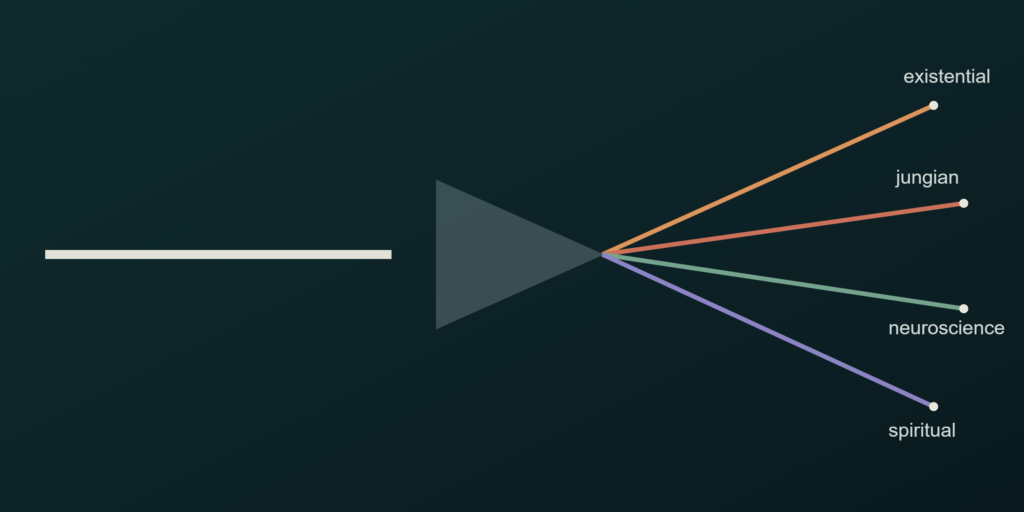
The existential and identity-focused view treats the experience as a crisis of meaning and self. Existential psychology has long held that a life built entirely around external achievement is vulnerable to exactly this kind of rupture, since achievement alone can’t answer deeper questions about purpose and direction.
The Jungian perspective frames it as part of individuation, the lifelong process by which the ego confronts material from the unconscious and the personality expands as a result of that confrontation. In this view, disruption isn’t a malfunction; it’s how psychological growth often works. It’s important to note this is a theoretical framework rather than a clinical model with standardized diagnostic criteria.
A neuroscience-informed analogy offers another angle. The brain is generally understood to operate by generating stable predictions about the world and the self, predictions that let people move through life without constantly re-evaluating who they are. A major disruption, whether it’s a loss, a failure, or a slow accumulation of stress, can break those predictions down, leaving a period of genuine confusion while the brain works to build new ones.
Traditional spiritual accounts, going back to St. John of the Cross and echoed across other contemplative traditions, describe the experience as a necessary stripping away, one that clears space for a deeper, less ego-driven relationship with meaning or the divine. These accounts are experiential and rooted in specific traditions rather than empirical claims, and they’re worth taking seriously on those terms.
None of these perspectives fully replaces the others. Someone going through this experience may recognize elements of all four at once: a loss of meaning, a psychological restructuring, a neurological recalibration, and something that feels, subjectively, spiritual.
Dark Night of the Soul vs. Depression
This is one of the most important distinctions to understand, and one of the easiest to get wrong in either direction.
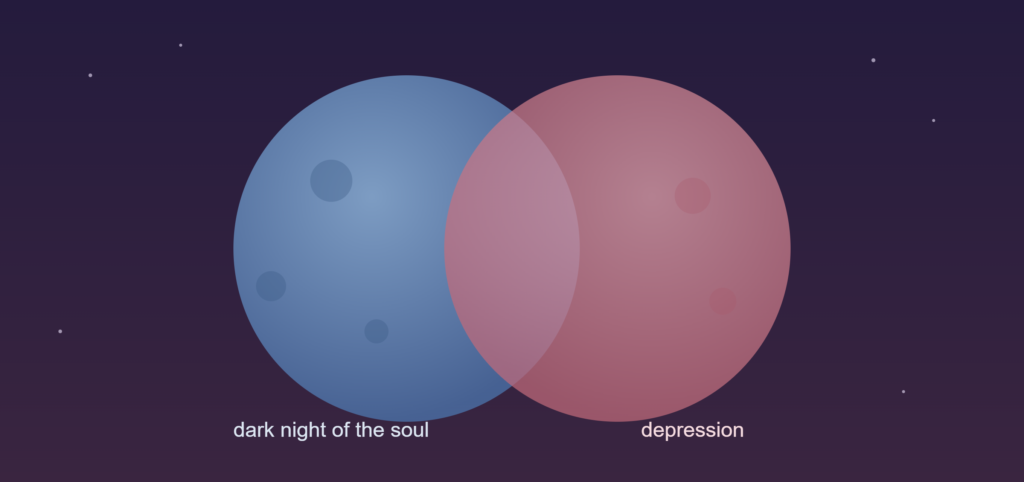
The overlap is real. Low mood, loss of interest, sleep disruption, difficulty functioning, and a sense of meaninglessness show up in both experiences, which is exactly why they can be hard to tell apart from the inside.
The key difference is that the dark night of the soul specifically involves a meaning and identity dimension, a felt sense that one’s inner framework for understanding life has collapsed. Depression, by contrast, is a clinical condition with diagnostic criteria, and it requires proper evaluation by a qualified professional.
The safest approach is to rule out clinical conditions first. This includes depression, bipolar disorder, trauma responses, and medical or sleep-related issues that can produce similar symptoms. A spiritual or existential framing should never replace medical evaluation, particularly when symptoms are severe or persistent.
At the same time, both things can be true. The experience can involve real, clinically significant suffering and also represent a genuine developmental transition. Two mistakes are worth avoiding here. One is catastrophizing, insisting “this will never end.” The other is spiritual bypassing, waving off real distress with “this is just growth, I don’t need help.” Pain doesn’t need to be justified as meaningful to be worth taking seriously, and it doesn’t need to be pathologized to be worth exploring.
How to Move Through the Dark Night of the Soul
There’s no formula that guarantees resolution, but there are practices that tend to help people move through this kind of crisis rather than getting stuck in it.
Allow the process instead of suppressing it. Fighting the discomfort or trying to force quick answers tends to prolong it. Letting emotions and uncertainty exist, without immediately needing to resolve them, is often the first real step.
Rest and slow down. Sleep and physical recovery matter more than they might seem to. A nervous system under sustained stress needs support, not more demands placed on it.
Observe thoughts without fully believing or fighting them. Fear-based thinking tends to intensify during this period. Noticing those patterns, rather than treating them as fact or trying to aggressively argue them away, creates some breathing room.
Stay grounded in the physical. Simple, tangible practices help: walking outside, eating nourishing food, and generally staying present in the body rather than living entirely in the head.
Seek support. This can include skilled, trauma-informed therapy, trusted people who can listen without immediately trying to fix things, and contemplative or somatic practices that build a sense of steadiness over time.
Accept uncertainty. There’s often a long in-between phase with no clear answers and no quick resolution, and learning to trust your own inner signals during that stretch matters more than finding a definitive explanation. Progress during this stretch tends to feel inconsistent rather than linear, and that’s a normal part of the process, not a sign that something is going wrong.
It’s worth being honest that this experience doesn’t resolve the same way for everyone. It may not lead to growth in every case, and it can last for an extended period. It is not a guaranteed spiritual awakening, and it is not a substitute for medical care when medical care is needed.
Common Misconceptions
One persistent misconception is that the dark night of the soul is simply a more poetic name for depression. As outlined above, there’s real overlap, but the two aren’t identical, and treating them as interchangeable can lead people to either over-medicalize a meaning crisis or under-treat a genuine clinical condition.
Another misconception is that everyone who struggles emotionally is having a dark night of the soul, or that everyone eventually has one. This isn’t a universal developmental stage. It’s a specific pattern of identity and meaning collapse that some people experience and others don’t.
A third misconception is that the experience always leads somewhere good. Growth is a possible outcome, not a guaranteed one. Framing it as automatically transformative can pressure people to find meaning in suffering before they’re ready, or to stay in a difficult state longer than is healthy because they believe it’s “supposed” to lead to awakening.
When to Seek Professional Help
Some signs indicate a need for immediate or professional support rather than self-guided coping:
- Thoughts of self-harm or suicide
- Severe difficulty functioning in daily life
- Symptoms of psychosis, dissociation, or bipolar episodes
- Ongoing sleep disruption
- Substance or medication issues
- Situations involving abuse or danger
The underlying principle holds regardless of how the experience is framed: a spiritual or existential explanation should never delay or replace proper clinical evaluation and care.
For daily insights on consciousness, clarity, and trusting yourself, explore Bahlon’s free daily transmissions. Sign up to receive them directly in your inbox each morning.
Related Readings:
Frequently Asked Questions
What is the meaning of dark night of the soul?
It refers to a deep crisis of meaning and identity, one where old beliefs, roles, or sources of self-worth stop working and nothing has yet replaced them. The phrase originated in Christian mysticism but is now widely used to describe a secular psychological experience as well.
What does dark night of the soul mean psychologically?
Psychologically, it describes an existential and identity crisis, sometimes understood through frameworks like Jungian individuation or as a breakdown of the mental “predictions” people rely on to feel stable and oriented in life.
Is the dark night of the soul the same as depression?
Not exactly. The two can look similar and often overlap, but the dark night of the soul specifically centers on a collapse of meaning and identity, while depression is a clinical condition that requires proper diagnosis and treatment. It’s important to rule out depression and other clinical conditions first.
How long does a dark night of the soul last?
There’s no fixed timeline. For some people it resolves in weeks or months; for others it extends much longer, especially without support. Outcomes vary, and it doesn’t always lead to a clear resolution or breakthrough.
How do you get through a dark night of the soul?
Common approaches include allowing the experience rather than suppressing it, prioritizing rest, observing difficult thoughts without over-identifying with them, staying grounded through physical activity, and seeking support from trusted people or trauma-informed professionals. Accepting a period of uncertainty is often part of the process.