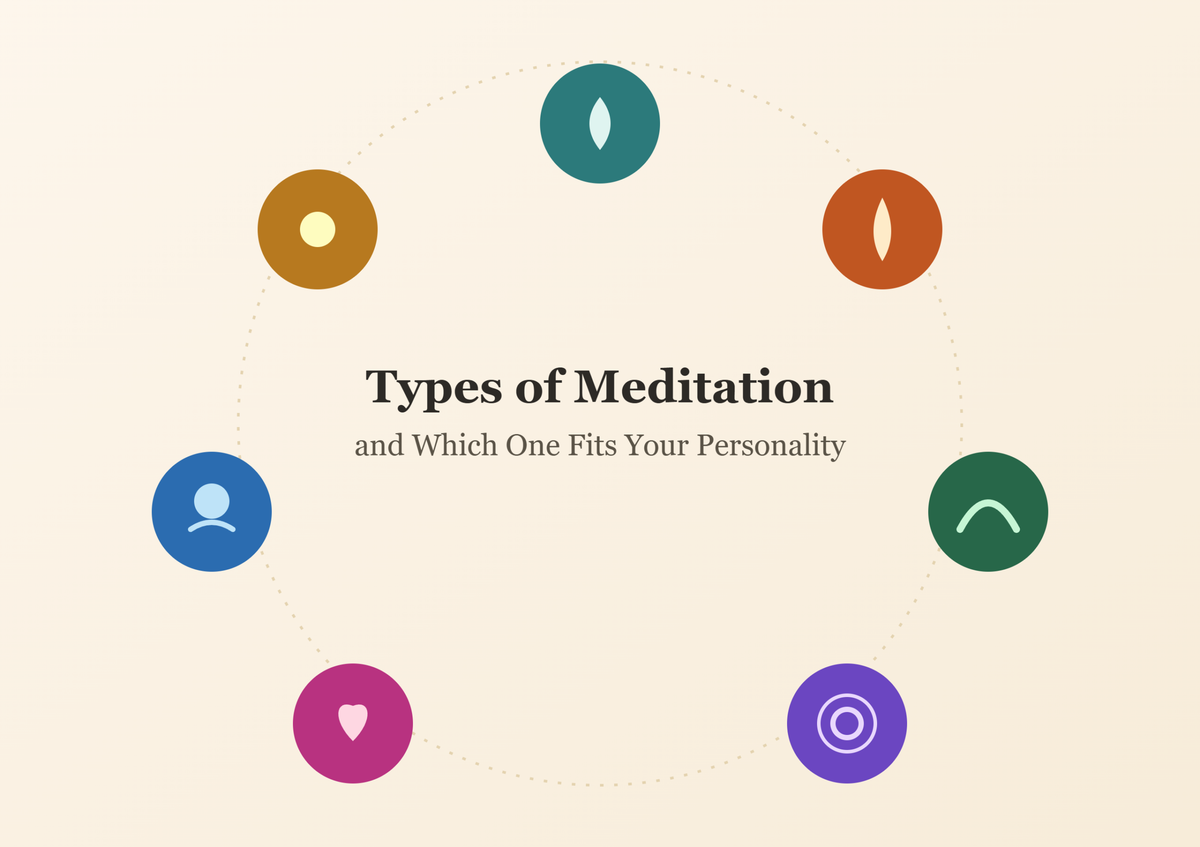
There are several distinct types of meditation, and each one trains the mind in a different way, meaning the “best” practice isn’t universal but personal. Mindfulness meditation suits analytical minds, focused meditation suits goal-driven personalities, movement meditation suits restless energy, mantra meditation suits sound-sensitive learners, loving-kindness meditation suits empathetic people, and visualization meditation suits creative thinkers. The right fit depends less on discipline and more on how your particular mind naturally settles.
Anyone who has tried to meditate and quit after a week has usually run into the same problem: they picked a technique that fought against their own wiring instead of working with it. A restless, physically energetic person forced to sit motionless for twenty minutes isn’t failing at meditation. They’re just using the wrong tool. Understanding the different types of meditation, and how each one interacts with personality, temperament, and goals, changes meditation from a chore into something sustainable.
What Are the Different Types of Meditation?
Meditation is not one activity wearing different names. It’s a family of practices, developed across centuries and traditions, that share a common aim (training attention, awareness, or emotional state) while using very different methods to get there. Some ask you to observe. Some ask you to focus. Others ask you to move, repeat, feel, or imagine.
The six meditation types covered most often in both traditional teaching and modern research are:
- Mindfulness meditation – observing breath or thoughts without judgment
- Focused meditation – concentrating on a single object, sound, or sensation
- Movement meditation – practicing present-moment awareness through motion
- Mantra meditation – repeating a word or sound to anchor the mind
- Loving-kindness (metta) meditation – directing compassion toward yourself and others
- Visualization meditation – using mental imagery to relax or focus the mind
None of these forms of meditation is inherently superior. They simply produce different effects, a point modern neuroscience has started to confirm in ways that traditional teachers described experientially long before brain scans existed.
How Each Meditation Style Works (and Who It Suits)
Mindfulness Meditation: For the Analytical, Curious Mind
Mindfulness meditation asks you to sit quietly and observe your breath, bodily sensations, or passing thoughts without trying to change them. There’s no goal beyond noticing. For people who are naturally curious about how their own mind operates, this open, investigative quality feels less like a discipline and more like a fascinating experiment. It rewards patience and self-reflection rather than intensity.
Focused Meditation: For the Structured, Goal-Oriented Mind
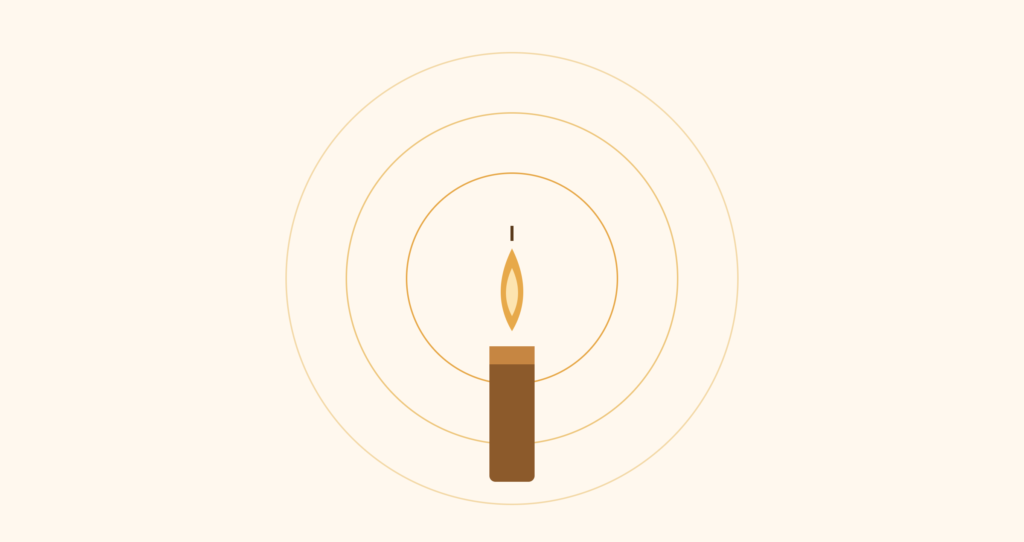
Focused meditation narrows attention onto one single point: a candle flame, a repeated sound, the physical sensation of breathing in and out. Every time the mind drifts, you gently bring it back to that one anchor. People who like clear rules, measurable progress, and a defined task tend to find this approach easier to stick with than the more open-ended style of mindfulness practice, simply because there’s one job and one job only.
Movement Meditation: For the Restless and Physically Active
Not everyone can, or wants to, sit still. Movement meditation, including slow walking meditation, mindful yoga, and deliberate stretching, channels attention through the body instead of against its natural energy. This is often the entry point for people who’ve tried seated meditation and given up, not because they lacked discipline but because stillness itself was the obstacle.
Mantra Meditation: For Auditory, Sound-Sensitive Minds
Mantra meditation, sometimes practiced formally as Transcendental Meditation, involves silently repeating a word, phrase, or sound. The repetition gives the mind something rhythmic to hold onto, which can be more effective than trying to think about nothing for people whose inner world is naturally verbal or musical. Instead of fighting mental chatter, this technique redirects it.

Loving-Kindness (Metta) Meditation: For the Emotionally Attuned
This practice involves deliberately generating warmth and goodwill, first toward yourself, then toward loved ones, acquaintances, and eventually people you find difficult. For those who already feel things intensely, whether that’s empathy, sensitivity, or emotional reactivity, metta meditation gives that trait a direction rather than asking it to switch off.
Visualization Meditation: For Creative, Image-Based Thinkers
Visualization meditation uses mental imagery: a peaceful landscape, a source of light, a specific desired outcome held in detail. People who naturally think in pictures rather than words, artists, designers, daydreamers, tend to find this one of the more intuitive meditation techniques to sustain, since it uses a mental skill they already rely on.

What the Research Actually Shows About Meditation Types
For a long time, meditation was treated in casual conversation as a single, generic activity with a single generic benefit: relaxation. Recent research complicates, and enriches, that picture considerably.
One of the most detailed investigations into this question, known as the ReSource Project, followed over 300 adults across a structured, months-long training program. Participants meditated for roughly 30 minutes a day and attended weekly sessions, with their progress tracked through cognitive testing, questionnaires, and brain imaging. The training was divided into three separate modules, each targeting a different mental skill: Presence (attention and body awareness), Affect (compassion and emotional connection), and Perspective (self-awareness and understanding others).
The findings are worth sitting with, because they push back against the assumption that any meditation practice will deliver any benefit. Attention-based training improved focus and awareness, and interestingly, both attention practices and compassion practices contributed to that improvement. But compassion itself only increased through the emotionally focused Affect module; attention training alone did not build it. Perspective-taking, the ability to understand another person’s point of view, improved only through the specific Perspective training designed for it.
Brain imaging told a parallel story. Different practices appeared to engage different neural regions: attention training toward areas tied to focus, compassion training toward areas linked to empathy, and perspective training toward regions associated with understanding others. Stress responses also diverged in a notable way. Attention-based meditation reduced how stressed participants felt, but not their underlying biological stress markers. Social and emotional practices, by contrast, meaningfully lowered cortisol, the body’s primary stress hormone. Partner-based emotional exercises additionally strengthened participants’ sense of closeness with others, and body awareness, one of the slower benefits to develop, took roughly six to nine months of consistent practice to show measurable improvement, but was linked to better emotional understanding once it did.
Alongside this scientific lens sits a much older one: centuries of traditional teaching from Buddhist, yogic, Vedic, and contemplative Christian lineages, each of which developed these techniques experientially, long before anyone could measure cortisol. Practitioner accounts, passed down through direct teaching rather than clinical trial, describe the same distinctions the ReSource data later confirmed: that stilling the mind, opening the heart, and sharpening insight are related but genuinely separate skills, each requiring its own practice.
Taken together, the honest conclusion is this: science has started to validate what contemplative traditions asserted long ago, that different meditation styles do different things, though researchers are still working out precisely how and why at a mechanistic level.
Practical Application: How to Choose and Start
Matching yourself to the right meditation style doesn’t require a personality test, though understanding your own tendencies helps. Here’s a practical way to approach it:
- Start with your obstacle. If your mind races with analysis, mindfulness or focused meditation gives that tendency somewhere useful to go. If your body can’t stay still, begin with movement meditation instead of forcing stillness.
- Match technique to goal. Want calmer nerves generally? Attention-based practices help with perceived stress. Want to actually shift your stress hormones or feel closer to the people around you? The research points toward emotional and social practices like loving-kindness meditation.
- Try short sessions before long ones. Ten minutes of a technique that suits you will teach you more about whether it fits than thirty minutes of one that doesn’t.
- Expect different timelines. Attention and focus can improve within weeks. Compassion may need consistent emotional practice. Body awareness, per the ReSource findings, is a slower build, often taking several months.
- Combine, don’t just choose once. Many long-term practitioners rotate between meditation styles depending on what they need that week, using mantra meditation on a scattered morning and loving-kindness practice after a difficult conversation.
Consistency matters more than intensity. Roughly 30 minutes a day, sustained over months, appears repeatedly in research as the threshold where measurable change begins to show up, though shorter daily sessions still offer value, particularly for beginners building the habit.
Common Misconceptions About Meditation Types
“Meditation means clearing your mind of all thoughts.” This is one of the most persistent myths and it discourages more beginners than almost anything else. Most meditation types don’t ask you to eliminate thought; they ask you to change your relationship to it, whether that’s observing it, redirecting it, or generating a specific kind of thought (like compassion) on purpose.
“There’s one correct way to meditate.” As both traditional teaching and the ReSource research suggest, different techniques serve different purposes. A practice that fails to calm one person completely might be exactly what settles another.
“If it isn’t relaxing, it isn’t working.” Some meditation techniques, especially perspective-taking or emotionally confronting practices, can feel effortful or even uncomfortable before they feel rewarding. Discomfort isn’t automatically a sign of doing it wrong.
“You need to sit cross-legged for it to count.” Movement meditation is a legitimate, well-established practice, not a lesser substitute for seated stillness.
For daily insights on consciousness, clarity, and trusting yourself, explore Bahlon’s free daily transmissions.
Related Readings:
- Meditation Guide for Beginners
- Meditation for Inner Exploration: Your Inner Being
- Meditation Techniques for Psychics
Frequently Asked Questions
What are the main types of meditation?
The most commonly practiced forms are mindfulness, focused, movement, mantra (or Transcendental), loving-kindness, and visualization meditation. Each trains a different mental or emotional skill.
How many types of meditation are there?
There’s no single official count, since techniques vary across traditions and often overlap, but most modern guides group meditation into roughly six to eight core styles, with countless variations within each.
What are the 3 types of meditation, according to research?
The ReSource Project, a major long-term study, organized meditation training into three core categories: Presence (attention), Affect (compassion), and Perspective (cognitive understanding of others).
Which type of meditation is best for beginners?
There’s no universally “best” starting point, but mindfulness and focused meditation are often recommended first because they’re simple to learn, don’t require physical movement, and build a foundational skill useful across other techniques.
Can I combine different meditation techniques?
Yes. Many experienced practitioners rotate between styles depending on their mood, energy level, or goal for that particular day, rather than committing to a single lifelong technique.