What does it mean when you see a crow? In most spiritual traditions, it signals a period of transformation, heightened awareness, or a message worth paying attention to. Crows are widely regarded as intelligent, perceptive creatures, and their sudden appearance is often read as an invitation to slow down, look more closely at your circumstances, and trust what your intuition is already telling you.
That’s the short answer. But the fuller picture involves centuries of folklore, several distinct cultural lenses, and a genuine debate about how much of this symbolism is rooted in observable bird behavior versus inherited belief. Understanding all of it gives you a much richer way to interpret your own encounter, rather than settling for a single generic meaning.
The General Spiritual Meaning of Seeing a Crow
Before getting into specific traditions, it helps to answer the broader question directly: what does it mean when you see a crow in a general sense, outside of any one culture’s framework? Across cultures, crows tend to occupy a similar symbolic space: they are seen as messengers, guardians, or guides that move between the ordinary world and something larger than it. This isn’t accidental. Crows are unusually smart birds. They recognize individual human faces, use tools, and hold grudges long enough to teach other crows to distrust a specific person. That behavioral sophistication has, over generations, translated into a spiritual reputation for wisdom and perception.
When people ask what a crow symbolizes, the answer usually clusters around a few consistent themes: change, insight, protection, and the mysterious. A crow crossing your path is rarely interpreted as meaningless. Instead, it’s treated as a prompt, something asking you to notice more, assume less, and stay open to a shift that may already be underway in your life.
It’s worth being honest about where this symbolism comes from. Some of it is rooted in centuries-old religious and cultural frameworks. Some of it is modern, shaped by online spiritual communities who’ve built a shared vocabulary around animal encounters. Neither version is “more correct.” They simply reflect different sources of meaning, and both are worth understanding.
How Crow Symbolism Actually Works
Answering “what does it mean when you see a crow” on a mechanical level, rather than a purely cultural one, means looking at where the symbolism actually comes from. Crow symbolism generally operates on a mix of observed behavior, historical association, and personal resonance. It helps to break this down into its component parts rather than treating it as one uniform belief.
Transformation and the End of a Chapter
Crows carry a long association with death in Western folklore, largely because they’re scavengers and were historically seen near battlefields or burial sites. But most contemporary spiritual interpretation reframes this connection. Rather than predicting physical death, a crow sighting is more often read as a marker for the end of one phase of life and the start of another. Old habits, relationships, or mindsets giving way to something new.
Intelligence and Seeing Past the Surface
Because crows solve problems and adapt quickly, they’re frequently used as a symbol for cutting through illusion. If you see a crow during a moment when you’re wrestling with a decision, some traditions suggest this as a nudge to trust your own judgment rather than second-guessing yourself into paralysis.
Messages Between Worlds
Many belief systems position the crow as an intermediary, a creature that moves comfortably between the physical and spiritual realms. This is where the idea of crows as spiritual messengers comes from. The message itself isn’t fixed. It depends heavily on when and how the crow appears, which is why context matters as much as the sighting itself.
Protection and Vigilance
Crows are territorial and alert, often seen guarding nests or mobbing larger predators. That watchfulness has been folded into their symbolic role as protectors. A crow’s presence, in this reading, is less about warning of danger and more about encouraging you to stay attentive to your surroundings.
Crow Spiritual Meaning Across Cultures and Traditions
One reason crow symbolism feels so layered is that it hasn’t developed from a single source. It’s been shaped independently across continents, and the differences are genuinely interesting.
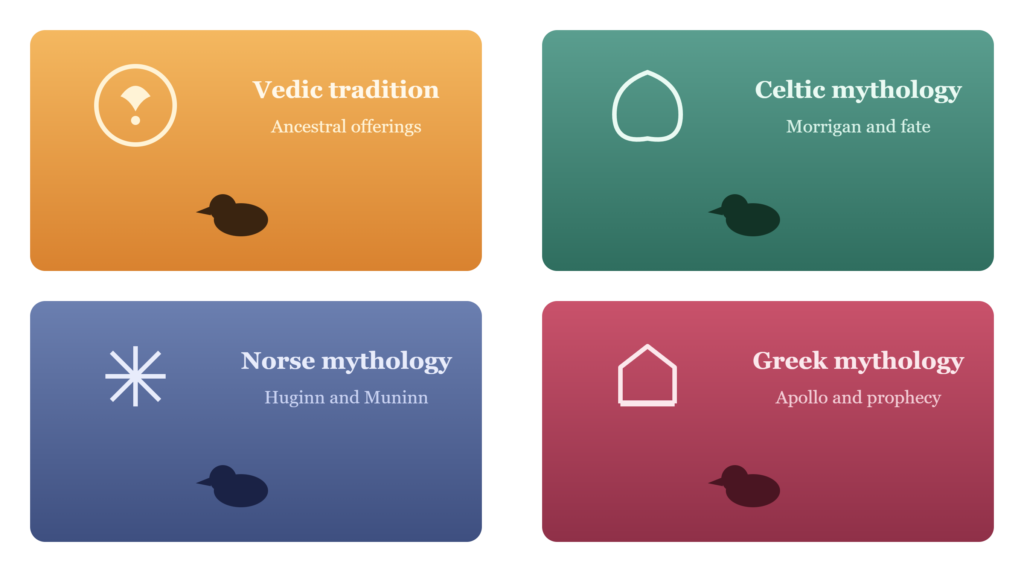
In Hindu culture and Vedic tradition, crows hold a specific and honored role connected to ancestry. They are associated with Pitru, or ancestral energy, and during the ritual period known as Shradh, families make offerings to crows as a way of honoring deceased relatives. A crow visiting a home in this tradition can be read as a sign of an incoming message, guest, or ancestral presence rather than something ominous.
In several Native American traditions, including accounts from Hopi and Sioux communities, crows are described as spiritual guides tied to the world of ancestors and personal transformation. They’re treated as bearers of wisdom rather than symbols to fear.
In Celtic mythology, the crow is closely tied to the goddess Morrigan, a figure associated with fate, sovereignty, and the outcome of battles. Crows appearing before conflict were historically read as omens, linking the bird to themes of death and rebirth rather than one or the other exclusively.
In Norse mythology, Odin’s two ravens, Huginn and Muninn, represent thought and memory. This is one of the clearest examples of corvids being linked directly to intelligence and foresight rather than misfortune.
In Ancient Greek mythology, crows were connected to Apollo, the god of prophecy, and were believed to appear ahead of significant events as a kind of forewarning from the gods.
Folklore traditions have also assigned meaning to the number of crows seen at once, with rhymes suggesting one crow relates to sorrow or wisdom, two to luck, and three to communication or union. These counting rhymes vary by region and shouldn’t be treated as universal law, but they show how deeply embedded crow symbolism became in everyday folk belief.
Is Seeing a Crow Good or Bad Luck?
This is one of the most common ways people phrase what does it mean when you see a crow, and the honest answer is that it depends entirely on the tradition and the context of the sighting. In some cultures, a crow is a good omen tied to fortune or a message from something greater. In others, particularly older European folklore, crows carry an association with misfortune or death.
Even within the more cautionary interpretations, most contemporary readings soften this into something less literal: the end of one chapter, not the end of a life. And regardless of whether a given tradition treats crows as fortunate or unfortunate, there’s a consistent thread running through nearly all of them, the idea that a crow’s appearance is a call to pay closer attention. That common ground matters more than the good-luck-or-bad-luck framing suggests.
How to Know if a Crow Is Your Spirit Animal
Part of asking what does it mean when you see a crow is wondering whether the connection runs deeper than a single sighting. For people drawn to the idea of animal guides, a few patterns tend to come up repeatedly when they describe a connection to crows.
- Frequent encounters. Repeated crow sightings, whether in daily life, dreams, or recurring imagery, are often cited as the clearest sign of a spiritual connection.
- An emotional or intuitive pull. If a crow’s presence affects you more than encounters with other animals typically do, that reaction itself may hold meaning.
- An affinity for intuition and sharp thinking. People who lean on instinct and enjoy solving problems creatively often report feeling aligned with crow symbolism.
- Curiosity about the unknown. A pull toward hidden knowledge, mystery, or unexplored ideas is commonly described alongside a crow connection.
- Clarity during hard times. Some people notice that crow sightings coincide with moments when they find unexpected calm or direction during difficult periods.
None of these are diagnostic checkboxes. They’re patterns that practitioners and spiritually inclined communities have described consistently enough to become part of the shared interpretation of crow symbolism. If this kind of pattern-recognition resonates with you, it’s worth exploring how to identify your spirit animal more broadly, since many of the same signs apply beyond crows specifically.
What It Means When a Crow Appears in Specific Situations
People often ask what does it mean when you see a crow in a particular moment rather than in the abstract, since context changes the reading considerably. This is part of why crow encounters feel so personal.
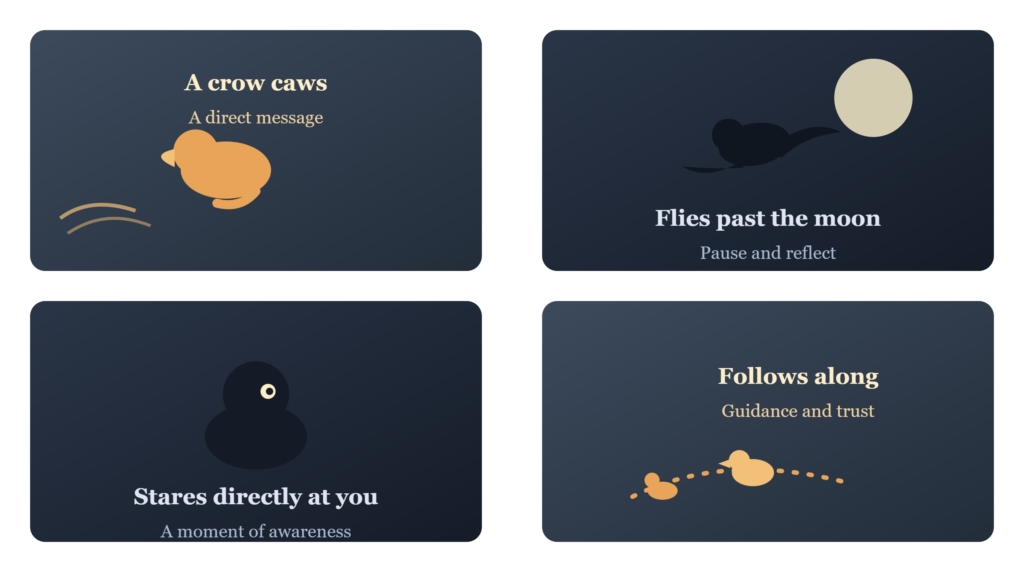
A crow outside your home is frequently interpreted as a call to become more aware of what’s happening around you, whether that means noticing an opportunity, recognizing a challenge early, or simply feeling a sense of guardianship over your household.
A crow cawing at you is often read as a more direct message, sometimes a caution, sometimes a nudge to listen more closely to your own intuition.
A crow flying in front of you tends to be interpreted as an invitation to pause and reconsider your current path before continuing forward.
A crow staring at you is commonly described as a moment of mutual acknowledgment, a sense that the bird has “seen” you in a way that feels significant.
A crow following you is often tied to the idea of guidance or protection, encouraging you to trust your instincts while staying alert to change.
Multiple crows gathering, sometimes called a murder of crows, is generally connected to themes of community, collaboration, and collective strength, given how genuinely social these birds are in the wild.
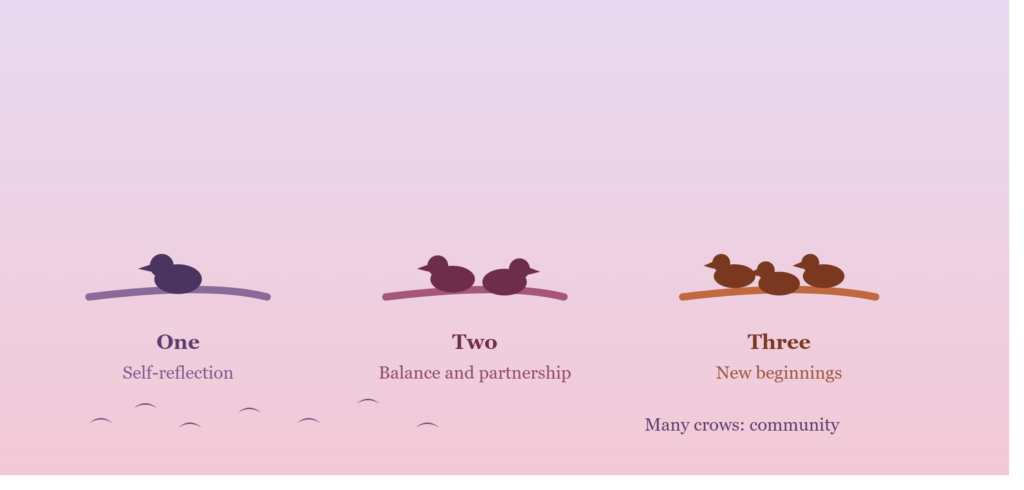
One layer often missing from a general answer to what does it mean when you see a crow is the count. The number of crows in front of you carries its own layer of meaning in a lot of traditions, separate from behavior or location. It’s one of the more specific ways people try to read a sighting, and while it varies by source, a few interpretations show up consistently enough to be worth knowing. As for numbers specifically: one crow is often linked to self-reflection, two to balance and partnership, three to creativity and new beginnings, and larger groups to the value of community and support.
Do Crows Represent Death or Ancestors?
Because of their scavenging behavior, crows have long been associated with death in Western folklore. But most modern spiritual interpretation treats this less literally, framing it instead as symbolic of an ending, a transition, or the closing of one phase before another begins.
The ancestral connection runs deeper in several traditions. In Hindu culture, crows are honored as carriers of ancestral spirits, particularly during Shradh rituals. Similar ideas appear in some Native American traditions, where crows are described as intermediaries capable of carrying messages from those who have passed. If you feel a strong, specific connection during a crow sighting, particularly one that surfaces around the memory of someone you’ve lost, many traditions would treat that as meaningful rather than coincidental. This overlaps closely with broader questions about signs from deceased loved ones, a topic worth exploring if animal encounters like this keep resurfacing for you.
Common Misconceptions About Crow Symbolism
When people search for what does it mean when you see a crow, a few misunderstandings come up often enough to address directly. First, seeing a crow does not universally predict misfortune or death. That reading exists in some folklore but is far from the whole picture, and many traditions treat crows as protective or auspicious. Second, crow symbolism isn’t a single fixed system. What a crow “means” shifts depending on the culture, the number of birds, the behavior you observe, and your own emotional response in the moment. Treating any single interpretation as the definitive one overlooks just how varied this symbolism genuinely is.
If crow encounters have you thinking more broadly about how animals show up as guides, our guide to animal symbolism and spirit messages covers the same underlying framework across other species. It’s also worth noting plainly that none of this is scientifically verified. Ornithologists can confirm that crows are remarkably intelligent and socially complex animals, and that much is well documented in behavioral research. But the spiritual meanings attached to their appearances are experiential and cultural rather than empirical. That doesn’t make them less valuable to the people who find guidance in them, it simply means they belong to a different category of knowledge than biology does.
For daily insights on consciousness, clarity, and trusting yourself, explore Bahlon’s free daily transmissions. Subscribe here.
Related Readings:
Frequently Asked Questions
A few final questions come up often around what does it mean when you see a crow, so here are direct answers to each.
What does it mean when you see a crow?
Most spiritual traditions interpret it as a sign of transformation, heightened awareness, or a message worth paying attention to. The specific meaning often depends on the number of crows, their behavior, and the context of the sightinga.
What does a crow symbolize spiritually?
Crows are generally associated with intelligence, protection, change, and the connection between the physical and spiritual worlds. In several cultures they’re also linked to ancestral spirits and guidance.
Is a crow a good omen or a bad one?
It depends on the tradition. Some cultures view crows as fortunate messengers, while others associate them with endings or caution. Many contemporary interpretations focus less on good versus bad and more on the idea of paying closer attention.
What does it mean when a crow keeps appearing near you?
Repeated crow sightings are often interpreted as a sign of a spiritual connection or guidance, sometimes described as the crow acting as a spirit animal or guide during a period of change.
Do crows really represent death?
Not necessarily in a literal sense. While some folklore ties crows to death due to their scavenging habits, most modern interpretations treat this symbolism as representing an ending or transition rather than physical death.