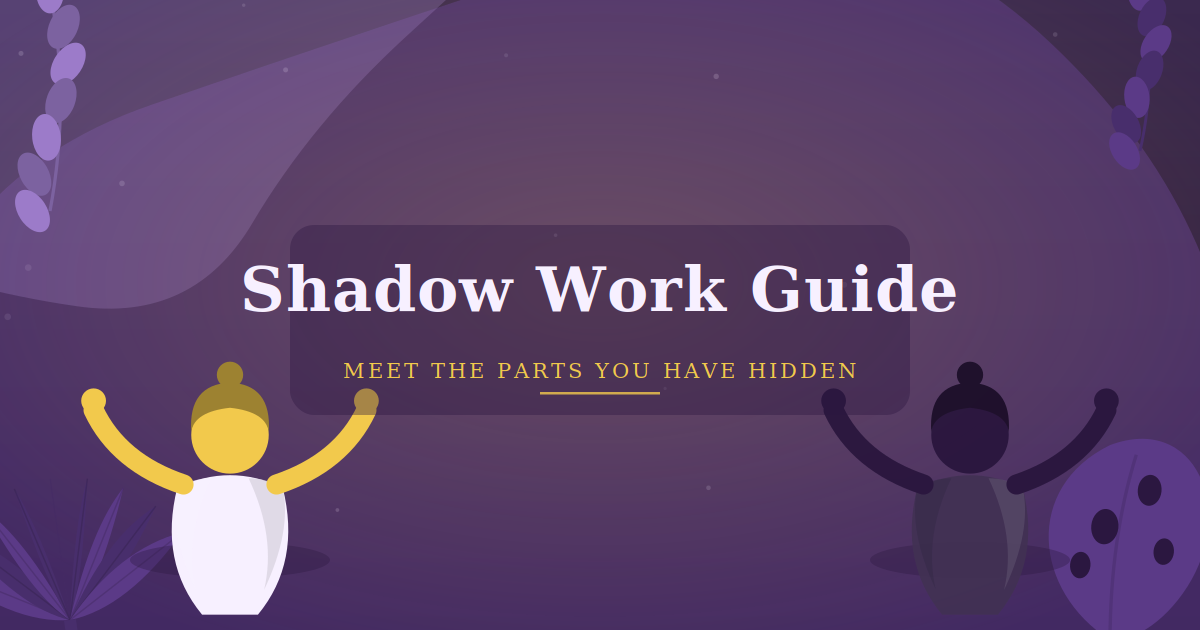
A shadow work guide exists to help you do one specific thing: bring the parts of yourself you have hidden, denied, or outgrown back into conscious awareness so they stop running your life from behind the scenes. Rooted in the analytical psychology of Carl Jung, shadow work is the practice of identifying these buried traits, emotions, and desires and integrating them rather than continuing to suppress them. It is not about becoming a different person. It is about becoming a more complete one.
What Is a Shadow Work Guide?
At its core, a shadow work guide walks you through the process of meeting your “shadow self,” a term Jung used to describe everything about us that our conscious mind has rejected. This includes emotions we were taught were unacceptable, like anger, envy, or grief, as well as strengths we never got permission to express, like creativity, ambition, or assertiveness.

The concept traces back to Jung’s model of the psyche, developed in the early twentieth century. Jung proposed that alongside the persona, the curated mask we present to the world, there exists a shadow: everything that mask was built to hide. He considered the shadow morally neutral rather than inherently negative. It simply holds what got left out when we decided, often as children, which parts of ourselves were safe to show.
That distinction matters because it separates a genuine shadow work guide from a self-criticism exercise. The shadow is not a flaw to be corrected. It is closer to an unfinished conversation with yourself, one that started decades ago and never got resolved.
Historically, this idea did not stay confined to clinical psychology. Therapists, coaches, and spiritual teachers have all adapted Jung’s framework over the following century, which is part of why the term shows up today in contexts ranging from clinical trauma work to journaling apps and meditation platforms. The underlying premise has stayed remarkably consistent even as the delivery methods multiplied.
How Shadow Work Guide Practices Work
The mechanics of shadow work are less mysterious than the language sometimes suggests. In practical terms, the process usually moves through a few recognizable stages.
Recognition.
Something triggers a reaction in you that feels bigger than the situation warrants. A coworker’s tone irritates you far more than it should. A stranger’s confidence makes you defensive. These outsized reactions are often the shadow announcing itself, because the shadow tends to reveal itself through projection: the tendency to notice, and judge, in others exactly what we have refused to acknowledge in ourselves.
Inquiry.
Once you notice a reaction, the next step is curiosity rather than judgment. You ask what the trigger might be reflecting back at you. This is not about assigning blame to yourself; it is about tracing a reaction to its root, which is often a much older wound than the present moment suggests.
Expression.
Journaling, talking with a therapist, or simply naming a feeling out loud gives the buried material somewhere to go. Writing, in particular, creates a structured bridge between the conscious mind and material that has been sitting in the unconscious, sometimes for years.
Integration.
This is the part that separates shadow work from venting or rumination. Integration means accepting the trait or emotion as part of you, understanding where it came from, and deciding how you want to relate to it going forward, rather than continuing to disown it.
None of this requires an altered state or a dramatic breakthrough. Most of the actual work happens in small, repeated moments: noticing a pattern, sitting with an uncomfortable feeling for a few extra seconds instead of pushing it away, writing a paragraph you would normally never let yourself write.
Benefits of Following a Shadow Work Guide
People who follow a shadow work guide consistently report a set of changes that tend to cluster together, even though the experience is inherently subjective and difficult to measure in a lab setting.

Commonly reported benefits include:
- Reduced reactivity. Understanding where a trigger comes from tends to loosen its grip, even if the trigger does not disappear entirely.
- More self-compassion. Recognizing that rejected traits developed as protective strategies, not moral failures, tends to soften harsh self-judgment.
- Improved relationships. Because projection often plays out most visibly with partners, family, and close friends, addressing it directly tends to reduce recurring conflict patterns.
- Increased energy and creativity. Many practitioners describe suppression as exhausting, and the relief of no longer maintaining that effort as a felt sense of lightness.
- A stronger sense of authenticity. Living without a constant internal edit can feel, to many people, like relief they did not know they needed.
It is worth being direct about what is supported by research versus what remains anecdotal. Jungian concepts like the shadow are foundational to depth psychology and have influenced decades of clinical practice, but shadow work as a self-guided practice has not been studied with the same rigor as, say, cognitive behavioural therapy. Much of what is known comes from clinical case studies, practitioner reports, and the lived experience of people who do this work, rather than large, randomized trials. That does not make the practice invalid, but it does mean claims should be held as experiential rather than proven in a clinical sense.
How to Get Started with Shadow Work
You do not need a therapist’s office or a retreat center to begin. Here is a straightforward sequence for a complete beginner working through their first shadow work guide.

1. Ground yourself first.
Before looking inward, spend a few minutes on slow, deliberate breathing. This calms your nervous system enough that you are working from a place of safety rather than reactivity.
2. Track your triggers for a week.
Keep a simple note on your phone. Anytime you feel a disproportionate flash of anger, jealousy, judgment, or defensiveness, jot down what happened and who was involved. Do not analyze yet. Just collect data.
3. Ask the mirror question.
For each trigger, ask yourself: what exact quality in this person am I reacting to, and where might that same quality exist in me, whether expressed or suppressed? Sometimes the answer is obvious. Sometimes it takes a few days to surface.
4. Journal without editing.
Set a timer for ten minutes and write continuously about one trigger. Do not worry about grammar or making sense. Useful starter prompts include: What do I judge most in other people? Which emotions were discouraged in my house growing up? What do I secretly admire in people I claim to dislike?
5. Notice the body, not just the mind.
Unprocessed emotion often shows up as physical tension: a tight jaw, a knotted stomach, shallow breathing. When you catch yourself in a reaction, pause and notice where you feel it physically, then breathe into that area rather than immediately distracting yourself from it.
6. Revisit patterns, not single incidents.
After a couple of weeks, look back over your notes. Repetition is the clue. A single irritated moment might be nothing. The same trigger showing up five times points to a shadow pattern worth exploring further.
7. Know when to bring in outside support.
Shadow work done entirely alone has real limits, because we all have blind spots we cannot see without an outside perspective. If you are dealing with significant trauma, post-traumatic stress, or intense emotional distress, a licensed therapist trained in depth psychology is a safer and more effective path than working through it solo.
Common Misconceptions About Shadow Work

“The shadow is only bad or evil.” This is probably the most persistent myth. The shadow contains repressed positive traits just as often as repressed negative ones. Unused creativity, ambition, or assertiveness can live in the shadow too, especially if expressing them once felt unsafe or unwelcome.
“Shadow work means dwelling on negativity.” Done well, shadow work is closer to the opposite. The goal is not to marinate in old pain but to metabolize it so it stops quietly steering your decisions.
“A shadow work guide is something you complete once and are done with.” Integration tends to happen in layers. A trait you thought you had fully worked through can resurface in a new context years later, not because you failed, but because self-understanding deepens over a lifetime rather than arriving all at once.
“It requires plant medicine, breathwork, or intense experiences to be real.” These modalities can be powerful entry points for some people, but they are not prerequisites. Quiet, consistent journaling and honest self-reflection are just as legitimate a path, and considerably more accessible.
“Shadow work is a replacement for therapy.” For everyday self-reflection, shadow work stands well on its own. For processing significant trauma, it works best alongside, not instead of, professional support.
Shadow Work for Beginners: Tips and Best Practices

Do:
- Start small. Ten minutes of journaling a few times a week beats an occasional marathon session.
- Approach every discovery with curiosity instead of shame. The point is understanding, not self-punishment.
- Expect discomfort in small doses. Growth in this area rarely feels neutral, but it should not feel unbearable either.
- Pair shadow work with grounding practices like breathwork or meditation so you have tools to regulate difficult emotions as they surface.
- Give yourself permission to go slowly. There is no deadline on becoming whole.
Avoid:
- Using shadow work to diagnose or judge other people rather than examining yourself.
- Pushing into intense trauma memories without support, especially if you have a history of significant trauma.
- Expecting a single insight to change everything overnight.
- Treating every strong emotion as automatically shadow related. Sometimes anger is just a reasonable response to a real problem.
What to expect: early sessions often feel awkward or unproductive, and that is normal. Clarity tends to arrive gradually, often in the form of a pattern you suddenly recognize rather than a single dramatic revelation. Many people also find that certain themes, like self-worth or boundaries, resurface repeatedly, which is not a sign of failure but a sign of where the deepest work is happening.
For those building a broader self-inquiry practice, shadow work pairs naturally with other reflective disciplines. If you have already explored meditation or work with chakra balancing, you may notice these practices reinforce each other, since both involve becoming more attuned to what is happening beneath the surface of everyday awareness. Similarly, those developing their intuition often find shadow work sharpens that inner signal, simply because there is less unconscious noise competing for attention.
If exploring shadow work has opened questions about your own path, you may find value in Bahlon’s free daily transmissions, brief insights for people seeking clarity. Subscribe here.
Related Readings:
Frequently Asked Questions About Shadow Work
Is shadow work the same as therapy?
No. Shadow work is a self-reflective practice you can do independently, often through journaling or meditation, while therapy involves working with a licensed professional. The two can complement each other well, especially when deeper trauma is involved.
How long does shadow work take to show results?
There is no fixed timeline. Some people notice shifts in how they respond to triggers within a few weeks of consistent practice, while deeper patterns can take months or years to fully integrate. Consistency matters more than speed.
Can shadow work be dangerous?
For most people exploring everyday patterns, it is not. However, if you are dealing with significant trauma or a diagnosed mental health condition, working through intense material alone can be overwhelming, and professional guidance is strongly recommended.
Do I need special training to start shadow work?
No formal training is required. A notebook, honest self-reflection, and a willingness to sit with discomfort are enough to begin. Many people also use guided journal prompts or meditations as a starting structure.
What is the difference between the shadow and the ego?
The ego is generally understood as the conscious, decision-making part of the self, while the shadow holds what the ego has pushed out of awareness. Shadow work aims to bring the two into a more honest relationship rather than letting the ego operate on autopilot.