The difference between forgiveness and reconciliation comes down to who is involved. Forgiveness is an inner decision one person makes to release resentment and the wish for revenge, while reconciliation is a shared process of rebuilding a damaged relationship. You can forgive someone without ever speaking to them again, but reconciliation requires honesty, changed behavior, and effort from both people.
Many people suffer needlessly because these two ideas get tangled together. Someone feels pressure to forgive, hears it as an obligation to return to a person who hurt them, and either refuses to forgive at all or walks back into harm. Understanding the difference between forgiveness and reconciliation gives you room to heal without surrendering your safety, and room to repair a relationship without pretending nothing happened.
What Forgiveness Actually Is
The first half of the difference between forgiveness and reconciliation is that forgiveness is personal. It asks nothing of the other person: no apology, no confession, no change. It is a choice to stop carrying bitterness, to loosen the grip of the offense on your inner life, and to stop rehearsing the wish that the other person suffer.
That is a narrower thing than most people assume. Forgiveness does not mean the harm was acceptable, and it does not require you to say “it’s fine.” It does not demand that you forget, and it does not dissolve your right to protect yourself. Many people resist forgiving because they believe it would betray their own pain or excuse what was done. Forgiveness leaves the wrong exactly as wrong as it was. What changes is what the wrong is allowed to do to you.
Forgiveness also rarely arrives all at once. Psychologist Everett Worthington, one of the most cited researchers in the field, distinguishes between decisional forgiveness and emotional forgiveness. Decisional forgiveness is a commitment to treat the person without vengeance. Emotional forgiveness is the slower replacement of resentment, fear, and hostility with something closer to neutrality or compassion. The decision can be made in a moment. The feelings often follow at their own pace.
Because it is internal, forgiveness can happen with no contact at all. It can happen when the other person has died, disappeared, or never acknowledged what they did. For that reason, it is sometimes described as a gift you give yourself, though for many people it is also something larger than self-interest: an act of moral or spiritual meaning. This inner timeline is one reason the difference between forgiveness and reconciliation matters so much in daily life.
What Reconciliation Requires
The other half of the difference between forgiveness and reconciliation is that reconciliation is relational. It is the work of restoring a relationship that has been broken, and it cannot be done by one person alone. Both people have to participate, and both have to want the relationship to continue.
In practice, reconciliation usually involves several things:
- The person who caused harm takes honest responsibility, without minimizing or blaming.
- Behavior actually changes, and stays changed over time.
- The hurt person is given room to rebuild trust at a realistic pace.
- Both people communicate openly about what happened and what each needs going forward.
- Both are willing to compromise where compromise is fair.
Trust is the heart of it. Trust is not restored by an apology alone, however sincere. It is rebuilt through consistent action over months or years, and the person who was hurt is allowed to set the pace. Someone can say, truthfully, “I forgive you, but it will take time for me to trust you again.” Those two statements do not contradict each other. They describe two different tasks.
This is also where consequences live. Being forgiven does not erase the effects of a person’s actions. A person can be released from resentment and still face the natural results of what they did, including a relationship that has changed.
The Difference Between Forgiveness and Reconciliation at a Glance
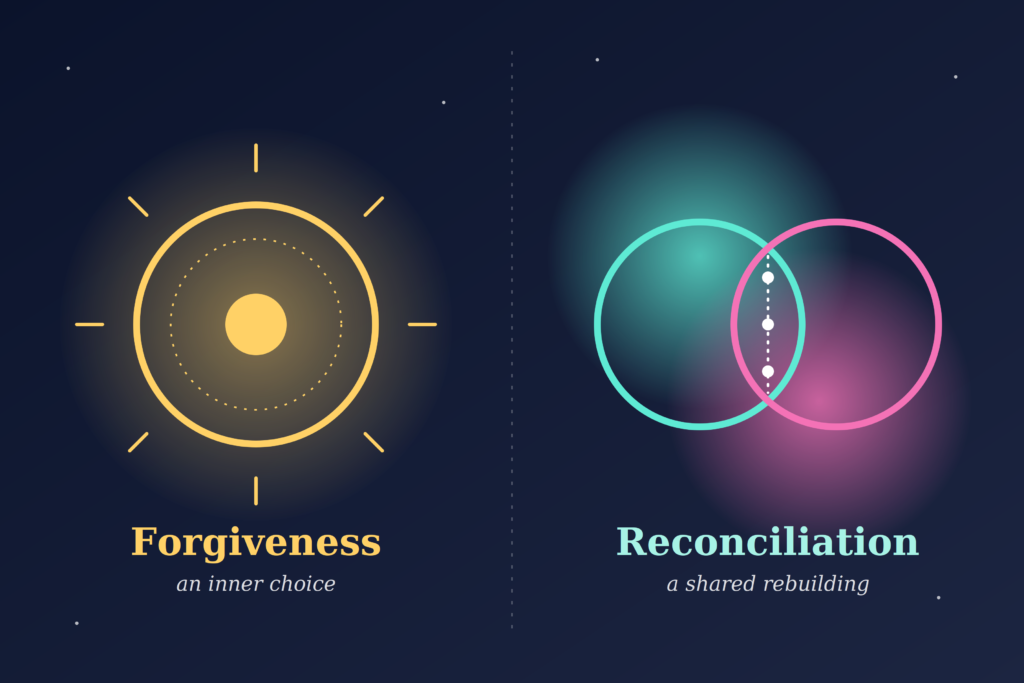
Read down the columns and the difference between forgiveness and reconciliation shows up in every row.
| Forgiveness | Reconciliation | |
|---|---|---|
| Who is involved | One person | Two people |
| Nature | An internal decision | A mutual process |
| Focus | Releasing resentment and revenge | Restoring a broken relationship |
| Needs an apology? | No | Usually, along with accountability |
| Contact required? | No | Yes, in some form |
| Trust | Not automatically restored | Must be rebuilt |
| Timeline | Can begin quickly | Often slow |
| Always appropriate? | Generally possible | Not always safe or wise |
The most important row is the last one. Forgiveness is almost always available to you. Reconciliation is not.
The Psychological Difference Between Forgiveness and Reconciliation
Researchers who study forgiveness are careful to keep the two concepts apart, and the evidence supports the distinction.
On the forgiveness side, studies suggest that holding onto grudges takes a physical toll. In a well-known 2001 experiment published in Psychological Science, Charlotte Witvliet and colleagues found that when participants dwelt on a past offense, they showed higher heart rate, blood pressure, and facial muscle tension than when they practiced empathy and forgiveness toward the offender. Structured approaches, including Robert Enright’s process model and Worthington’s REACH method, have been tested in intervention studies, and a 2014 meta-analysis of such studies found that people who took part reported meaningful reductions in unforgiveness and gains in emotional well-being compared with those who did not. This research is generally correlational or based on short-term outcomes, so it is best read as encouraging rather than conclusive, but the pattern is consistent.
On the reconciliation side, the research is more cautionary. Some longitudinal studies of couples, notably work by psychologist James McNulty, found that forgiveness without any change in the other person’s behavior was associated with a greater chance of repeated mistreatment in some relationships. The lesson researchers draw is not that forgiveness is dangerous. It is that forgiving and re-trusting are separate acts, and that reconnecting with someone who has shown no change can carry a real cost.

Researchers keep the difference between forgiveness and reconciliation clear for a practical reason: forgiveness works on your inner state, while reconciliation depends on the other person’s conduct, which you cannot control.
The Biblical Difference Between Forgiveness and Reconciliation, and Other Traditions
Most major spiritual traditions treat forgiveness as a high calling, and many also recognize that restoring a relationship is a separate matter.
In Christian teaching, forgiveness is a command. Matthew 6:14-15 links receiving God’s forgiveness with extending it to others, and many Christians understand forgiveness as an act of releasing bitterness and trusting God with justice rather than taking it into one’s own hands. The biblical difference between forgiveness and reconciliation shows up in how Scripture frames each. Forgiveness is commanded without condition. Reconciliation, by contrast, is described as something pursued where possible. Romans 12:18 says, “if it is possible, as far as it depends on you, live at peace with everyone,” a phrase that openly acknowledges peace may not always be within one person’s power. Luke 17:3-4 also connects forgiveness with repentance in the context of a relationship. Many Christian writers therefore teach that a believer is called to forgive and to love, but is not required to remain in close relationship with someone who is harmful.
Other traditions arrive at similar distinctions in their own language. In Jewish practice, teshuvah, the process of repentance, asks the person who caused harm to acknowledge the wrong, make amends, and seek forgiveness directly, which places a clear responsibility on the offender for the work of repair. Islamic teaching praises pardon (afw) as a mark of character, while also recognizing justice and the value of making peace (sulh) as distinct goals. Buddhist practice emphasizes releasing hatred and cultivating compassion, including loving-kindness meditation, without requiring that one remain in contact with the person who caused harm. Public reconciliation efforts, such as South Africa’s Truth and Reconciliation Commission, tied the possibility of restored relationships to truth-telling and accountability, not to forgiveness alone.
These are different frameworks with different sources of authority, some grounded in scripture and tradition, others in contemplative experience. Yet they converge on a common insight: letting go of resentment and restoring a relationship are related but separate movements.
When Reconciliation Is Not Possible or Wise
Forgiveness may always be possible. Reconciliation is not. Some situations make it unsafe, unrealistic, or simply impossible.
Reconciliation may not be appropriate when the other person is abusive or continues to cause harm, when they refuse to acknowledge what happened, when contact would put you or others in danger, or when they are no longer living. In these cases, choosing distance is not a failure of forgiveness. It can be the most responsible expression of it. You can release your anger and still decline to place yourself where you will be hurt again.
Scripture and most ethical traditions call people toward kindness, love, and mercy. They do not call anyone to be close friends with everyone, or to remain exposed to harm. If you are in an unsafe situation, contacting a qualified counselor or a domestic violence support service is a sound step, whatever you decide about forgiveness.
Several misconceptions tend to cause the most confusion:
- “If I forgive, I have to let them back in.” No. Access to your life is governed by trust, not by forgiveness.
- “If I haven’t reconciled, I haven’t really forgiven.” Also no. Many people forgive fully and never reconnect.
- “Forgiving means forgetting.” Remembering can be part of wise self-protection.
- “The other person has to apologize first.” For reconciliation, their accountability matters a great deal. For forgiveness, it is not required.
How to Apply This in Practice
If you are working through a specific hurt, a few questions can help you see which task is in front of you.
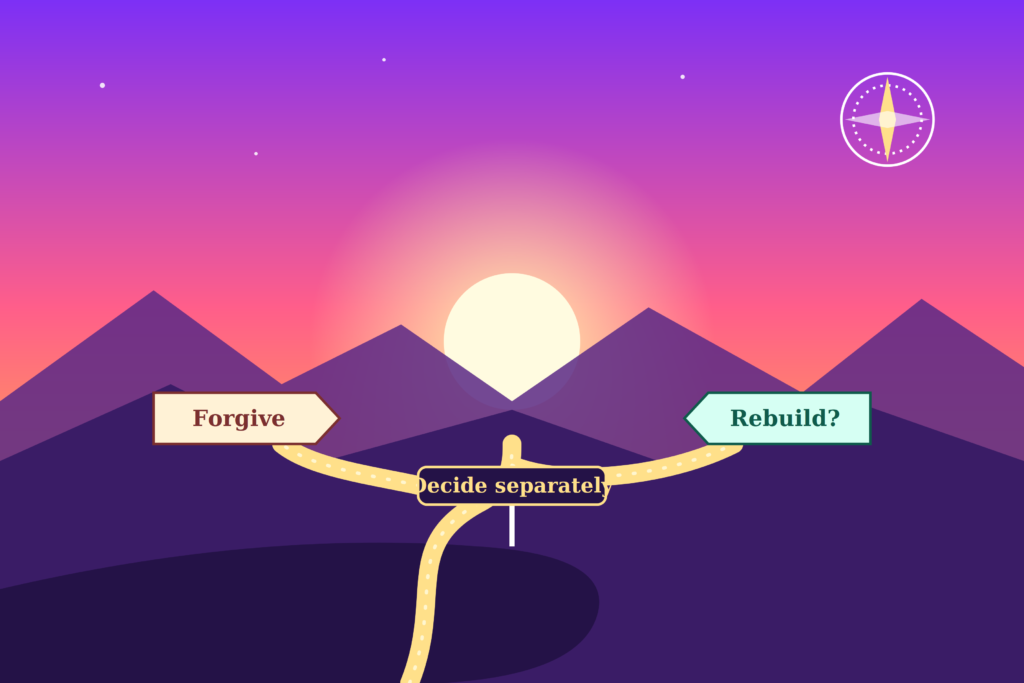
Start by naming what you are being asked to do. Once you see the difference between forgiveness and reconciliation, each question becomes smaller and easier to answer. Are you trying to release resentment, or are you deciding whether to rebuild a relationship? Treating them as one question is usually what makes both feel impossible.
Work on forgiveness on your own timeline. Writing honestly about what happened, practicing empathy where you can, talking with a counselor or spiritual mentor, and permitting yourself to feel anger without acting on it can all help. If resentment keeps returning, learning how to let go of resentment can offer additional tools. It is normal for emotional forgiveness to take time, and for it to arrive in waves.
Decide about reconciliation separately. Ask whether the person has taken responsibility, whether their behavior has actually changed, whether contact is safe, and whether you genuinely want the relationship. A useful test is to look at what they do, not only what they say. If you are unsure how to proceed when no apology has come, this guide on how to forgive someone who isn’t sorry explores that situation directly.
Protect the boundary while you decide. Clear limits are what make it safe to forgive. If the idea of setting them feels uncomfortable, setting boundaries without guilt is a good place to begin.
If you are the one who caused harm, remember that being forgiven does not entitle you to immediate trust. Own what you did, change what needs changing, and allow the other person to move at their own pace.
Reconciliation of differences between two people is possible when both are willing and conditions are safe. When it isn’t, you still have somewhere to go. Peace with the past does not depend on anyone else showing up.
For daily insights on consciousness, clarity, and trusting yourself, explore Bahlon’s free daily transmissions. Subscribe here.
Related Readings:
Frequently Asked Questions
What is the difference between forgiveness and reconciliation?
Forgiveness is an internal choice to release resentment and revenge, and it requires only one person. Reconciliation is the mutual work of restoring a broken relationship, which requires both people and the rebuilding of trust.
Can you forgive someone without reconciling?
Yes. Forgiveness does not require contact, an apology, or a renewed relationship. Many people forgive from a distance, especially when the other person is unsafe or unwilling to change.
Can reconciliation happen without forgiveness?
Genuine reconciliation generally depends on forgiveness from both sides. Without it, a relationship may continue outwardly, but resentment tends to remain beneath the surface.
Does forgiving someone mean I have to trust them again?
No. Trust is rebuilt through consistent behavior over time. You can forgive fully and still wait, or decide never, to trust that person again.
Is it wrong to forgive but keep my distance?
No. In cases of abuse or ongoing harm, staying away can be the wisest choice. Forgiveness and self-protection can exist together.