Body scan meditation is a mindfulness practice that guides your attention slowly through each part of the body, from head to toe or toe to head, noticing physical sensations without trying to change them. It takes anywhere from five to thirty minutes, requires no equipment, and can be done lying down, sitting, or standing. The goal isn’t relaxation itself, though relaxation often follows. The goal is simply to notice what’s already there.
If you’ve ever lain awake at night with a racing mind, or sat at a desk carrying tension you didn’t know was there until someone pointed it out, you already understand the appeal. Body scan meditation doesn’t ask you to think your way to calm. It asks you to feel your way there instead.
What Is Body Scan Meditation?
At its core, body scan meditation is an exercise in redirecting attention. Instead of following thoughts, which is what the mind does by default, you move your awareness deliberately through different regions of the body: scalp, jaw, shoulders, arms, chest, stomach, hips, legs, feet. At each stop, you simply notice. Is there tightness? Warmth? Tingling? Nothing at all? None of these observations are right or wrong.
This is what separates body scan meditation from stretching or progressive muscle relaxation, where the aim is to actively release tension. Here, the practice is closer to listening than to doing. You’re not instructing your shoulders to drop. You’re just checking in on them, and often, the dropping happens on its own once you pay attention.
The technique traces back to mindfulness-based practices rooted in Buddhist meditation traditions, though it was popularized in a clinical, secular form through Jon Kabat-Zinn’s Mindfulness-Based Stress Reduction (MBSR) program in the late 1970s. That program brought body scanning into hospitals, therapy rooms, and eventually smartphones, where it now sits alongside breathing exercises and guided visualizations as one of the most commonly taught mindfulness meditation body scan practices in the world.
How Body Scan Meditation Works
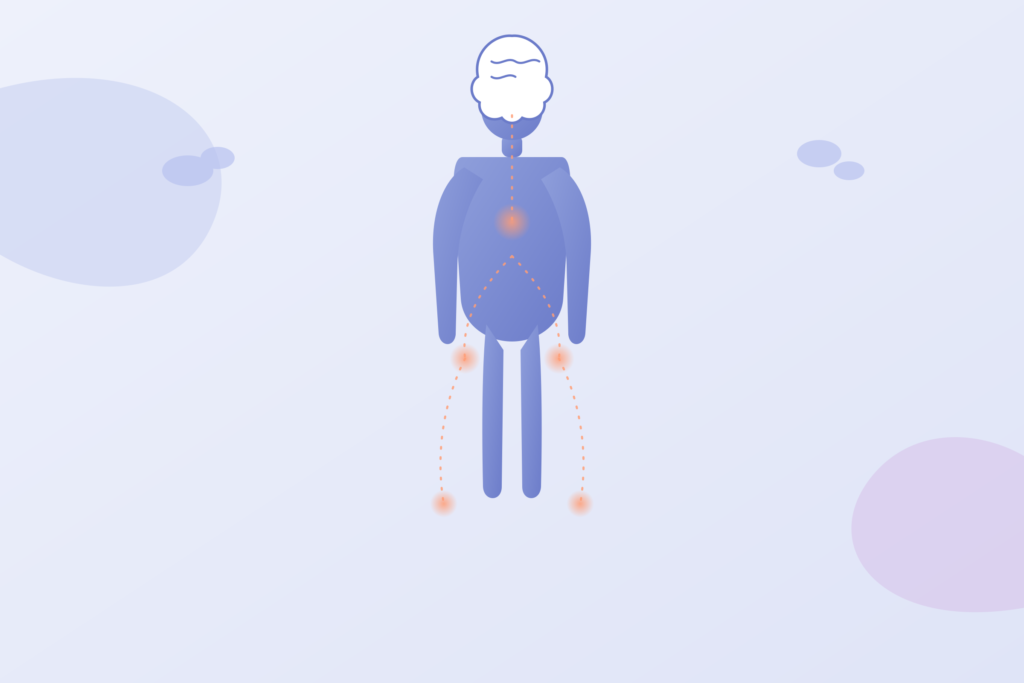
The mechanics are deceptively simple, but there’s real psychology and physiology behind why moving attention through the body has an effect on the mind.
Stress and anxiety tend to live partly in the body, not just in thought. A tight jaw, shallow breathing, a clenched stomach: these are physical expressions of mental states, and most people walk around only half aware of them. Body scanning interrupts the usual pattern of ignoring the body until it demands attention through pain or exhaustion. By checking in systematically, you start to notice tension earlier, sometimes before it builds into something more uncomfortable.
There’s also a more direct mechanism at play. The brain has limited bandwidth for focused attention. When that attention is occupied with methodically scanning physical sensation, it has less room left over for rumination, worry, or the mental loops that tend to accompany anxiety and poor sleep. This is part of why body scan meditation for sleep is so widely recommended: it gives a busy mind something concrete and slow-moving to do instead of spiraling.
Practitioners often describe a secondary effect, too. Over repeated sessions, the practice builds what’s sometimes called interoceptive awareness, or the ability to sense internal bodily states accurately. This has been linked in research to better emotional regulation, since recognizing a sensation like a racing heart or tight chest early can help someone respond to stress before it escalates.
What Science and Practitioners Say
The evidence on body scan meditation sits in a reasonable middle ground: not universally conclusive, but consistently promising, especially for stress and sleep.
Several studies on MBSR programs, which include body scanning as a core component, have found reductions in self-reported stress, anxiety, and rumination among participants. Research published in journals covering behavioral medicine has also pointed to modest improvements in sleep quality when body scan practices are used before bed, likely tied to the way the technique slows both breathing and mental activity. For chronic pain, some studies suggest that body scanning can shift how people relate to painful sensations, not necessarily reducing the sensation itself but reducing the distress that accompanies it.
It’s worth being honest about the limits here too. Much of the research on mindfulness meditation body scan practices uses small sample sizes, and effects vary meaningfully from person to person. It is not a clinical treatment for anxiety disorders, insomnia, or chronic pain conditions, and it shouldn’t replace medical or psychological care when those are needed. What the evidence does support is body scanning as a low-risk, accessible tool that measurably helps many people manage everyday stress and improve present-moment awareness.
Beyond the clinical research, there’s a long tradition of experiential accounts from meditation practitioners describing the practice as a way to reconnect with the body after periods of stress, illness, or simply too much time spent living in the head. These accounts are personal rather than empirical, and they’re presented here as such: not proof, but a genuine part of why the practice has endured for decades.
Body Scan Meditation Technique: Step by Step
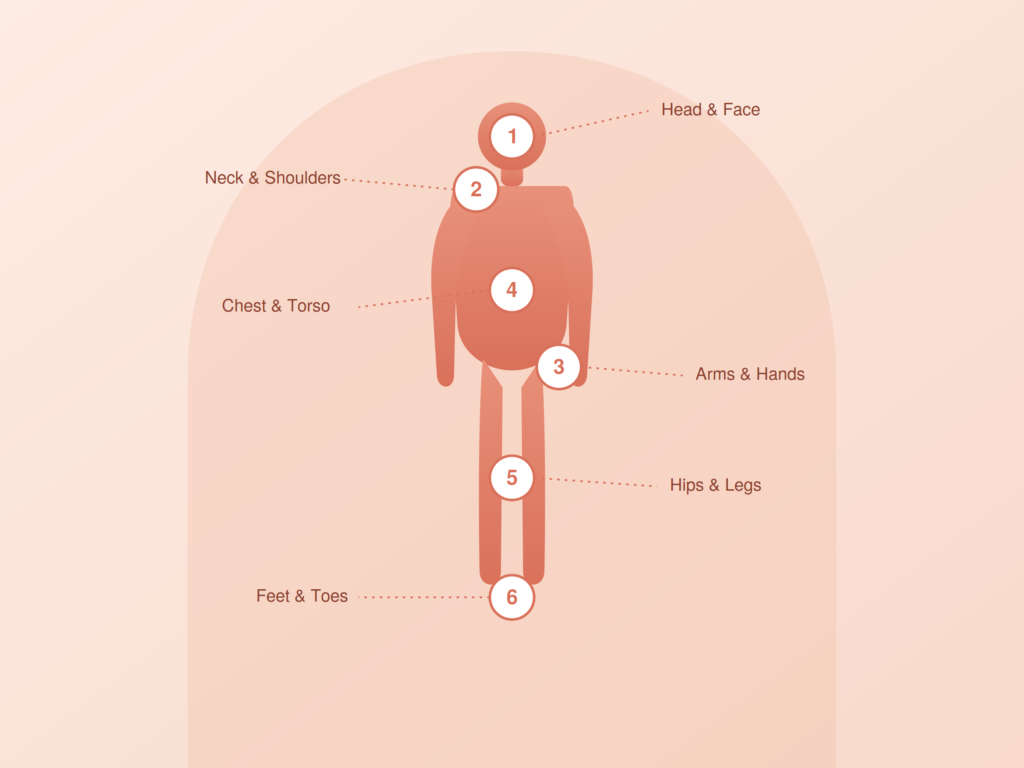
Here is the full body scan meditation technique step by step, from setup to close.
Getting Ready
Find a quiet space where you won’t be interrupted for the length of your session. Lie down with your arms resting at your sides, palms facing up, and legs uncrossed, or sit in a chair with your feet flat on the floor and your hands resting comfortably. Close your eyes. Take three or four slow, deep breaths, and notice the weight of your body against the surface beneath you before you begin.
1. Head and Face
Bring your attention to the top of your head, then your forehead, eyes, and jaw. Notice any tightness, especially around the eyes or jaw, which tend to hold tension without us realizing it. There’s no need to force anything to relax. Just notice, and let the face soften naturally if it wants to.
2. Neck and Shoulders
Move down to the neck and shoulders, an area that carries a disproportionate amount of stress for most people. Notice heaviness, tightness, or the urge to hunch. Let the shoulders drop, if that happens naturally.
3. Arms and Hands
Shift attention down through the upper arms, elbows, forearms, wrists, and into the fingers. Sensations here are often subtle: warmth, faint tingling, or simply the feeling of contact with the surface below.
4. Chest and Torso
Notice the natural rise and fall of your chest with each breath, without changing your breathing pattern. Bring awareness to the stomach, upper back, and lower back. This region often holds tension tied to anxiety, so give it a little extra time.
5. Hips and Legs
Move to the hips, thighs, knees, calves, and shins. Let the legs feel heavy and supported by whatever surface you’re resting on.
6. Feet and Toes
Finish at the ankles, soles of the feet, and toes. Notice the points of contact with the floor or bed beneath you, and any remaining sensation in this area.
Alternative: Toe to Head
Some people prefer starting at the toes and working upward through the legs, torso, arms, and face instead. Both directions follow the same principle: slow, non-judgmental attention, one region at a time. There’s no correct starting point, only the one that feels more natural to you.
Finishing the Practice
Bring your awareness to the whole body as a single space, noticing any overall shift from where you started. Take a few deep breaths, gently wiggle your fingers and toes, and open your eyes slowly when you’re ready.
Body Scan Meditation for Sleep and Anxiety
Two of the most common reasons people search for this technique are sleep and anxiety, and it’s worth addressing each directly.
For body scan meditation for sleep, the lying-down position is usually recommended, and falling asleep partway through the scan is not a failure of the practice. It’s actually one of the more common outcomes, and for many people, it’s the point. If staying awake is the goal instead, such as during a midday reset, sitting upright or practicing earlier in the day tends to work better.
For body scan for anxiety, the value often lies less in eliminating anxious thoughts and more in giving the mind something physical and immediate to hold onto instead of a spiral of worry. Anxious thoughts tend to be about the future or the past; body sensations only exist in the present moment, which is part of why this practice can feel grounding even when the underlying stress hasn’t gone away yet.
If anxiety is a frequent or intense presence in daily life, body scanning works best as one part of a broader approach to self-regulation, alongside other practices like breathwork or mindfulness-based stress management techniques, rather than a standalone fix.
Common Questions and Misconceptions
“I fell asleep, did I do it wrong?” No. Especially when practiced lying down or at night, falling asleep is common and, for sleep-focused sessions, often welcome.
“My mind kept wandering, so I failed.” A wandering mind is not a sign of failure; it’s the expected texture of the practice. The technique isn’t about achieving a blank mind. It’s about noticing the wandering and gently returning attention to the body, over and over, for as long as the session lasts.
“I didn’t feel relaxed, so it didn’t work.” This is one of the most common misconceptions. The instruction is to notice sensations, not to force relaxation. Relaxation is a frequent byproduct, not the requirement. Some sessions will feel calming; others will mostly surface tension you didn’t know you were carrying, and that’s still useful information.
“There’s a correct pace or order.” There isn’t. Some guided sessions move quickly through the body in five minutes; others take thirty. Starting at the head or the toes both work. The practice is meant to be personal and adaptable, not performed to a fixed standard.
Practical Tips for Getting Started
For anyone approaching body scan meditation for beginners, a few adjustments make the early sessions easier to sustain:
- Start short. Five to ten minutes is enough to learn the rhythm of the practice before extending toward twenty or thirty.
- Use guidance at first. A recorded or guided body scan can help maintain pacing and focus until the sequence becomes familiar enough to do unguided.
- Practice at a consistent time. Morning, a midday break, or right before bed all work; consistency tends to matter more than timing.
- Expect an imperfect experience. Distraction, restlessness, or falling asleep are all normal parts of learning body scanning techniques, not signs that something needs fixing.
There is no single correct way to do a body scan. The practice is flexible by design, and its value comes from consistent, gentle attention rather than precise execution.
For daily insights on consciousness, clarity, and trusting yourself, explore Bahlon’s free daily transmissions. Subscribe to receive a new reflection in your inbox each morning.
Related readings:
- Meditation Guide for Beginners
- Types of Meditation and Which One Fits Your Personality
- Mindfulness Meditation Made Easy
Frequently Asked Questions
How long should a body scan meditation session last?
Sessions typically range from five to thirty minutes. Beginners usually start with five to ten minutes and extend the duration as the practice becomes more familiar.
Is it normal to fall asleep during a body scan?
Yes. It’s especially common when lying down or practicing before bed, and for those using body scan meditation for sleep, it’s often the intended outcome.
What’s the difference between a full body scan meditation and progressive muscle relaxation?
A full body scan meditation focuses on noticing sensations without trying to change them, while progressive muscle relaxation actively involves tensing and releasing muscle groups. They’re related but distinct techniques.
Can body scan meditation help with anxiety?
Many people use it for this purpose, and research on mindfulness-based programs suggests it can reduce self-reported stress and anxiety. It works best as one part of a broader self-care approach rather than a standalone treatment.
Do I need an app or guide to practice body scanning?
No, though guided recordings can help beginners maintain pacing and structure. Once the sequence feels familiar, many practitioners move to unguided sessions.