
People often interpret finding a white feather as a sign of comfort, protection, or a message from a loved one who has died, but it also has a simple natural explanation: birds shed feathers constantly. Which meaning rings true usually depends on your beliefs, the moment you found it, and what you were carrying emotionally when it appeared. Here is a clear, balanced look at what the experience has meant to people across traditions, what science can and cannot say, and how to decide what it means for you.
What Does It Mean to Find a White Feather Spiritually?
Ask a hundred people what it means when you find a white feather and you will hear a surprisingly consistent set of themes. Peace, purity, hope, protection, and reassurance come up again and again. White has long stood for clarity and innocence in many cultures, and a feather adds the idea of something lightweight that drifts between earth and sky. Together they make a natural symbol for the border between the physical and the spiritual.
The spiritual meaning of a white feather tends to cluster around a few ideas:
- Comfort during hard times. Many people describe finding a white feather during grief, illness, or a stretch of uncertainty, and feeling that it was a quiet reminder that they were not alone.
- Protection. In several traditions a feather signals that unseen guardians, whether angels, ancestors, or a higher power, are watching over you.
- Messages from the departed. Some people read an unexpected feather as a greeting from someone they have lost.
- New beginnings. A white feather appearing at a turning point can feel like encouragement to begin again.
- Spiritual awakening. For some, it marks a deepening of faith or a new phase of inner growth.
Context shapes everything. A feather on your doorstep may feel like a blessing on your home. One that floats down while you are thinking about someone you miss may feel startlingly personal. One tucked in your coat after a hospital visit may simply be a feather. Most people who treat these moments as meaningful say the circumstances matter more than the object itself, and that is worth holding onto as you read further.
White Feather Meaning Across Cultures and Traditions
No single tradition owns the white feather. Each one brings its own vocabulary, and the overlap between them is part of why the symbol feels so enduring.
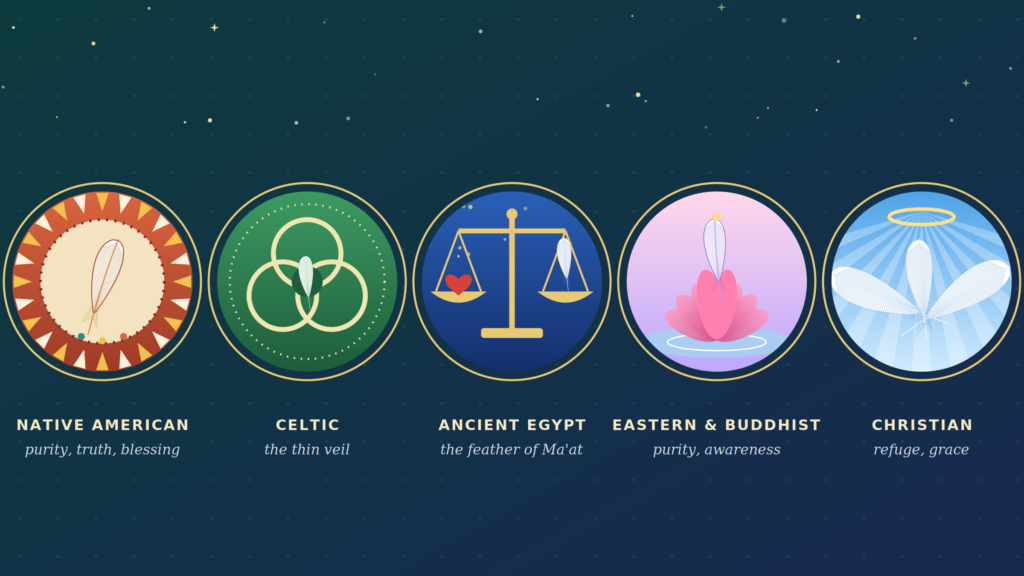
Native American Traditions
Feathers carry deep cultural and spiritual weight in many Native American communities, where they may be regarded as gifts from the sky and as symbols of prayer, honor, and connection to the Creator. White feathers are often associated with purity, truthfulness, respect, and blessing. It is important to remember that practices differ widely between nations, and a general summary cannot stand in for the teachings of any particular community. Many feather customs are also sacred and carry legal and cultural protections, so it is worth learning from Native sources directly.
Celtic Spirituality
In Celtic belief, birds and feathers were linked with communication between this world and the otherworld, a boundary understood to be thin at certain times and places. Within that view, a white feather could be a message from ancestors or divine forces arriving at a meaningful moment.
Ancient Egypt
The Egyptians gave the feather one of its most famous roles. Ma’at, the goddess of truth, justice, and balance, was symbolized by a feather, and in afterlife tradition the heart of the deceased was weighed against it. A heart that balanced against the feather had lived truthfully and could continue its journey. Here the white feather stands for moral balance and the soul’s passage after death.
Eastern and Buddhist Perspectives
In many Eastern traditions white represents purity, transcendence, and the divine. In that spirit, noticing a white feather can serve as a gentle prompt toward awareness and a more conscious way of living, a pause rather than a prophecy.
Christian and Biblical Meaning
The biblical meaning of a white feather is symbolic rather than doctrinal. Scripture does not teach that finding a feather is a supernatural sign. What it does offer is imagery. Psalm 91:4 speaks of being covered with God’s feathers and finding refuge under his wings, picturing divine protection, faithfulness, and shelter. Because the Holy Spirit is traditionally pictured as a dove, many Christians also connect white feathers with grace and peace. For believers, finding a white feather can serve as a personal reminder of God’s nearness, especially in seasons of loss or fear, without being treated as a formal teaching.
Is Finding a White Feather a Sign from a Loved One or an Angel?
This is the question that brings most people here, and it deserves a careful answer.

Among the bereaved, a white feather is one of the most commonly reported symbols of a departed loved one. The belief rests on the idea that the soul continues after death and that love can still reach us. People often describe the feather appearing at a charged moment: at a funeral, on a birthday, or while saying the person’s name aloud. Some link these experiences to vivid, peaceful dreams of the person they have lost.
Angels are the other major association. Because angels are traditionally pictured with white wings, a feather drifting down from nowhere easily evokes an angelic message. In modern spiritual practice, people may read it as a sign that their prayers were heard, that a guardian is near, or that support is available during a transition. Some traditions also associate white feathers with Archangel Michael and his protection.
As for how to tell whether a white feather is an angel sign, there is no physical test that separates an ordinary bird feather from a spiritual one. The significance lies in the timing, the emotional context, and how the experience lands for you. That is not a weakness of the belief. It is simply how symbolic experience works: meaning is something a person receives and interprets, not something a laboratory can detect.
What Science and Everyday Life Say About White Feathers
Honesty matters here, and a good-faith reading of this topic holds both perspectives at once.
The natural explanation is straightforward. Pigeons, doves, gulls, and many other birds molt, shedding and replacing feathers on a regular cycle. Loose feathers get carried by wind and foot traffic into gardens, doorsteps, footpaths, and spots near open windows. Finding a white feather often just reflects birds living nearby.
Psychology adds some useful context. Humans are pattern-seeking, and we notice what matters to us. During grief, attention narrows toward reminders of the person we lost, which makes a symbol like a feather stand out. Research on bereavement also shows how common these experiences are. A well-known 1971 study of widows and widowers in Wales by physician W. Dewi Rees found that nearly half reported sensing the presence of their late spouse. Later work on “continuing bonds” suggests that maintaining an ongoing inner relationship with someone who has died is a normal and often healthy part of grieving, not a sign of confusion.
What science cannot do is rule meaning in or out. It can explain why a feather is on the ground. It cannot tell you what that feather means to a person standing over it. The two accounts do not have to compete. You can know that a gull was molting nearby and still find real comfort in the moment, and many thoughtful people hold both without strain.
White Feather Meaning in Love, Twin Flames, and Dreams
Beyond grief and faith, a few more specific interpretations are worth understanding, with the caveat that they come from belief systems and personal experience rather than established evidence.

Love. The white feather meaning in love is generally gentle: a sign of blessing, reassurance, or spiritual support for a relationship, or encouragement that you are being guided toward the right one. People sometimes search for small white feather meaning love when a feather appears during a tender or uncertain moment in a relationship.
Twin flames. In twin flame spirituality, a white feather during a separation is read as a reminder to trust the journey, stay open, and be patient. Those can be wise instincts in any hard season. It is still important not to treat a feather as proof that a relationship is destined or that a separation will end. Take the encouragement and keep making grounded decisions.
Dreams. Dreaming of a white feather is commonly read as a positive symbol of peace, guidance, and clarity. In dream interpretation traditions, a feather falling toward you may suggest guidance approaching, holding one may suggest protection or trust in your inner sense, a feather drifting upward may suggest a prayer being received, and many feathers may suggest abundant support. These are symbolic readings, not scientific ones.
Numbers. Some people assign meaning to how many feathers they find: one for remembrance or a personal message, two for deep connection or a time of change, three for stronger support and new foundations. These ideas are not universal and vary widely, so treat them as one possible lens rather than a rulebook.
Is Finding a White Feather Good Luck?
In many folk and spiritual traditions, yes. Finding a white feather is seen as a blessing or sign of protection. A feather on the doorstep is often read as a blessing on the home, and one drifting down from the sky can feel like a direct and personal message.
It helps to understand luck here in a broader sense. The feather is usually seen less as a promise of money or success and more as a reminder that you are supported. No tradition credibly guarantees a particular future from a feather, and an honest reading avoids treating it as a prediction. Its real gift is often the pause: the calm, the smile, the moment of feeling accompanied.
What to Do After Finding a White Feather
If you have just had the experience, here are some grounded ways to meet it.

- Notice what was happening. Where were you, what were you thinking about, and what were you feeling when you saw it? Those details usually hold the personal meaning.
- Hold both explanations. Acknowledge the natural cause and the meaning you feel. They are not enemies.
- Write it down. A short note about the date, place, and your state of mind lets you see patterns over time without forcing them.
- Let it comfort you, not direct you. A feather can steady you. Important decisions still deserve your own judgment and, where relevant, professional advice.
- Mark it in a way that feels right. Some people keep the feather, others return it to nature, and some say a prayer or a name. Handle feathers gently and avoid collecting from protected wild birds, since laws in many places restrict possessing certain species’ feathers.
- Talk to someone. If the feather arrived during grief, sharing the moment with a friend, faith leader, or grief counselor can deepen the comfort.
Common Misconceptions About Seeing White Feathers
“It always means someone has died.” No. Seeing white feathers can carry many meanings, and for many people it has nothing to do with loss.
“It is a guaranteed prediction.” Feathers are symbols, not forecasts. Any good outcome still depends on your choices and circumstances.
“If it is natural, it cannot be meaningful.” Meaning and mechanism answer different questions. Nearly every meaningful experience has a physical cause.
“If you do not feel anything, you are missing it.” Not at all. Plenty of people find a feather and feel nothing in particular, and that is perfectly fine.
“Only one tradition has it right.” Traditions interpret feathers differently, and that diversity is worth respecting rather than ranking.
For daily insights on consciousness, clarity, and trusting yourself, explore Bahlon’s free daily transmissions.
Related Readings:
- What Does It Mean When You See a Crow? Spiritual Symbolism
- Why Do You Keep Seeing Butterflies? The Spiritual Meaning Explained
Frequently Asked Questions
What does it mean when you find a white feather?
Most commonly, it is read as a sign of peace, protection, or comfort, sometimes as a message from a loved one or angel. It can also simply be a shed bird feather. Your own context decides which reading fits.
What does it mean when you see white feathers repeatedly?
Repeated sightings are often taken as stronger reassurance or encouragement. Psychologically, we tend to notice what we are primed to look for, so it may also reflect a period of heightened attention. Either view can coexist.
Is a white feather a sign from heaven?
Many people experience it that way, and some traditions support the idea. Science can’t confirm it, so it remains a matter of belief and personal experience.
What is the biblical meaning of a white feather?
The Bible does not describe finding a feather as a sign. Feather and wing imagery, such as in Psalm 91:4, symbolizes God’s protection and refuge, and many Christians draw on that symbolism for comfort.
Is finding a white feather good luck?
In many folk and spiritual traditions, it is considered a blessing or sign of support, though not a guarantee of future fortune.