Grounding meditation is a mindfulness practice that uses breath, body sensation, and physical contact with the earth to bring a racing or overwhelmed mind back into the present moment. Rather than asking you to empty your thoughts entirely, it asks you to notice where your body actually is right now, its weight, its temperature, its points of contact with the floor or chair beneath it, and to let that noticing become an anchor. For anyone who has ever felt untethered by anxiety, grief, or simple mental overload, grounding offers a fast, accessible way back to steadiness.
It sounds almost too simple to matter. Sit down, feel your feet, breathe. But the simplicity is the point. Grounding meditation doesn’t require years of training or an unusually quiet mind. It requires a body, a few minutes, and a willingness to pay attention to what’s already there.
What Grounding Meditation Actually Means
The word “grounding” gets used loosely in wellness culture, so it helps to be precise. In the context of meditation, grounding refers to the act of re-establishing contact with your physical self and, by extension, with your immediate environment. It’s a return to center: to the sense of wholeness and stability that gets scattered when the mind is caught up in worry, memory, or anticipation.
Most people who practice describe grounding less as a technique and more as a feeling. You know you’re grounded when you feel calm, rooted, secure, and mentally clear rather than scattered or reactive. That felt sense of stability is really the destination; the breathing and body-awareness exercises are simply the route there.
It’s worth distinguishing grounding meditation from meditation in general. Traditional mindfulness meditation often trains sustained attention on a single object, like the breath, for its own sake. Grounding meditation borrows those tools but applies them with a specific aim: reconnecting a dysregulated nervous system to the physical present. It’s less about achieving a particular state of consciousness and more about coming back down to earth, literally and figuratively.
How Grounding Meditation Works
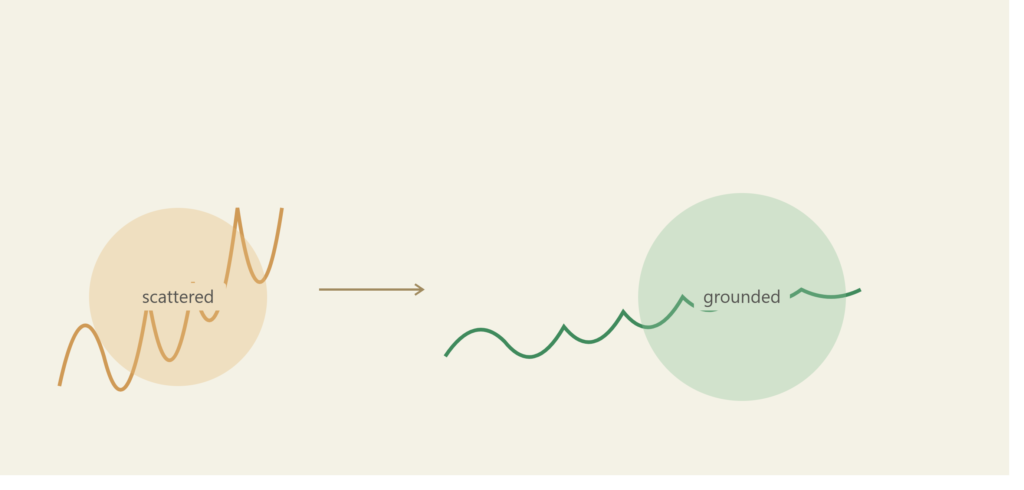
The mechanics are straightforward, even if the underlying psychology is layered. When the mind spirals into anxious thought, whether that’s replaying a stressful conversation or worrying about tomorrow, attention drifts away from the body and into abstraction. Grounding meditation reverses that drift by deliberately redirecting attention toward concrete physical sensation: the weight of the body in a chair, the rhythm of the breath moving in and out, the contact between feet and floor.
This redirection does a few things at once. First, it interrupts rumination simply by giving the mind something else to do. Second, it activates a kind of nervous system reset: slow, deliberate breathing signals safety to the body, which can lower physiological stress responses like elevated heart rate or shallow breathing. Third, repeated practice builds a kind of muscle memory, so that returning to a grounded state becomes faster and more automatic over time.
Many practitioners also incorporate visualization, imagining roots extending from the feet into the earth, or picturing the strength of the ground rising up through the spine. Whether or not you find that imagery meaningful, it serves a practical function: it gives the mind a vivid, embodied image to hold onto instead of an anxious one.
What the Evidence and Different Perspectives Say

Grounding meditation sits at an interesting intersection of clinical psychology, contemplative tradition, and personal experience, and it’s worth being honest about what falls into which category.
From a clinical standpoint, the body-awareness and breathing components of grounding overlap heavily with techniques used in trauma-informed therapy and anxiety treatment. Bringing attention to the five senses, a method often called the 5-4-3-2-1 grounding exercise, is widely used by therapists to help clients manage flashbacks, panic, and dissociation. The underlying logic, that focused sensory attention can interrupt distressing thought patterns and calm physiological arousal, is well supported in the broader literature on mindfulness-based stress reduction.
From a traditional and spiritual perspective, grounding carries a different emphasis. Many contemplative traditions frame the earth itself as a source of stability and energy, and grounding practices in these lineages are described in terms of reconnecting not just the mind and body, but also a sense of spiritual wholeness. This framing is experiential rather than empirical, and it’s presented honestly as such: people who practice this way often report a felt sense of connection that resists easy measurement, and that’s a legitimate part of how the practice is used and understood, even if it sits outside what clinical research can quantify.
Practitioner accounts, meanwhile, tend to emphasize the practical, day-to-day payoff: better sleep, fewer anxious spirals, a quicker recovery after a stressful event. These reports are consistent across a wide range of people, though like most self-reported wellness outcomes, they haven’t been rigorously isolated from other factors like general mindfulness practice or simply taking dedicated time to rest.
Taken together, the honest picture is this: the core mechanics of grounding meditation align well with what’s known about stress physiology and attention, while the deeper spiritual claims remain a matter of tradition and personal experience rather than settled science. Both are worth taking seriously on their own terms.
How to Practice Grounding Meditation
Grounding meditation is simple to learn but benefits from patience. It isn’t designed for instant results, and treating it as a quick fix tends to undercut its value.
1. Get clear on your intention.
Before you begin, decide what you want from the session. It can be as specific as “I want to calm my racing thoughts before this meeting” or as broad as “I want to feel more like myself.” Naming the intention gives the practice direction and makes it easier to notice whether it’s working for you.
2. Remove distractions.
Set aside a stretch of time, even just ten minutes, where you won’t be interrupted. Turn off your phone, dim harsh lighting, and if quiet music helps you settle rather than distract you, use it.
3. Get physically comfortable.
Sit in a chair with your feet flat on the floor, or sit directly on the ground if that feels more natural. Rest your hands on your lap, palms up, and settle into a position you can hold without fidgeting.
4. Notice your body.
Before doing anything else, simply notice how your body feels right now. Feel the weight of it pressing into the chair or floor. Notice where your feet make contact with the ground.
5. Settle into your breath.
Close your eyes or soften your gaze. Breathe slowly through your nose, noticing your stomach relax on each exhale. When your mind wanders, and it will, gently bring your attention back to the breath without judgment.
6. Scan for tension.
Move your attention through your body, noticing areas of discomfort or tightness, whether that’s a knot between the shoulder blades or heaviness in the legs. You don’t need to fix anything; simply noticing is often enough to begin releasing it.
7. Visualize your connection to the earth.
Imagine roots extending from your feet deep into the ground, or picture strength and stability rising up through your spine. This step is optional but many practitioners find it deepens the sense of steadiness.
8. Release with each exhale.
With every breath out, imagine letting go of a little more tension.
9. Return slowly.
Before opening your eyes, spend a few moments simply resting in the calm you’ve built. When you’re ready, bring your attention back to the room and open your eyes.
A full grounding session can run anywhere from twenty minutes to an hour or more, depending on your goals and available time. If you’re grounding yourself quickly before a stressful event, even a five-to-ten-minute version, focused on breath and one sensory anchor, can be enough to shift your state.
Sensory Grounding Techniques for Everyday Anxiety
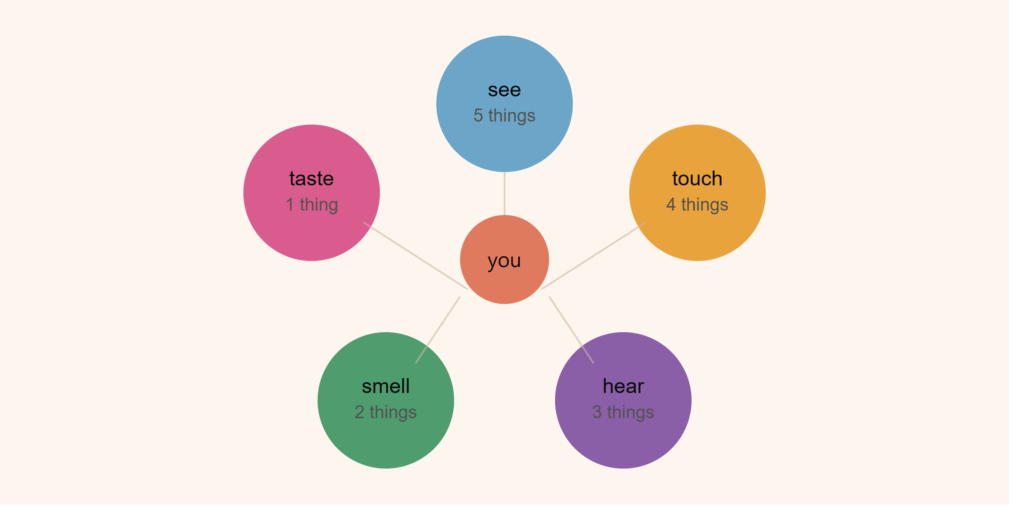
Not every moment of overwhelm allows for a full seated practice, which is why sensory grounding techniques are worth having on hand. The most well-known version, often called the 5-4-3-2-1 grounding exercise, asks you to identify five things you can see, four you can touch, three you can hear, two you can smell, and one you can taste. Working through the senses in sequence pulls attention out of anxious thought and back into the immediate, physical world.
Other mindfulness grounding techniques for anxiety include simply pressing your feet firmly into the floor and naming the sensation aloud, holding a textured object and describing it in detail, or splashing cold water on your hands. None of these require special training. They work precisely because they’re so ordinary; the mind can’t fully spiral while it’s busy noticing the temperature of water on skin.
It’s worth building a small personal list of grounding exercises rather than relying on just one. Different situations call for different tools, and what settles you during a work deadline may not be what helps after a difficult memory surfaces. Having options on hand, and knowing which ones actually work for you, is often more useful than mastering any single technique perfectly.
Common Questions and Misconceptions
One persistent misconception is that grounding meditation requires suppressing or ignoring your emotions. In practice, it does the opposite: it creates enough physical stability that difficult emotions become easier to feel and process rather than avoid.
Another misunderstanding is that grounding only helps with anxiety. While it’s widely used for that purpose, people also turn to grounding meditation for grief, mental fog, exhaustion, or simply the disorientation of a demanding week. It’s less a treatment for a single condition than a general practice for reconnecting with a steady sense of self.
Some also assume grounding requires being outdoors or physically touching soil. While contact with nature can enhance the experience for many people, the core mechanics work indoors just as well. The essential ingredients are attention, breath, and a felt connection to the body, not a particular location.
For daily insights on consciousness, clarity, and trusting yourself, explore Bahlon’s free daily transmissions. Subscribe here.
Related Readings:
- Meditation Guide for Beginners
- Manifestation Meditation Techniques
- Types of Meditation and Which One Fits Your Personality
Frequently Asked Questions
How long should a grounding meditation session last?
There’s no fixed rule. A deep session might run an hour or more, while a quick reset before a stressful event can take as little as five to ten minutes. Consistency matters more than duration.
Is grounding meditation the same as mindfulness meditation?
They overlap significantly but aren’t identical. Mindfulness meditation often trains sustained attention broadly, while grounding meditation specifically aims to reconnect a dysregulated mind and body with the present physical moment.
Can grounding meditation help with panic attacks?
Many people use grounding techniques, particularly sensory exercises like the 5-4-3-2-1 method, to interrupt panic and bring their nervous system back toward calm. It’s widely used in therapeutic settings for exactly this reason, though it’s not a substitute for professional care if panic attacks are frequent or severe.
Do I need a teacher to learn grounding meditation?
No, though working with a meditation coach or mindfulness teacher early on can help you refine your breathing and body-awareness technique more quickly than learning entirely on your own.
What’s the difference between grounding and centering?
The terms are often used interchangeably. Both describe a return to a stable, secure sense of self, though “centering” sometimes emphasizes the internal, energetic aspect while “grounding” emphasizes physical connection to the body and earth.